

Quick article this week as I’m currently getting over jet lag after flying back from Europe. For some reason, heading back west is always so much harder for me than heading east. There’s probably some underlying geographic logic there, but I’m too tired to dive into it and I still need to write an article about the Gulf Stream!
And, speaking of the Gulf Stream, if you’re at all curious about the body of water that largely creates it, check out my video this week:
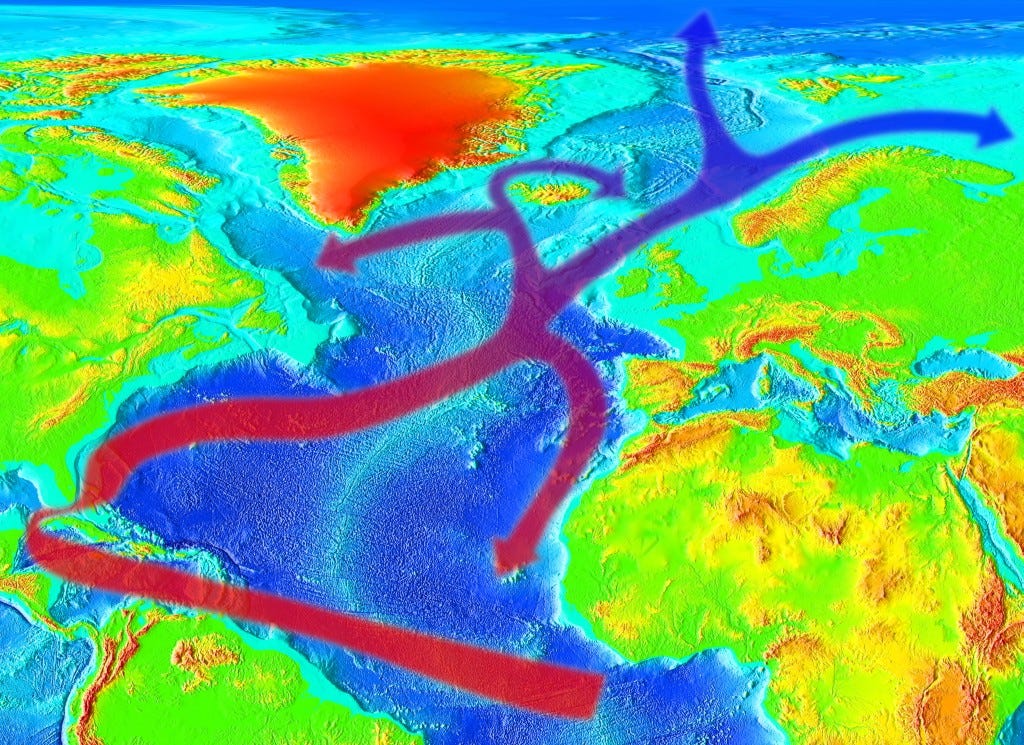
Flowing like a colossal (but invisible!) river within the Atlantic Ocean, the Gulf Stream is one of our planet’s most powerful ocean currents. It’s essentially a massive conveyor belt of warm water that originates in the Gulf of Mexico, sweeps up the east coast of the United States, and then veers northeast towards Europe. It’s actually a critical component of a larger system known as the Atlantic Meridional Overturning Circulation (AMOC), which acts like the planet’s circulatory system, shuttling heat from the tropics toward the poles. But that’s like a WHOLE other topic, so we’re not going to touch on it too much for this article. Regardless, for centuries, this reliable current has profoundly shaped climates and coastlines, but today, scientists are watching with growing concern as this oceanic engine shows signs of faltering.
To put it mildly, the influence of the Gulf Stream on Europe is staggering, granting the continent a far milder climate than its latitude would otherwise dictate. Berlin, for example, shares a similar latitude with Calgary, Canada, yet its winters are drastically less severe. This climatic “gift” is a direct result of the Gulf Stream carrying enormous quantities of heat across the Atlantic. Basically, as the warm water travels north, it heats the air above it. The prevailing westerly winds in this part of the world then carry this warmed, moist air over Western and Northern Europe, resulting in more moderate temperatures and preventing the extreme cold that grips other northern regions. In fact, without this oceanic heater, much of Europe would experience a climate more akin to Siberia. Not as drastic, of course, but more similar than not.
Unfortunately for Europe, this climate regulating conveyor belt is in jeopardy. The system isn’t collapsing in a sudden, dramatic event, but it is undergoing a significant and unprecedented slowdown. You see, as the Greenland ice sheet melts and global temperatures rise, vast quantities of cold, fresh water are pouring into the North Atlantic. This influx of fresh water disrupts the delicate balance of the Gulf Stream. The circulation is driven by a process where cold, salty water in the north becomes dense and sinks to the ocean floor, pulling warmer surface water north to replace it. The massive input of freshwater is less dense and doesn’t sink as readily, effectively weakening the “pull” of this oceanic engine and slowing the entire system down. Studies suggest that the Gulf Stream (and the AMOC) are now at its weakest point in over a millennium.
And if the Gulf Stream collapses, the consequences will be severe. For Europe, it would ironically mean a dramatic cooling, leading to much colder and more severe winters, potentially disrupting agriculture and energy systems. That might sound weird because all conventional logic around climate change is that Europe has been warming as a rapid pace. But a collapse of this heat transfer system would very likely reverse that trend in an extreme manner.
Of course the United States and Canada wouldn’t be safe either. The eastern seaboard of North America would likely experience accelerated sea-level rise, as the current’s slowing would allow coastal waters to pile up. Global weather patterns could be radically altered, shifting the location of vital rainfall belts that billions of people in regions like West Africa and South America rely on for agriculture. The resulting droughts and floods could trigger widespread food and water insecurity, fundamentally reshaping life on both sides of the Atlantic and beyond. The future of this mighty ocean current remains a critical and uncertain variable in a warming world.
I don’t intend for this article to be all doom and gloom. Truth be told, we don’t know what will really happen with the Gulf Stream or AMOC yet. But it does show that the climate of the planet is a very delicate system, one where a continent thousands of miles away relies on a relatively tiny, warm bowl tucking in the middle of North America.
The geography at play here is simply stunning.
Ben Franklin and Timothy Folger mapped it for the first time in 1769. Im such a Gulf Stream fanatic I got Franklin Folger's map tattooed on my arm. Growing up on the outer banks of NC will do that to ya. Geoff this is a great video thank you.
I knew Europe would be in trouble but hadn’t focused on the impact here in the mid-Atlantic/DC-Maryland-Virginia region