


The National Park System of the United States are a national treasure. I think that’s something everyone can agree on regardless of political affiliation… probably. Regardless, they are truly amazing and they hold a special place in the United States. But while we all take for granted that these amazing places exist, it wasn’t always a given that they would be protected in the form of a national park system. In fact, the National Park Service, the federal agency responsible for managing these places, almost didn’t exist at all! Three very specific events had to align to get the ball rolling.
How we got National Parks
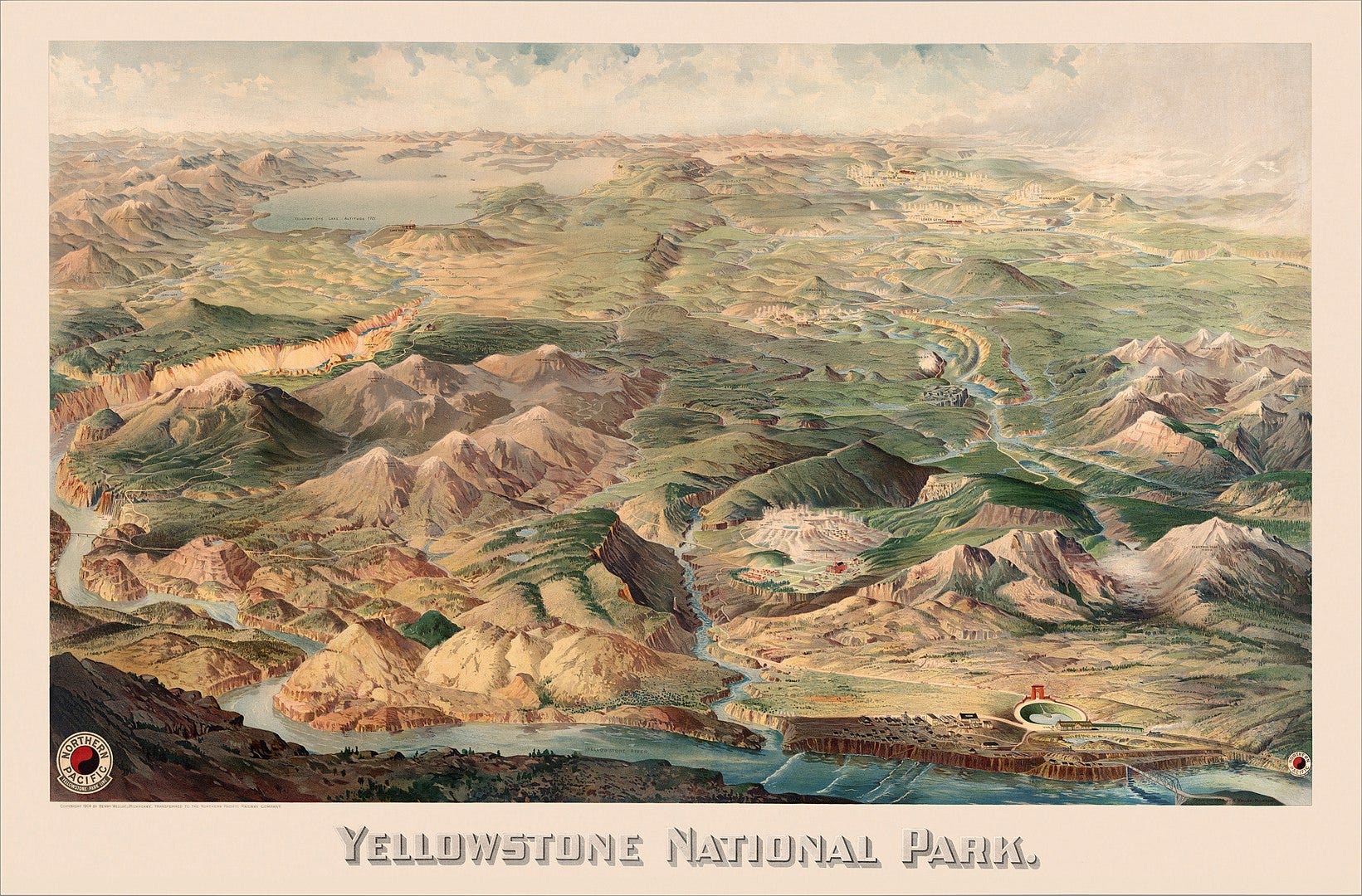
All National Parks are managed by the National Park Service today. But the first national park, Yellowstone, predates the National Park Service by 44 years! Yellowstone was first established by the federal government in Washington D.C. as a national park in 1872. But the very concept of a national park would begin in the early 1830s. Over the decades this would evolve into a movement for the United States to set aside land as national parks. And Yellowstone would pave the way for what we have today.
You see, the Yellowstone region was first explored by a group of people under what was called the Washburn Expedition. And late one night, while the group was making camp for the night, a discussion was started that would largely entail the benefits of this “newly explored” land being set aside for public use rather than it being sold to developers or private entities… or so the myth goes. And it was, in fact, a myth! This conversation never happened according to historians, but it was used by national park boosters at the time to spearhead a national conversation on the issue!
But while the boosters were able to get the public talking and thinking about the use of land in new ways, another completely separate entity had eyes on Yellowstone! The Northern Pacific Railroad Company was in the midst of extending their railway to the Pacific Northwest and they desperately wanted another stop and destination to bridge the gap between the midwest and the west coast. Yellowstone, given the early buzz generated by national park boosters, created a region that people would want to visit and the railway company jumped at the chance to promote this place as a destination it could sell. With the railway company’s help, Yellowstone would be officially designated a national park in 1872, but one more thing would need to happen in order to recognize the need for a more formalized national park service for the country at large: the military!
During the 1800s, the western United States had a poaching problem (it still does actually but that’s another article!) and in order to fight poachers, the U.S. military established a fort in the early 1880s. The military personnel established in that fort was tasked with the very specific purpose of protecting the parks, stop poaching, and maintenance of the land overall. It was this fort and their duties that would establish the system that modern day National Park Rangers still follow to this day.
The rest is history! The National Park Service was formed in 1916 to manage the increasing amount of national parks. In 1933, President Franklin Roosevelt would reorganize the agency to not only manage national parks, but also national monuments, national memorials, national cemeteries, and more.
National Parks today

Today the National Park Service manages over 130,000 square miles of land across the country, of which the majority is an actual designated national park. In total, there are 63 national parks spread across the country, though the majority of them are located in the western half of the country. And while all national parks are fairly popular, some are far more popular than others. The Great Smoky Mountains in North Carolina and Tennessee, for example, gets approximately 14 million visitors every year. Yellowstone, the original national park, gets a little over 4 million visitors per year. The least visited national park is also the country’s northernmost national park. Gates of the Arctic, based in Alaska, gets only 7,300 visitor per year. A far cry from the Great Smoky Mountains.
My personal favorite national park is Crater Lake which, of course, is located here in Oregon. But it’s not pure homer-ism that draws me to it. I legitimately think it’s one of the country’s most under appreciated natural spectacles. Being able to walk up to the ledge of the crater and look down on the park is truly awe-inspiring in a way that few other natural phenomena in the country can match. Seeing Yellowstone’s old faithful geyser, looking down into the Grand Canyon, and looking up at Half Dome in Yosemite are similar experiences, but Crater Lake gets a fraction of the visitors. Which I selfishly kind of like!
But not all national parks are created equally. One of the more bizarre national parks is the Gateway Arch in St. Louis, Missouri. Now, if you’ve ever been to St. Louis, you’ve no doubt seen the Gateway Arch and it is very impressive! But when you look at the list of national parks, it sort of stands out when placed alongside the likes of Yosemite, Crater Lake, the Grand Canyon, and other very large, very natural areas. Gateway Arch is neither a large area, nor naturally created. Which leads to an interesting question: how does a national park become a national park anyways?
How a National Park gets made

National parks are highly desired by states these days. To have one is to have a destination. A reason for people to visit. A marketable attraction with which you can use to advertise and bring in those highly sought after tourism dollars. And while not all national parks bring in visitors — North Cascades National Park in Washington state gets about half of 1% the visitors as Olympic National Park gets, which is only a couple hundred miles away — they’re still highly sought after. And, in 2017, Missouri realized it was on the outside looking in in terms of national parks. And this is where things get a little political.
As of 2018, Gateway Arch is an officially designated national park managed by the National Park Service. The way this happened was like how most things occur within the country: a representative or senator sponsors a bill, the bill passes, and then proceeds to the President to sign. In this case, Congress approved a bill to re-designate the Gateway Arch and then President Trump signed it into law officially changing the designation. This occurred over the protest of then Acting Deputy Director of the National Park Service, Robert Vogel, who felt that it was more in line with the national monument designation.
This re-designation has been largely panned as a way to increase tourism to St. Louis by Missouri officials. There are few who truly believe Gateway Arch is on the same level as, say, Bryce Canyon. Regardless, the process Gateway Arch went through is largely the same process any park would have to go through. And there are a number of contenders for potential national parks:
Georgia: Ocmulgee Mounds National Historic Park
New Jersey/Pennsylvania: Delaware Water Gap National Recreation Area
Idaho: Craters of the Moon National Monument and Preserve
Oregon: Mount Hood National Forest
Minnesota: Boundary Waters Canoe Area Wilderness
Maine: Katahdin Woods and Waters National Monument
Nevada: Avi Kwa Ame National Monument
Pennsylvania: Allegheny National Forest
Louisiana: Atchafalaya National Heritage Area
Alaska: Tongass National Forest
Borders of Wisconsin, Minnesota, and Iowa: Driftless Rivers
Whether any of them actually get made into one, is another question entirely.
Neat tidbit too... Crater Lake wasn't created by a crater.
Great post! I have a question about Yellowstone based on your info, though. Those early boosters who promoted the myth of the earliest settlers having a conversation about not having the region privatized, what got them interested in the Yellowstone region to begin with? Why were they promoting it as such vs other natural wonders that later became national parks?