

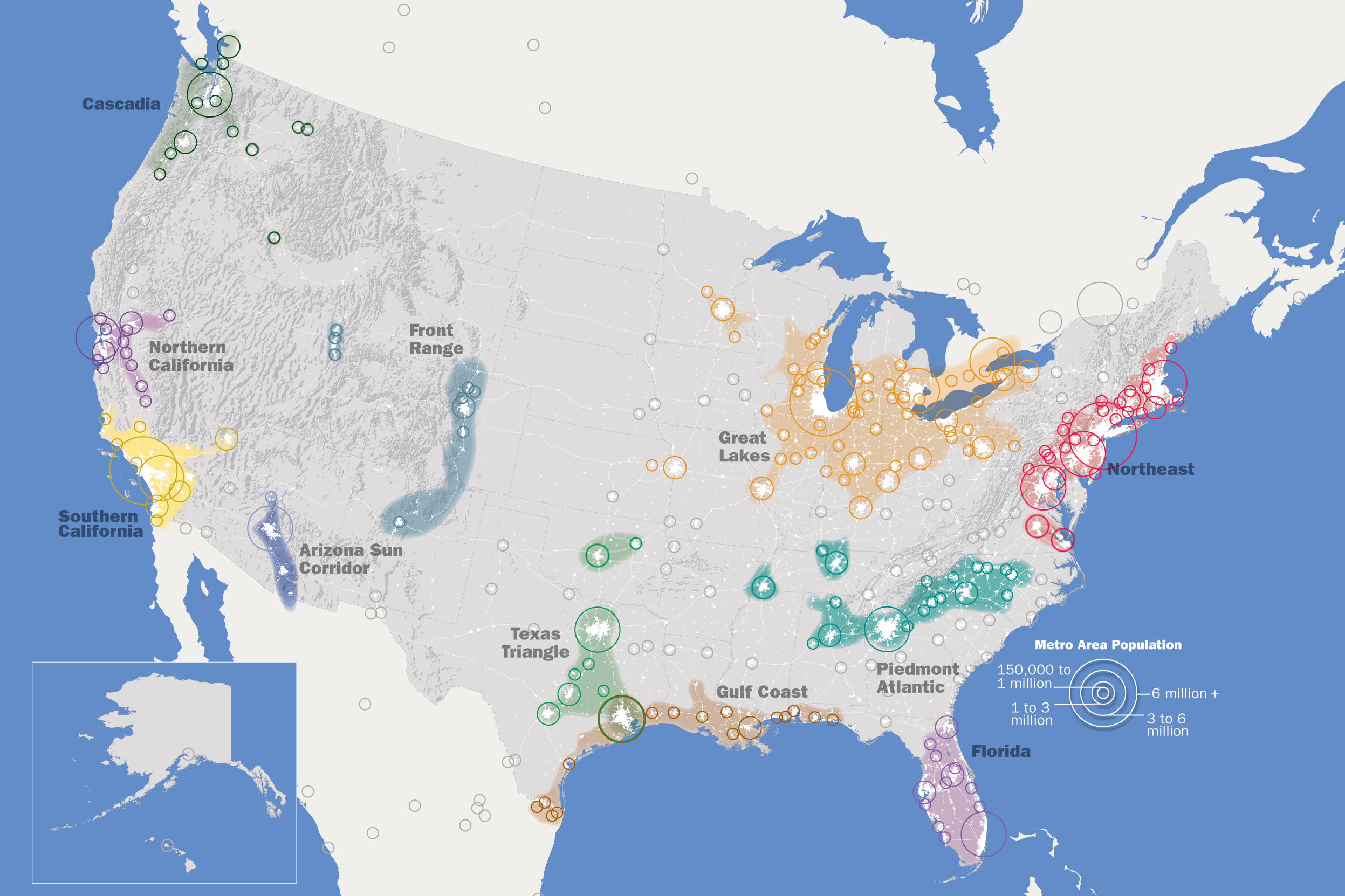
Sort of an interesting article for you today, but I’m actually in the midst of creating an episode on the top megaregions of the United States for my YouTube channel so it’s been top of mind. And while that’s been a fun episode to explore, it’s also brought a nagging question to my mind. One that I won’t share on YouTube, but will happily with you all:
Does the very concept of a megaregion apply to our current economic and societal system, especially after the COVID-19 pandemic upended traditional work flows?
Now for those who want an actual answer to this question, you’re better off reading elsewhere, though I doubt any concluding answer exists anywhere. While I am a former city planner and a geographer in general, I rarely deal in absolutes and this particular question is about as wishy-washy as you can get. So instead, what I’ve written today is really a breakdown of what the megaregion is and what it means now that people can be much more dispersed.
So what is a megaregion?

Essentially, a megaregion is a merely large network of interconnected cities and metropolitan areas that share common economic, social, and infrastructural characteristics. And these clusters of cities are specifically not confined to state or province boundaries but rather can — and usually do — span across multiple states. In some rare cares, such as in the United States’ and Canada’s Cascadia megaregion, they can even reach into other countries (Eugene, OR - Portland, OR - Seattle, WA - Vancouver, BC).
But the concept of a megaregion goes beyond mere geographical proximity. Instead these areas exhibit integrated labor markets, transportation systems, and often cultural affinities. Transportation infrastructure is particularly vital in defining megaregions, with major highways, railways, and airports creating corridors that facilitate movement and commerce.
The idea behind megaregions is that they guide regional planning and development strategies through continuous or linked areas in a more cohesive pattern. Policymakers may focus on enhancing transportation connectivity by building a new high speed rail line, for example, fostering increased economic collaboration between cities, and/or addressing shared environmental challenges within the megaregion's scope.
And one of the most recognized megaregions in the U.S. is the Northeast Corridor, which stretches from Boston to Washington, D.C., encompassing other major cities like New York, Philadelphia, and Baltimore. This densely populated area is linked by transportation networks and has a significant impact on finance, technology, education, and other industries within the United States.
All told, here are the ten largest megaregions as defined by the Regional Plan Association (RPA), though there are a few others that I would include today:
Northeast Corridor: Includes cities from Boston to Washington, D.C.
Southern California: Extends from Los Angeles to Tijuana, Mexico.
The Great Lakes: Encompasses cities around the lakes such as Chicago, Detroit, Toronto, Cleveland, and Pittsburgh.
Texas Triangle: Covers Houston, San Antonio, Dallas, Austin, and Fort Worth.
Northern California: Focuses on the Bay Area, including San Francisco, San Jose, and sometimes Sacramento.
Florida Megaregion: Encompasses cities like Miami, Orlando, and Tampa.
Piedmont Atlantic: Centered around Atlanta, includes parts of North Carolina and Tennessee.
Cascadia: Covers parts of the Pacific Northwest, including Portland, Seattle, and Vancouver.
Front Range: Stretches from Denver to Albuquerque, in the central-western U.S.
Sun Corridor: Ranging from Phoenix to Tucson in Arizona, recognized for rapid growth and integration.
But while this is all very interesting from a geographic perspective (Spatially grouping regions beyond their borders? Yes please!) I’m not sure that they matter as much today as they might have seemed back in 2008 when the RPA originally defined them.
Megaregions don’t matter!
There are plenty of criticisms of the megaregion theory. From its over-emphasis on transportation networks and nodes and corporation locations, to it completely lacking any sort of rural representation. And while all those criticisms are valid, one thing I’ve starting asking myself is: do they even matter at all anymore?
Prior to the pandemic, remote work and the economics of such were very much tied to place. If someone worked in Houston, Texas, for example, they likely lived in Houston. But the pandemic threw all those old workplace rules out the window. Suddenly a very large portion of the world could and would work from home. And as the pandemic dragged on and on, people decided to sell their homes or let their leases expire and move to places that might otherwise have more of a connection to yet still maintain their job located in the original city. So that person within Houston very easily could have moved to Chicago, but still kept their same job. Therein lies the problem. The separation of a person’s physical place from their economic place kind of spoils the whole theory.
And even if the majority of a workforce is located within the greater megaregion, with the rise in telecommunications technologies allowing for a reduced need for physical transportation, it begs the question of whether or not additional transportation infrastructure is even needed. Or if old transportation networks are now obsolete.
The clearest indication of this is the airline industry. Have you noticed that flights are considerably more expensive than they were pre-pandemic? While some of this is due to inflation, most of it is due to the drop in business travel. Prior to the pandemic, airlines could count on a steady customer base in businesses flying their employees around the country (but mostly to cities nearby within the megaregion). Today, however, this is no longer the case because it’s much faster, more convenient and cheaper to have a meeting over Zoom than it is to fly someone to another city.
That said, this entire thought process leans heavily on the economic and transportation network aspect of what makes a megaregion. And perhaps, that’s part of the problem.
Megaregions do still matter!

Twist! This whole time you thought you were reading a compelling article on why megaregions don’t matter, when, in fact, I’ve actually been prepping an article on why they are important, just maybe in a different way. While economy and transportation are still important, if minor, parts of what makes a megaregion, I would argue that what really binds a megaregion together is their shared cultural identity.
Take, for example, the Cascadia megaregion, which largely comprises the major population centers of the Pacific Northwest. This region, while still very economically linked together, share a common cultural thread that is the general bioregion of the Pacific Northwest. That being specifically, large mountain ranges, prominent stratovolcanoes, expansive forests, and, of course, lots of water. So much so that the very name, Cascadia, comes from the Cascade Mountain Range which was only called that because of the sheer amount of waterfalls within them.
And this expands into other areas as well, the regions shared love for soccer as a professional sport (the Timbers, Sounders, and Whitecaps of MLS are all very popular in ways few other cities can claim), the regions love of beer (more craft breweries than anywhere else in the country), and camping and hiking. These cultural touchstones transcend Portland, Seattle or Vancouver, and instead apply to every city.
And the same can be said for the Great Lakes region, Southern California, the Northeast Corridor, the Sunbelt, Florida’s major cities, and so on. While the economic ties might dwindle, the shared cultural ties are, in my opinion, what truly make a megaregion something worthy of calling out.
I hope you enjoyed today’s article! If you’re interested in learning more about megaregions, be sure to check out the first part in a series of videos I’m making on YouTube about them. They should be pretty fun!
It would be cool if Chicago was an anchor for a Northeast Corridor style network
TorHamBuffChester has been thrown around a few times as a bi-national megalopolis.