


European Union is often seen as the ultimate goal for eastern European countries. And for good reason too! In the wake of the Soviet Union’s oppression and the chaotic economic period following its collapse, joining the E.U. is seen as a beautiful, bountiful island in the middle of a tumultuous sea. So it’s not surprising that Bosnia and Herzegovina, the subject of my video this week, would cast joining the E.U. as its long term goal. Despite this desire, however, actually joining has proven to be quite elusive even though Slovenia and Croatia have been able to join.
And, as usual, here’s a link to the video that dives deeper into some of Bosnia and Herzegovina’s unique fracturing issues:
To start, the path to European Union membership has been a long one for the countries that emerged from the breakup of Yugoslavia. While Slovenia and Croatia now sit comfortably within the European family, their journey also took time and effort. So Bosnia' and Herzegovina’s efforts aren’t exactly surprising, but there is something else going on.
For Bosnia and Herzegovina, the journey toward joining the E.U. is linked to the very structure of its state, a legacy of the 1995 Dayton Accords that ended a brutal war but created a deeply complex and often dysfunctional political system. This intricate framework, designed to ensure peace, has become a significant impediment to the reforms required for EU accession.
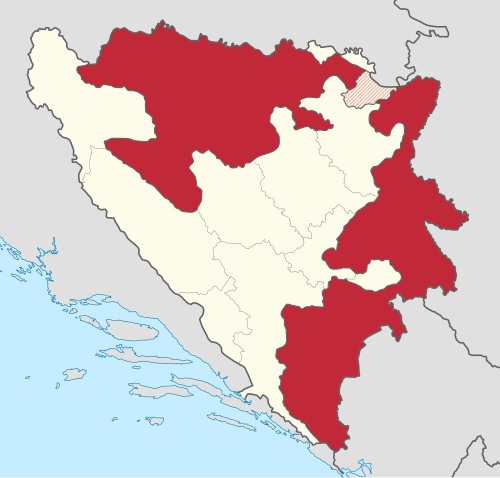
You see, the country’s political landscape is divided into two main entities: the Federation of Bosnia and Herzegovina and the Republika Srpska, with a decentralized structure that often leads to political gridlock. This arrangement has made it exceedingly difficult to achieve the consensus needed for the sweeping legal and economic reforms that are prerequisites for E.U. membership. The European Commission has outlined 14 key priorities for Bosnia and Herzegovina, which include crucial reforms in the judiciary, the fight against corruption, and public administration. However, progress has been painstakingly slow, often held hostage by ethnic and political divisions.
A significant hurdle has been the consistent obstructionism from the leadership of Republika Srpska, which has often challenged the authority of state-level institutions and threatened secession. This has not only undermined the country’s sovereignty but has also created a climate of instability that is anathema to the E.U.’s core principles of political stability and the rule of law.
In contrast, Slovenia’s journey into the European Union was a story of relative success and swift integration. Emerging from the breakup of Yugoslavia with minimal conflict, Slovenia had a significant head start. Also, its homogeneous population and pre-existing institutional capacity allowed for a more focused and efficient reform process. The country embraced a gradualist approach to economic reform, which, while cautious, ensured economic stability and steady growth. This prudent economic management culminated in Slovenia becoming the first of the 2004 E.U. entrants to adopt the Euro in 2007, a testament to its successful transition to a functioning market economy.
Slovenia’s success can be attributed to a broad political consensus on E.U. membership, which translated into a consistent and determined effort to align its legislation and institutions with European standards. The country’s leaders and citizens saw E.U. accession not just as a foreign policy goal but as a strategic imperative for national development and security.
Croatia’s path to the EU was more challenging than Slovenia’s, marked by the legacy of the Croatian War of Independence and initial concerns in Brussels over nationalism and cooperation with the International Criminal Tribunal for the former Yugoslavia. However, once Zagreb fully committed to the accession process, it also undertook a series of profound reforms, particularly in the critical areas of the rule of law and the fight against corruption.
A key element of Croatia’s success was the establishment of specialized anti-corruption courts and a more robust and independent judiciary. These institutions were instrumental in tackling high-level corruption, a significant concern for the E.U. at the time. And by demonstrating a track record of prosecuting corruption, Croatia built trust with its European partners and proved its commitment to fundamental E.U. values. This concerted effort to strengthen its democratic institutions and root out corruption provides a powerful lesson for Bosnia and Herzegovina.
The comparison between these three countries highlights the impact of the initial conditions of statehood and the political will to overcome historic legacies. While Slovenia benefited from a peaceful transition and Croatia from a determined and focused reform drive, Bosnia and Herzegovina remains entangled in a complex political structure that was a product of its devastating war. And one that’s almost intentionally designed to accomplish very little.
So, for Bosnia and Herzegovina to move forward on its European path, it must confront the fundamental challenges that stem from the Dayton Accords. This will require not only the implementation of the 14 key priorities set out by the European Commission but also a deeper, more inclusive dialogue among its political leaders and communities to forge a shared vision for a common European future. The successes of its neighbors offer a clear roadmap: a steadfast commitment to the rule of law, a robust fight against corruption, and a unified political will to embrace the reforms necessary for a more prosperous and stable future within the European Union.
Will it ever happen? Personally, I’m not sure. There’s significant and deep divisions within Bosnia and Herzegovina that won’t be easy to overcome, but I also believe the desire is there. Having spent a few weeks there this summer, I got to know and understand a little bit more how this country works and functions. And Bosnians, despite their differences, seem deeply committed to ensuring they maintain as a unified country.
Probably not, unfortunately. EU looks like a Christians only club.