

Why we have two Carolinas
The geographic split is complicated

I’ve always been fascinated by how states were formed. As someone who lives on the west coast, the process was fairly structured. A territory was formed (after lots of land was taken from the indigenous tribes, of course), the territory would then grow until it got to a point where the people who lived there wanted formal recognition and voting rights. They then petitioned the Congress who would vote on it. And so on and so forth. The process repeated constantly from Ohio all the way to Oregon. This is basically how we ended up with two Dakotas (even though we probably only need one).
But while this process was used for most states that exist today, there is a bit of a oddball in the mix. Or I should say two oddballs. I’m talking about North and South Carolina. Because, if you look at them on a map for long enough, you might find yourself wondering: why do we have two? Why did we ever need a second Carolina? Well, given that both North and South Carolina existed before the United States was even a thing, we gotta go back to the colonial era.
And trust me when I say that this particular geographic story is convoluted. So hang with me here.
The lost colony of Carolana
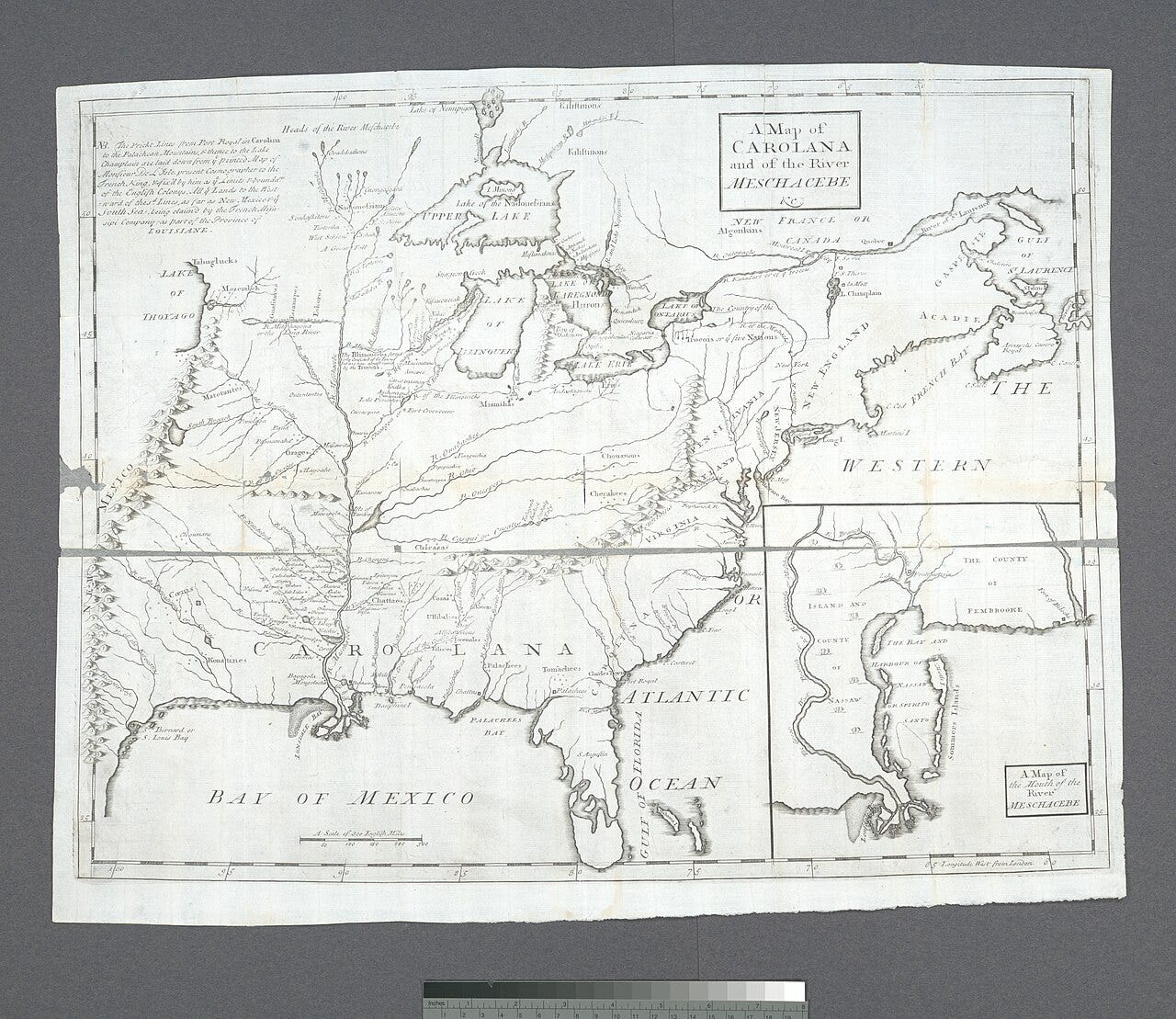
Okay, so the history of the North and South Carolina split is ultimately rooted in the history of how colonies even came to be colonies in the first place. Because it certainly wasn’t as clear cut as how states were formed throughout the 1800s. And here’s the weird thing: North Carolina and South Carolina actually started out their existence as a single territory called Carolana. And yes it’s spelled that way. It’s not a misspelling of “Carolina” it is 100% spelled “Carolana.”
Back in the late 1500s, the English monarchy was realizing that it was falling behind in the exploration and expansion of its empire in the “new world.” Of course the Americas weren’t new, and had actually been inhabited by thousands of different peoples for thousands of years but that’s a whole other story. But England quickly realized that if it was going to compete with the likes of Spain, who was busy pillaging much of Central and South America, it was going to need to start establishing its own colonies in what we now call North America. And so, it began issuing charters to various groups of people who wanted to establish settlements.
While the first English colony was established at Roanoke in modern day Virginia, which ultimately disappeared entirely, England persisted in its North American venture and began issuing more charters for more colonies. By the the mid-1600s, colonies were found up and down the east coast of the modern United States. Places like Massachusetts colony and the Virginia colony and then a colony called the province of Carolana. This colony consisted of the land from Albemarle Sound in present-day North Carolina, to the St. Johns River in the south, just a few miles below the current Florida-Georgia state line. So it was quite a bit more expansive than the Carolinas we know today.
But Carolana, for all its similarities to the Carolinas, would ultimately fail. A lack of funding and resources prevented it from growing and ultimately competing with the colonies in Virginia and Massachusetts. And, at the time, England simply found more value in its Caribbean colonies than it did in Carolana. But there would be a revival of sorts, this time with a slightly different spelling.
The Province of Carolina
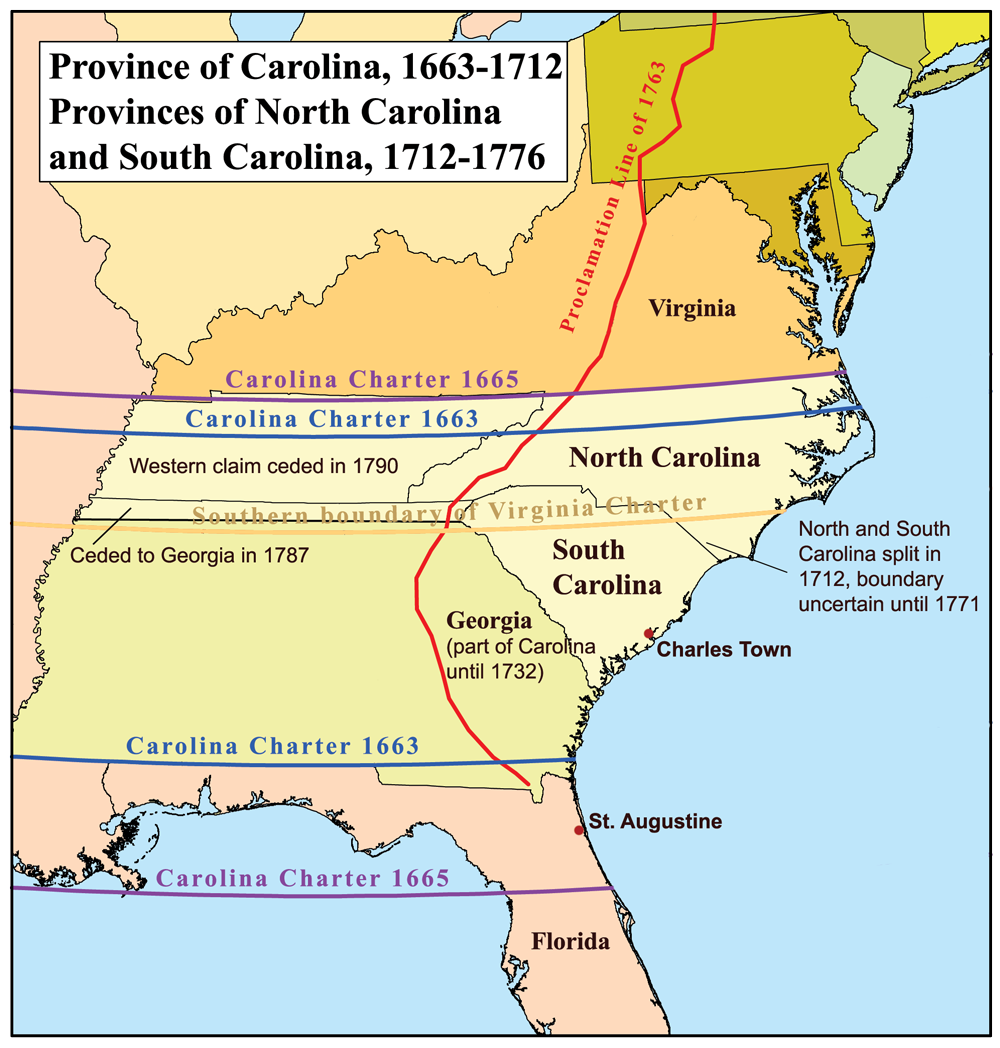
After Carolana packed up and called it a day, the entire region was left in a state of limbo. King Charles, who issued the original charter, was executed in 1649, and the original retainer of the charter, Sir Robert Heath, fled to France. This all gets a bit into the weeds of 17th century English politics, but essentially this left the entire region without any sort of owner or occupier aside from the indigenous tribes of course. Apparently, Heath’s heirs did try to claim the land for themselves, but the new king, Charles II, ruled the claim invalid. And so the region largely remained untouched by Europeans.
Then, on March 24, 1663, Charles II issued a new charter to a group of eight English noblemen, called the Lords Proprietors, granting them the land formerly known as Carolana, as a reward for their faithful support of his efforts to regain the throne of England. And it was at this time officially renamed the Province of Carolina. The charter granted the Lords Proprietors title to all of the land from the southern border of the Virginia Colony at 36 degrees north to 31 degrees north. The goal here was to provide a buffer colony between the successful English colony of Virginia from the Spanish colony in present day Florida and prevent any northern expansion by the Spaniards.
Of the eight Lords Proprietors, only one would take much interest in the new province: Lord Shaftesbury. Shaftesbury, along with famed English philosopher John Locke, would set about attempting to create their vision for a utopian society in the Province of Carolina known as the Grand Model. Really this was simply a plan for how cities and towns would be laid out with a particular emphasis to be resistant to fires (due to London almost burning down in 1666). It also factored in things such as public health and safety, land use, and urban aesthetics. All things we take for granted now, but in 1666 were revolutionary in terms of city and town planning.
But while Shaftesbury and John Locke had big goals for Carolina, the reality is that the based laid plans always go awry. And in the case of Carolina, it was destined to eventually be split in two.
The north and south split

The first thing to know about the split between North Carolina and South Carolina is that there was no single event that caused the divide. Instead it was really more of a slowly simmering buildup that eventually boiled over. That said, we can point to a couple different events that really spurred the division along.
The first is the Tuscarora War in 1711 between British colonial settlers and the native indigenous peoples of the area. The Tuscarora tribe existed in what is today North Carolina for hundreds of years before European settlers invaded their land. And, as one might expect, they didn’t take too kindly to having their lands taken from them. More to that point, because the province of Carolina was ruled by eight separate Lords Proprietors, the treaties and deals they struck with the tribe were often overruled, ignored, or broken by one of the other lords. This inevitably would lead to friction and, eventually, the war.
The Tuscarora would ultimately lose, but it would build contention in the Carolina colony between those in the north who pulled in more resources to defend the land, and those in the south who felt like it really wasn’t their problem.
You see, the northern part of the Carolina province and the southern part were always a bit separate. Charles Town, known today as Charleston, was the capital of the colony, but the northern area governed themselves independently and had their own major towns in Albemarle and Cape Fear. In fact, both the north and south had their own governors well before the formal split.
And so, due to the tensions between the two halves, the Lords Proprietors inability to effectively govern the territory, and the burgeoning wealth by the southern part of the colony, the King reclaimed the southern part of Carolina for the crown in 1719, and left the northern part for the Lords Proprietors. And thus, North Carolina and South Carolina were officially separated.
And so there you have it! North Carolina and South Carolina exist as two independent states not for any modern political reason like the Dakotas do, but really for economic reasons. Had the North not ensnared themselves in a long, bitter war with the Tuscarora that trapped them with debt, it’s likely that the King wouldn’t have split the colony and taken the southern half for himself. Which means, today, we’d have just a single state called Carolina.