

Why these countries aren't "South American" despite being in South America
Geography's orphan countries 😢

Think about South America for a minute. What are the first countries that pop into your head? Chances are you immediately went to the sunny beaches of Brazil, maybe the bright lights of Argentina’s largest city Buenos Aires, or the incredible mountains of Colombia (please consider donating to their recovery) or really any of the other large and prominent countries in South America. There are ten of them after all, right? So many to choose from! You almost can’t go wrong with any of them.
Wait, no, that’s actually not true. You CAN go wrong as it turns out. Because, even though I said there were 10 countries in South America, and you likely believed me, physically there are actually 13. It’s just that three of them don’t really count as being South America. These countries are Guyana, Suriname, and French Guiana.
These three countries, more than most other countries in the world, are kind of mysterious. We don’t really hear much about them. They’re usually not mentioned in terms of global geopolitics. And, when it comes to South American affairs, they’re not usually included. In fact, none of these three countries participate in CONMEBOL, the South American soccer (football) federation. Which means they don’t directly compete in international matches against the likes of Brazil or Argentina. Instead, they’re part of CONCACAF, the North American soccer (football) federation. And they compete competitively with the United States, Canada, Mexico, and so on.
So why is this? Why don’t we think of these three countries as being part of South America?
Physically isolated
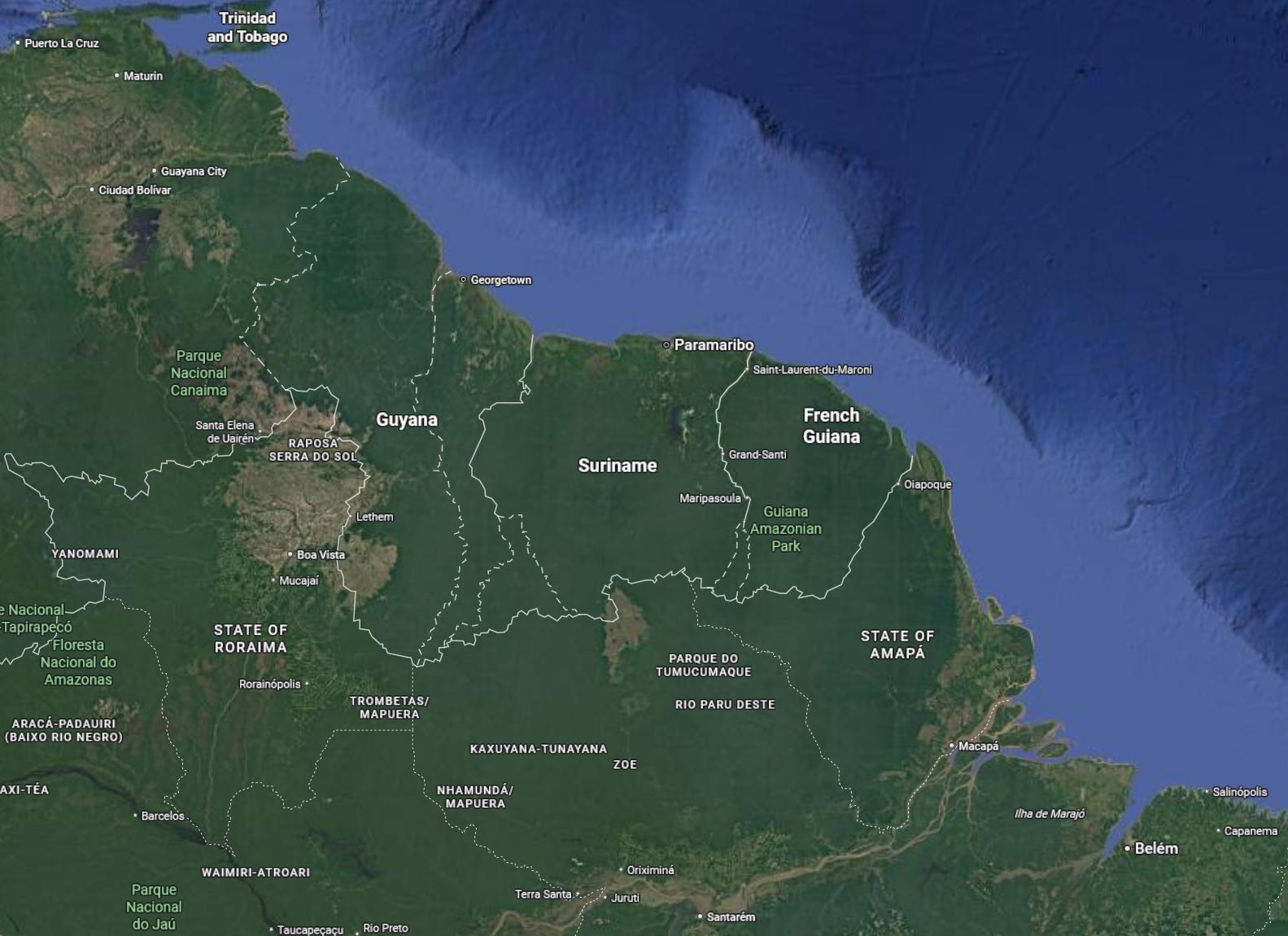
Here’s the strange thing about the three countries. Despite each sharing a large, physical border with Brazil, and Guyana sharing an additional (very complicated) border with Venezuela, there are only two roads between the three that connect to anyone outside of their little bubble.
In the east you have Rupununi Road which connects Guyana and its capital of Georgetown to the Brazilian state of Roraima. But here’s the thing, Roraima is Brazil’s least populated state. Of the country’s 213 million people, less than half of 1% live in Roraima. So, needless to say, Guyana is not extremely well connected to Brazil.
And then, over in the west, you have French Guiana’s N2 highway which connects its capital of Cayenne to the Brazilian state of Amapá which just so happens to be Brazil’s second least populated state. Again, less than 1% of all Brazilians live in Amapá.
Suriname, for its part, has no direct connections to anyone aside from Guyana and French Guiana.
And this is all because of the Amazon Rainforest. It turns out that the thickest, heaviest, most difficult to traverse regions of the Amazon happen to be in this part of South America. Southern Suriname, for example, is almost completely bereft of any infrastructure whatsoever.
All this is to say, these three countries are disconnected from the rest of South America in a unique way. But they’re not disconnected from everyone. And that’s key to this story.
While Guyana, Suriname, and French Guiana are isolated from Brazil and the rest of their continental neighbors, they’re very well connected to the Caribbean countries. Places like Trinidad and Tobago, Barbados, and Grenada. In many ways, this oceanic connection to the Caribbean makes these three countries more Caribbean than South American and we see that play out in things like international soccer.
But there’s something else going on here too: language!
The language divide

South America is overwhelmingly dominated by two languages. You have Portuguese, predominantly spoken by Brazil. And then you have Spanish, spoken by every other country in South America (outside of our three). It’s actually crazy how close these two countries are in terms of natively spoken language at home. From what I can find, 215 million people speak Portuguese in South America and 214 million speak Spanish. That’s a crazy fun fact.
But regardless of how close the two languages are and how dominant they are, none of our three not-quite-South American countries speak either of those languages. Instead, they each speak a different European language. In Guyana, they predominantly speak English. In Suriname, the mostly speak Dutch. And in French Guiana they almost exclusively speak, you guessed it, French. And this is because these three countries had a radically different colonial history than the rest of the continent.
You see, these three countries were colonized by the British, Dutch, and French respectively. They weren’t Spanish or Portuguese. Which means, they don’t look or feel Spanish or Portuguese in the same way as every other country on the continent does. And while Portugal and Spain are different countries with different customs, they still share more in common with each other than they do Britain, the Netherlands, or France. Which is why Brazil still “feels” South American in a way that these three don’t despite not being Spanish (and the same the other way around).
In fact, one of these countries isn’t an independent country at all. And, technically, it’s part of Europe. French Guiana is still entirely ruled by France. They use the Euro. Follow French laws. And generally adhere to French customs.
All this is to say, on a fundamental linguistic base, which controls so much of how our culture looks and feels and flows through everything else, these three are different. And that kind of linguistic divide, combined with a very real physical one, means that, on a continental level, these guys sort of fall outside what it means to be part of South America… even if physically they very much are.