

Why the scariest earthquake region in the US is not where you think
"But we don't get earthquakes"
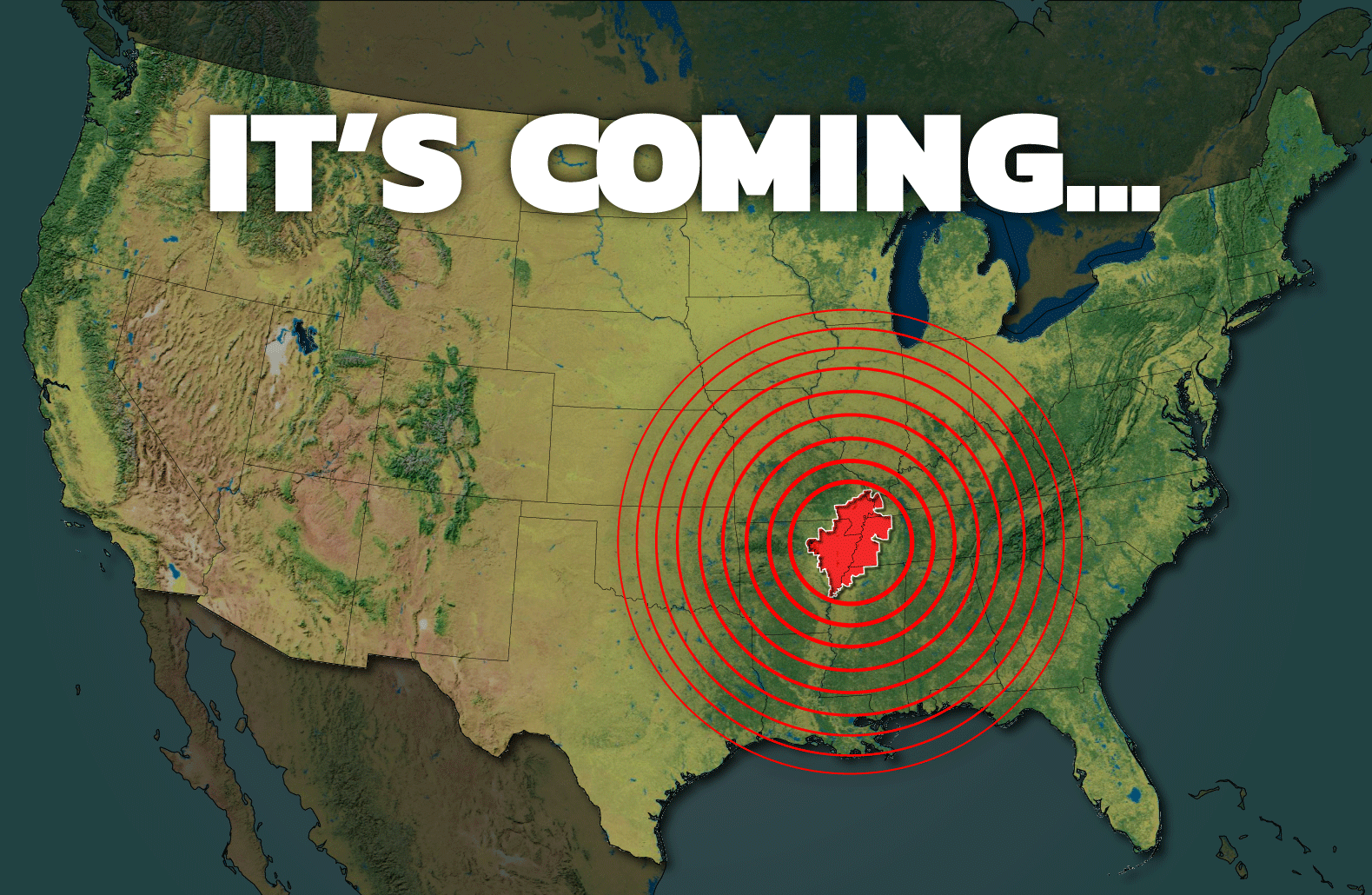
We’re going to dive deep today into a subject that I am equal parts fascinated by and terrified of. Earthquakes are, in my opinion, the most frightening aspect of our planet. Like, at any given moment, the Earth could just decide to grind and tear itself apart emitting unfathomable amounts of energy and unleash chaos and devastation across an entire region. And as someone who lives in a region that doesn’t get them often, but is expected to get a REALLY LARGE one in the future… ya I’m a bit scared.
But it’s also for this reason that I’m so interested in them. After all, earthquakes have a geography unto themselves that is unlike anything else on the planet. There’s nothing else that can hit in one place and physically be felt hundreds or thousands of miles away at nearly the exact same time. Maybe you could make that argument for hurricanes or typhoons, but I just don’t think its the same.
All of this is to say, while earthquakes are endlessly fascinating broadly. What I’m most interested in are places that are seemingly free or devoid of earthquakes, but, in reality, are anything but. And that brings us to today’s subject: the hidden fault line under the dead center of the United States. That’s right, this article is all about the New Madrid Seismic Zone.
And, of course, I’m writing about this today because, well, earlier this week Japan was struck by a rather large earthquake in its southern prefecture of Kyushu. The devastation, of course, is heartbreaking and I hope that survivors are found and Japan recovers quickly.
Hiding in middle America
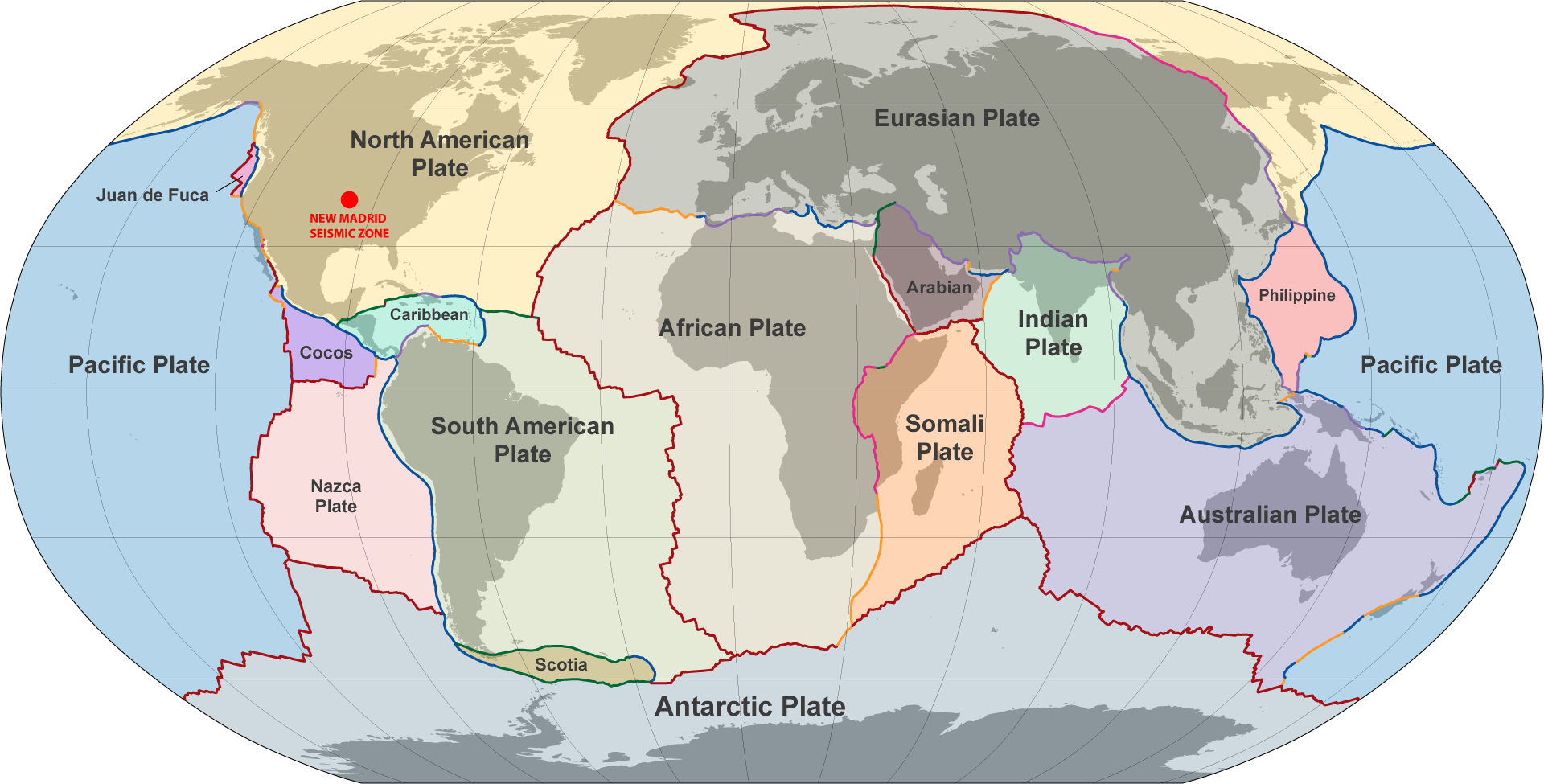
The New Madrid Seismic Zone is one of the more interesting seismic regions in the world. For one, it’s right in the middle of a tectonic plate. These are those really big pieces of crust that occasionally rub or push or pull against each other causing, well, earthquakes. Japan, widely considered to be the most seismically active country in the world, sits at the confluence of four different plates:
North America Plate (yes, despite being in Asia)
Pacific Plate
Philippine Plate
Eurasian Plate
Being near so many plate borders is a recipe for earthquakes because it is, quite literally, where all the action happens. So, needless to say, Japan is also one of the most prepared regions in the world when it comes to earthquakes. Which is why the New Madrid Seismic Zone is so weird: it’s nowhere near where a tectonic plate would be ripping and grinding past another plate. Which brings us to the second reason its so interesting: it’s ancient.
As it turns out, the New Madrid Seismic Zone sits above a geologic feature known as the Reelfoot Rift. And this rift was formed, get this, somewhere around 51 million years ago during the Cambrian Period. Its theorized that this rift is the remains of a failed attempt (of sorts) by the world to split the North American continent into two continents. However, just because it failed to split the continent into two pieces, doesn’t mean that it went away entire. So what we have is something of a “weak spot” in the Earth’s crust, a place that can and does get earthquakes because, on some level, maybe it’s still trying to create that split.
That’s mind-blowing. 🤯
This is why, back in the early 1800s, an earthquake swarm hit the New Madrid Seismic Zone. The Reelfoot Rift, the weakened part of the North American plate, had some sort of event (perhaps the continent trying to pull apart again?) and a bunch of earthquakes hit the region. We have documented evidence of this happening because, at this point in time, American settlers were living in the area. In fact, the earthquakes are estimated to have been somewhere between a 7.0 and an 8.2 in magnitude. Those are very larger earthquakes. So large, in fact, that it reversed the course of the Mississippi River for a period of time.
Oh and the earthquake that just hit Japan and is wreaking havoc? That was a 6.8.
But will an earthquake hit again soon?
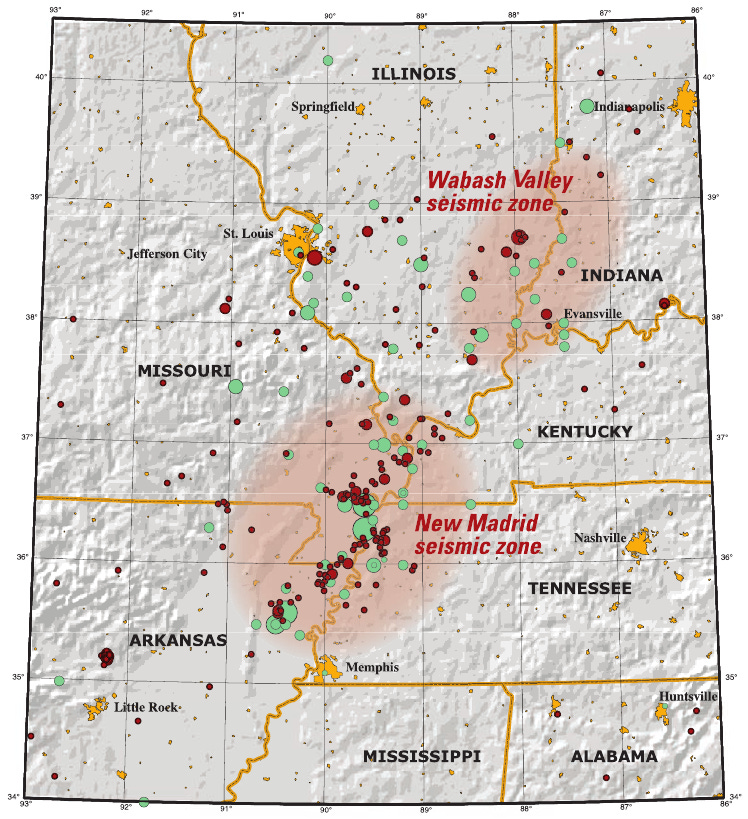
The short answer is, as it always is with earthquakes: we have no idea! There are predictions, of course. There are range expectations where an earthquake is likely or supposedly likely to hit within that range. But remember, we’re looking at a geologic time scale. A thousand years to the Earth is basically nothing. We all live on a human time scale where anything long than one year feels like an eternity away that we don’t really have to plan for.
In fact, there’s not actually broad consensus between scientists over whether there will ever be another earthquake here. According to a few different studies in late aughts, data from GPS data showed that there’s very little movement in the New Madrid Seismic Zone overall (certainly nothing compared to the San Andreas Fault) and therefore, it could be a signal that the seismic zone is shutting down entirely.
But again, we’re talking about a geologic entity sitting on a time scale that we have no way of predicting. And earthquakes, for all the research we’ve done on them, are still very mysterious. We really can’t predict when one will happen at all. It’s more like we’re just making educated guesses. Which is unfortunate because, if another earthquake swarm did hit the New Madrid Seismic Zone, like what happened in the early 1800s, there’s going to be a lot of damage. According to a FEMA report released in 2009 (from the Wikipedia page):
The report found that there would be significant damage in the eight states studied – Alabama, Arkansas, Illinois, Indiana, Kentucky, Mississippi, Missouri, and Tennessee – with the probability of additional damage in states farther from the NMSZ. Tennessee, Arkansas, and Missouri would be most severely impacted, and Memphis and St. Louis would be severely damaged. The report estimated 86,000 casualties, including 3,500 fatalities, 715,000 damaged buildings, and 7.2 million people displaced, with two million of those seeking shelter, primarily due to the lack of utility services. Direct economic losses, according to the report, would be at least $300 billion.
So let’s hope it is shutting down because, if not, middle America is gonna be in for a very rude awakening. In the mean time, I’ll go back to waiting for the Cascadia Subduction Zone to rip open… something we definitely know is going to happen sometime soon-ish (but hopefully in 100 years when I’m long gone).
Do you live in this region? Are you worried about an earthquake? Let me know in the comments!
I taught elementary school in Kentucky in the 80s and 90s. In 1990, there was a prediction of another earthquake along the New Madrid fault line. Stories were resurrected of the Mississippi River reversing course and widespread flooding. I taught in Lexington which was far enough away to be only mildly concerned, but many schools in Western Kentucky made news because they closed for the 2-day stretch around the prediction. I suspect this was also true for other nearby states. The schools closed in large part because of money. Parents made afraid by the prediction were going to keep their children close and at home and school attendance which affected school funding would be significantly diminished. It turned out to be a nice 2-day holiday for those kids. Nothing happened other than stories of things being closed and nothing happening. I don't doubt the region will experience another earthquake at some point.
Fascinating as always!
FYI, I think you missed a zero at the end of the Cambrian timing: more like 510M than 51M years ago.