

Why Saudi Arabia is really interested in sports these days
The oil-rich country seems keen on following the path set by other countries with dubious reputations.
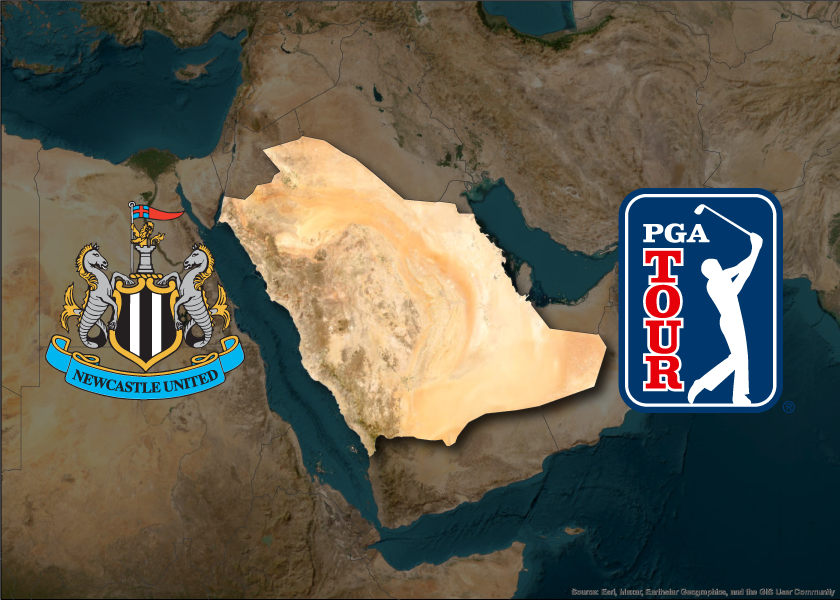
Saudi Arabia seems to be in the news a lot these days. I don’t know for sure if it’s more or less than in previous years, but they definitely seem more prominent. And while this article isn’t about a specific current event, what we’re going to be talking about broadly is why Saudi Arabia seems to be so intent on cleaning up its image, specifically by way of sports. But first let’s reset just a little bit and talk about why Saudi Arabia might seem so much more active on the world’s stage today than it did 20 or 30 years ago.
Before Mohammed bin Salman
Mohammed bin Salman (here on written as MbS) is a well known, global figure today, and I’m going to write quite a bit about him in later in this article because he has had a huge impact on the trajectory of Saudi Arabia today. But first, let’s go through what Saudi Arabia was like before his arrival.
Prior to MbS, Saudi Arabia was really only known for two things: Islam and oil. That is perhaps a little unfair, no country can ever just be boiled down to two things, but generally that is the case here. And it appeared for a long time, under Saudi Arabia’s current king and previous ruler (MbS rules the country but is not the king… it’s complicated), that Saudi Arabia was generally fine with this mantle.
In case you didn’t know, Saudi Arabia holds the second-largest proven crude oil reserves in the world (Venezuela is #1 and is the topic of Monday’s video on YouTube!) and is the world's largest oil exporter. The discovery and exploitation of this natural resource played a pivotal role in the country's rise to economic prominence. And without it, Saudi Arabia would undoubtedly be less prominent today. The 1973 oil embargo marked a turning point when Saudi Arabia and other Arab nations used oil as a political weapon to protest Western support for Israel during the Yom Kippur War.
Moreover, as the birthplace of Islam and custodian of its two holiest sites in Mecca and Medina, Saudi Arabia carries considerable weight in the Islamic world. Every year, millions of Muslims travel to Saudi Arabia for the Hajj pilgrimage, amplifying its influence over one of the world’s largest religions.
Overall, geography has also played a key role in Saudi Arabia's rise. Not only through oil and religion, but through its very location. The country lies at the intersection of three continents — Asia, Africa, and Europe — and heavily influences what can go in and out of the Bab el-Mandeb Strait, a critical choke-point in global energy shipments.
This was Saudi Arabia from about 1950 to 2015 or so. Very prominent in oil and energy, very prominent in Islam, but overall not super active on the global stage. Certainly not up there with the likes of the United States, China, or many western European countries. But that has started to change because of one man…
Saudi Arabia’s recent rise

In case you have noticed, in recent years, Saudi Arabia has been taking some pretty significant strides towards modernization and diversification of its oil-dependent economy. Crown Prince MbS launched Vision 2030, a plan aiming to reduce Saudi Arabia's dependence on oil, diversify its economy, and develop public service sectors such as health, education, infrastructure, and tourism. None of this was something that Saudi Arabia ever really cared to dive into previously.
The plan also involves creating a more liberal social environment, as demonstrated by recent reforms allowing women to drive and easing restrictions on public entertainment. Though the country is still very conservative in many, many ways. And more to that point, the country is still very hostile to those who are antagonistic against MbS or Saudi Arabia at large. It probably doesn’t need to be said here, but the grisly murder of Jamal Khashoggi in 2018 highlights the dark side of a Saudi Arabia that is desperately trying to paint itself not only as a global leader, but as a modern and progressive country that’s amenable to business, tourists, and can steer the world in ways it sees as beneficial.
But, as it turns out, convincing people within democratic countries that you’re a progressive country can actually be pretty challenging if you’re still an active authoritarian regime. And this is why we see Saudi Arabia getting so interested in global sports.
The sportswashing of Saudi Arabia
Over the last couple years, Saudi Arabia has really bolstered its sports holdings by way of its Public Investment Fund (PIF), which is really the collective wealth of Saudi Arabia’s oil that it can and does use to do really whatever it wants. Saudi Arabia’s money is everywhere these days. It has funded alfalfa farming in Arizona, it owns large stakes in media and entertainment companies such as Nintendo, and now, it’s started to purchase sports teams, players and whole tournaments. Which might seem weird because, unlike growing agriculture or investing in a company, there’s not a clear return on investment in the world of sport. So what could Saudi Arabia possibly get out of it?
But let’s back up really quick. If you didn’t know, Saudi Arabia has done a few major things in the sports world recently:
It has bolstered its home grown soccer (football for you Europeans) league by luring players such as Cristiano Ronaldo, who is reportedly being paid around $200 million per year;
It has purchased Newcastle United of the English Premier League, something that Saudi Arabia’s neighbors have done in recent years as well; and
It created its own golfing organization called LIV Golf and lured some of the most prominent global golfers to play in its tournaments before essentially purchasing the PGA Tour as well.
This will doubtless be the last sports purchase for Saudi Arabia. Reportedly the country’s Al-Hilal SFC of the Saudi soccer league, which is owned by the PIF, attempted to lure Lionel Messi to the league with a reported salary of $400 million per year. There have also been rumors that Saudi Arabia will invest in one or more NBA teams after the league opened themselves up to sovereign wealth funds. That’s not at all confirmed, but it also wouldn’t be surprising. And it’s all being done for one reason: get people to look at Saudi Arabia fondly.
Sports, as it turns out, is a great vessel to get people on your side. This probably comes as no surprise to most people, but sports are integral to billions of people around the world. We follow our teams, we support them, we cheer when they win, we cry when they lose, we even make the best players of our sports into global superstars. Sports, even if you’re not personally a fan, are incredibly important to people at large. And it’s because of this power that sports holds over billions of people that also makes it a great vessel for helping to clean up your image.
The United Arab Emirates (UAE) purchased Manchester City in 2008. The club has won its league championship 9 times in total and out of those 9 times, 7 came after the UAE bought the team. To all of those fans, and now all of Manchester City’s global fans, the UAE is a godsend. They love them! They invest billions of dollars into the team and the team wins consistently. Few of those fans, I’d argue would ever want to go back to the period before the UAE owned Manchester City. And since their purchase of Manchester City, the UAE has gone on to purchase or found soccer teams in the United States (New York City FC), Australia, India, China, Japan and many more.
Today, very few people ever think about the UAE’s very dark history around human rights, forced labor of migrant workers, and persecution of LGBTQ+ individuals. Instead they think about things like Manchester City and the glitz and glam of Dubai. Qatar, another oil-rich country with also a long track record of being not good, has used this method as well having recently hosted the 2022 World Cup and purchasing Paris Saint-Germain in France.
Saudi Arabia is a little late to this game, but has definitely seen it pay dividends to its respective neighbors. Not direct monetary dividends mind you, but invaluable reputational dividends. The goal is to get people around the world thinking about something nice and fun about the country and not its track record. And Saudi Arabia wants those reputational dividends. Sports is just one, very large way they’re trying to go about it.
"Western washing" seems appropriate.