

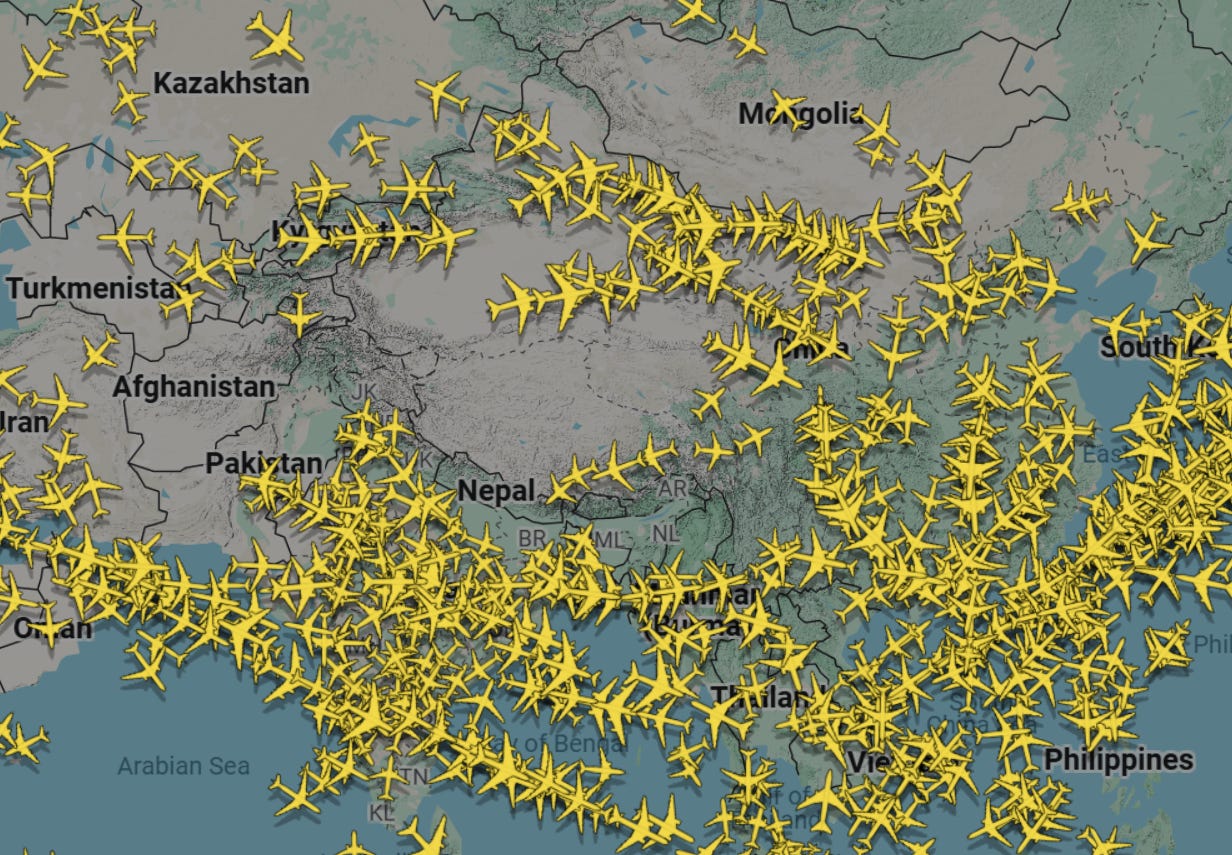
Have you ever looked at flight tracker? You know, the website where you can see where every flight in the world is at the moment, where it’s coming from, and where it’s going? Well, I do! Sometimes, I just poke around endlessly on it. Anyway, this website shows an interesting aviation quirk: planes don’t fly over Tibet. That’s actually not entirely true. They do if they’re flying to Lhasa, the capital of Tibet. But other than that, nobody ever flies OVER Tibet. Planes go either north of it, or south of it. This is super weird because it adds time and money to flights that are otherwise trying to maximize profits. So what’s going on?
Oh and of course, this article was inspired when I first began creating a video about why planes don’t connect from South America to Africa. Which you can watch right here:
Back to Tibet!
So, first and foremost, Tibet has a wild geography! In fact, it sits on the highest plateau on Earth. With an average elevation of over 4,500 meters (14,800 feet), the terrain is both mountainous and extremely remote. This would make the Tibetan Plateau taller than the highest mountains in the contiguous United States. Mount Whitney, the tallest mountain in the lower 48 states is 14,505 feet tall. But that’s just a single peak. The Tibetan Plateau is as vast as it is tall. And it has extreme peaks like Mount Everest which rise even higher to nearly 9,000 meters. This is just a hair below the typical cruising altitude of commercial jets. This means planes flying over Tibet would be operating with far less vertical buffer between themselves and the mountains below, leaving little room for error in case of an emergency.
So, in the rare event that a plane needs to make an emergency landing, options over Tibet are virtually nonexistent. With such a small amount of vertical clearance because of the high altitude plateau, any emergency landing would need to be really quick. This isn’t impossible, of course, but it does pose a problem because the area lacks the infrastructure for emergency diversion. Basically: there are few airports, sparse roads, and even more limited rescue services. So even if a plane did manage to descend safely, evacuating passengers or getting help in would be a massive challenge.

There's also the issue of "drift-down altitude." Now, you’ll forgive me a bit here because I’m a geography and not a pilot or aeronautics engineer. But the way I interpret it is if a plane loses one engine at cruising height, it must descend to a lower, safer altitude where the single engine can maintain flight. How does it do this? No idea whatsoever. It might as well be magic to me! But regardless, it seems to be a very important thing for airplanes. And over Tibet, since the available terrain is often higher than that drift-down altitude, it would be impossible for the plane to descend low enough without hitting the mountains. That, obviously, presents a major safety risk that airlines simply prefer to avoid. As would I!
Finally, just to add a third thing to the mix here, the thin atmosphere over the plateau presents performance challenges. Jet engines require a certain air density to function efficiently, and flying over high-altitude areas reduces engine performance and increases fuel consumption. So maybe it’s more efficient and profitable to simply go around the Tibetan Plateau.
All of these factors combine to make the region less than ideal for commercial air traffic. Which makes the Tibetan Plateau one of the very few places in the world where you can’t get a bird’s eye view. Not unless you fly directly into Lhasa anyways.
Now all that said, in theory, modern jets can fly over the middle of Tibet (like beyond Lhasa), and military aircraft sometimes do as well. But for passenger airlines, the risks simply outweigh the benefits. Instead, most routes between cities like Delhi and Beijing are routed south of the Himalayas, favoring safer paths with better infrastructure and lower elevations.
Regardless, this is a super interesting geographic area that has a drastic impact on air travel. 🤓
Tibet and 14,000 feet, but so is the Marina Trench, but that is under the Pacific. McNamee told you the reason.
Geo and most rivers start there, which is under the control of the Chinese.
Look up “single engine absolute ceiling” and find a reasonably technical explanation. Should suffice.