

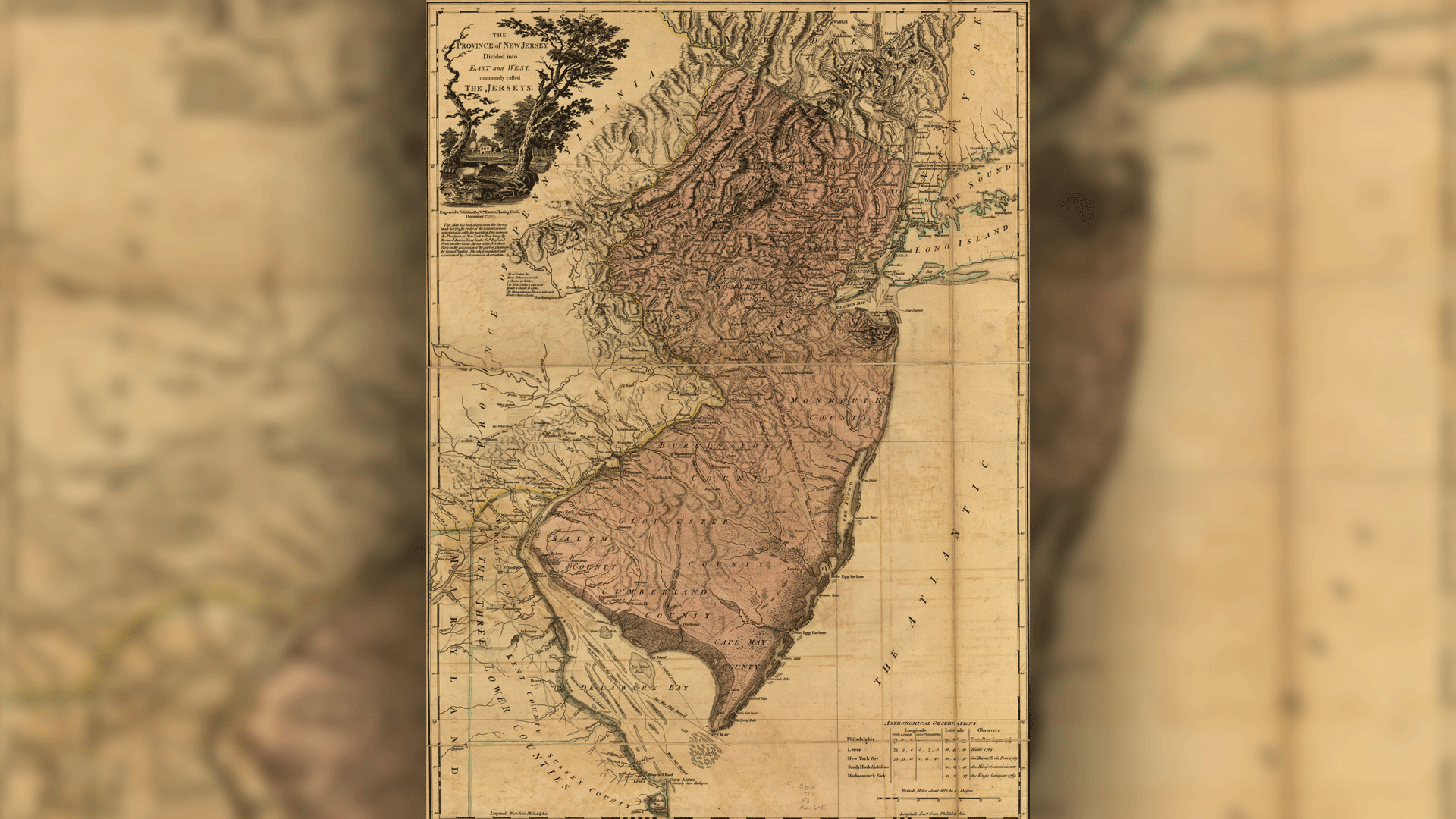
Happy New Year! I hope you had a happy holiday period. Apologies for the lack of articles, it was trying enough keeping up with all of my other content making and the normal weekly Substack articles fell by the wayside. But now that things are back to being normal, I’m back to writing here again!
If you walk into a deli in northern New Jersey’s Bergen County and want a “pork roll” you’ll likely be ordering something called a “Taylor Ham” instead. Conversely, if you go to a Wawa in southern New Jersey’s Camden County and ask for “Taylor Ham,” you might be politely asked to leave. Or just corrected that it’s called a “pork roll.” The point being though that there’s a very real divide in New Jersey that persists to this day.
You see, New Jersey is not one state. It’s two distinct cultures, two economies, and two media markets trapped in a single trench coat, pretending to be a unified entity. And while we treat the North/South Jersey divide like a quirky local rivalry such as with a debate over breakfast meats or whether you root for the Eagles or the Giants in the NFL, the divide is very real. You see, New Jersey has an actual colonial divide that simply didn’t survive into statehood.
Looking back at the colonial record, it becomes clear that this identity crisis isn’t an accident. For 28 years, New Jersey was split into two separate colonies: East Jersey and West Jersey. They had different capitals, different constitutions, and different religious makeups. But then, in 1702, Queen Anne reunited them into a single royal colony.
I don’t know if Queen Anne was wrong or not in doing this, but what I am saying is that this divide has created the very split New Jersey we still see today. In fact, I’d argue that northern New Jersey is far more different from southern New Jersey than North Dakota is from South Dakota.
But let’s figure out how New Jersey got to where it’s at today.
It all goes back to the British (of course)
Upon capturing New Amsterdam and the Dutch North American holdings, the British Empire found itself with quite a lot of territory in between its Massachusetts and Virginia colonies. And the Duke of York, who inherited New Amsterdam (and promtly renamed it New York) ended up giving away what would become New Jersey to two of his buddies, Sir George Carteret and Lord Berkeley of Stratton.
Now, the logical thing to at this moment was probably to jointly rule the single land mass as one entity and split any revenues. But that’s not what these two did. Instead, they split the colony in half and created East Jersey (Carteret) and West Jersey (Stratton). Stratton then, almost immediately sold his proprietorship of West Jersey to the Quakers.
This was all done via a document called the Quintipartite Deed (1676) that formally sliced the province in half diagonally.
East Jersey (roughly North Jersey today) was held by Sir George Carteret. It was settled largely by Puritans from Long Island and New England, along with Scottish immigrants. Its capital was Perth Amboy. It looked toward New York Harbor. Its commercial instincts were sharp, urban, and Calvinist.
West Jersey (roughly South Jersey today) was sold to a group of Quakers, including William Penn. Its capital was Burlington. It looked toward the Delaware River in the south and was largely egalitarian, agrarian, and culturally mild.
The line they drew (the “Keith Line”) wasn’t perfect, but it acknowledged a geographic reality that we still see today: The geology and hydrology of the state pull in opposite directions. The northeast drains into the Hudson and the Atlantic; the southwest drains into the Delaware.
Benjamin Franklin later famously described New Jersey as “a keg tapped at both ends,” drained by New York to the north and Philadelphia to the south.
By forcing these two distinct spheres of influence into one political unit, the British Crown guaranteed that New Jersey would never develop a singular, cohesive center of gravity.
If the separation had held, East Jersey would today be a powerhouse maritime state. It would likely be a dense, urbanized corridor—essentially a massive extension of the New York metro area, but with its own sovereign identity, perhaps rivaling Connecticut or Massachusetts in political clout.
West Jersey, meanwhile, would have evolved into a distinct Mid-Atlantic commonwealth. With its Quaker roots, it might have looked more like a coastal version of Pennsylvania—agricultural, suburban, and centered entirely on the Delaware Valley economy.
Reunification

Unfortunately, there’s no splashy answer for why the two merged back into a single colony. The reunification in 1702 was largely a matter of administrative convenience for the British Crown and a way to solve land disputes between the proprietors and the then the Quakers. And so, they all surrendered their governing rights, and New Jersey became a single royal colony.
But this reunification didn’t solve the underlying cultural rift. They just papered over it.
Fast forward to today, and we’re left with a state legislature that has to balance the needs of a commuter belt serving Wall Street with the needs of a region that shares more DNA with Eastern Pennsylvania. We have a “Central Jersey” that exists solely as a demilitarized zone where the two sides mix uneasily.
There’s no single major media market that New Jersey can call their own and they’re the only state completely sandwiched between two external media giants (NYC and Philly). This means New Jersey’s politics rarely gets the coverage it deserves because their news is filtered through the lens of their larger, more prominent neighbors (the most recent gubernatorial election aside).
And so, if East and West Jersey had remained separate, there likely wouldn’t be any of the usual jokes about being the “armpit” of New York or the shadow of Philly. And instead there would be two distinct, logical states that more accurately represent the two halves unique cultures.
East Jersey: The industrial, high-density engine in the north (oddly enough).
West Jersey: The garden state of the Delaware Valley in the south.
But as the French say: c’est la vie.
Seems like a lot of other states could be reasonably split in a similar way also. NY, PA, IL, MA, MI, VA, CT, CA, OR, WA, FL, MO and any other state dominated by either one or two big cities come to mind.
Analilia Mejia is running for congress in district 11 Morris county New Jersey. Everyone get out and vote February 5th. Everyone has to do their part and vote.
The SUPERMAJORITY PLAN TO SAVE THE COUNTRY FROM TRUMP
It will take 292 house and 67 senate votes to obtain a supermajority vote. A supermajority vote will override Trump’s veto of a bill. THIS WILL BE KEY TO ACCOMPLISHING ANYTHING. The house and senate can pass a law to release the classified Epstein files implicating Trump and his billionaire pedophile network. They can pass a law to investigate the coverup of those files within the Trump administration.
EVERYONE IS GOING TO HAVE TO VOTE FOR DEMOCRATS IN THE NOVEMBER 6th MIDTERM ELECTIONS TO MAKE THIS WORK
Make sure you share this with everyone you know without social media. People without social media are unaware how corrupt and detrimental Trump’s administration really is for our country. The media outlets do not post anything negative about Trump. Some people don’t even know what the midterm elections are or how important they are.
WE HAVE TO STOP TRUMP AND HIS ADMINISTRATION FROM DESTROYING THE COUNTRY.
TRUMP, HIS ADMINISTRATION, HIS BILLIONAIRE PEDOPHILE NETWORK , AND THE REPUBLICAN PARTY ARE MAKING IT IMPOSSIBLE FOR THE WORKING CLASS TO SURVIVE