


The North Atlantic Treaty Organization, often called NATO, is an incredibly strong military alliance. And the very existence of it has very likely staved off many wars and conflicts over the last few decades. In fact, were it not for NATO, the cold war between the United States and Soviet Union very well could have turned hot. But because NATO existed as a binding unit across a dozen and more different countries, it provided the necessary threat of “an attack on one is an attack on all.” This is authorized through Article 5 of the NATO charter, something every country a part of NATO has to agree to.
But while Article 5 of NATO is supposed to protect each country should the need arise, there are specific gaps in its protection. Relevant to today’s article is the great state of Hawaii, a full fledged part of the United States, but also one that has been explicitly excluded from the umbrella protection that NATO offers. But before we get to why Hawaii has been excluded, let’s go through exactly what Article 5 is, because it’s a super important part of NATO.
What is NATO’s Article 5?
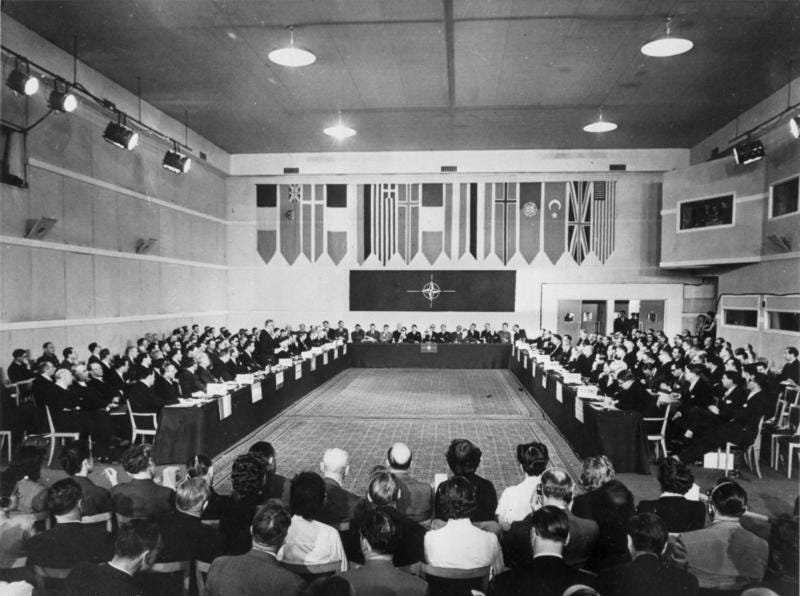
Article 5 is a fundamental provision of the North Atlantic Treaty, which established NATO in 1949. It really embodies the principle of collective defense, asserting that an armed attack against one or more NATO members is considered an attack against all members. Specifically, the article states:
The Parties agree that an armed attack against one or more of them in Europe or North America shall be considered an attack against them all...
In the event of an attack, each member is required to take "such action as it deems necessary, including the use of armed force" to restore and maintain security in the North Atlantic area. Importantly, however, Article 5 doesn’t dictate a specific type of response. Therefore, responses can range from direct military action to other forms of assistance, depending on the circumstances and the decisions of the member nations.
Interestingly, despite the numerous conflicts and confrontations during the Cold War, Article 5 has been invoked only once in NATO's history on September 12, 2001, a day you might be more familiar with as the day after 9/11/2001. The day after the September 11 attacks on the World Trade Center and the Pentagon, NATO invoked Article 5 for the first time, expressing solidarity with the United States. This declaration paved the way for NATO's involvement in the International Security Assistance Force (ISAF) in Afghanistan, a mission which aimed to combat terrorism and stabilize Afghanistan. But that’s a whole other thing!
The only U.S. state not located in North America

Now normally, continental boundaries don’t really matter all that much. And whether we have four, five, seven or even nine continents is really a matter for geography nerds like us to debate endlessly in our spare time. But sometimes it does matter, and in the case of Hawaii the definition of a continent matters quite a bit. While Hawaii might be a complete and full state as part of the United States, its geographic location in the middle of the Pacific Ocean actually means that its no longer defined as being in North America. And if you re-read the quote above, you’ll see it specifically only covers Europe and North America. It’s for this reason that French Polynesia, French Guiana, and the U.K.’s Falkland Islands are also not protected by NATO.
There are other reasons for why Hawaii is not protected by NATO though. In fact the United States actually kind of benefits from Hawaii not being protected by the military alliance.
Why Hawaii is not protected by NATO today
While Hawaii not meeting the definition of North America might be a bureaucratic reason to keep the island state out of NATO’s protective umbrella, there are other reasons as well. Some of these reasons are historic, but others focus on the way the U.S. views the Pacific theater and its position within the region at large.
NATO's territorial requirements
In 1949, the year NATO was founded, Hawaii was not yet a state. While it was an important territory for the U.S., its statehood only came a decade later, in 1959. When NATO's charter was drafted, the primary focus was on the immediate concerns of post-war Europe and the burgeoning Soviet threat. The territories and states of the continental U.S., Alaska, and the islands in the North Atlantic were the primary strategic concerns for a North Atlantic alliance. As such, being a territory, Hawaii was left out. As were Guam, American Somoa, the Northern Mariana Islands, and many territories of other NATO members as well.
Bilateral treaties and alliances in the Pacific
But while NATO is very important to the U.S., especially these days, the country, aware of the strategic importance of the Pacific, has established various bilateral agreements and alliances in the Pacific region. And it’s these commitments to Japan (under the U.S.-Japan Security Treaty), South Korea (the Mutual Defense Treaty), and other nations that serve as the backbone of its defense architecture in the Pacific. These arrangements address the specific geopolitical realities and threats of the region, offering a more tailored approach than a NATO-style multilateral alliance might provide. Bringing NATO into any potential conflict within the region could only exacerbate things within the Pacific.
Separate military commands
U.S. military strategy and command structures have historically treated the Atlantic and Pacific as distinct theaters of operation, each with their own challenges and requirements. And as NATO was being formed, military planners in the U.S. were more inclined to keep these theaters separate in terms of strategic alliances. This means that the the NATO-oriented arm of the U.S. military has not trained on the specific tactics that might be necessary in the Pacific. And the same could be said for NATO at large. Most European countries don’t have nearly the same adversarial outlook on China as the U.S. and therefor they don’t necessarily think of China as a potential military combatant in the same way the U.S., South Korea, Japan, Taiwan, Vietnam, and the Philippines do.
The unique geopolitics of the Pacific
Finally, the geopolitical situation in the Pacific is distinct from that of the North Atlantic. The rise of China, historical territorial disputes, North Korea's unpredictable behavior, and a host of other challenges require a different strategic approach. While NATO has evolved to address a range of threats beyond its original Soviet focus, its structure, and decision-making processes might not be agile enough for the Pacific's more nuanced landscape. Remember, NATO was born out of the need to have a unified front against a single, large enemy: the Soviet Union. But while China is a growing threat to the region at large, it’s also a major trading and diplomatic partner in ways that the Soviet Union never really was. This makes NATO uniquely unsuited for any potential conflict in the Pacific.
And while there are many bureaucratic reasons Hawaii is not in NATO today, it really boils down to the fact that Hawaii is very much part of the U.S.’s Pacific theater. If it were attacked, the country would absolutely respond in kind, and it would have other Pacific-oriented allies it could call upon to help protect it. While not a single, unified body like NATO, the Pacific has its own sort of umbrella defense.