

Why Haiti barely survives while the Dominican Republic thrives
How unlucky can a single country be?
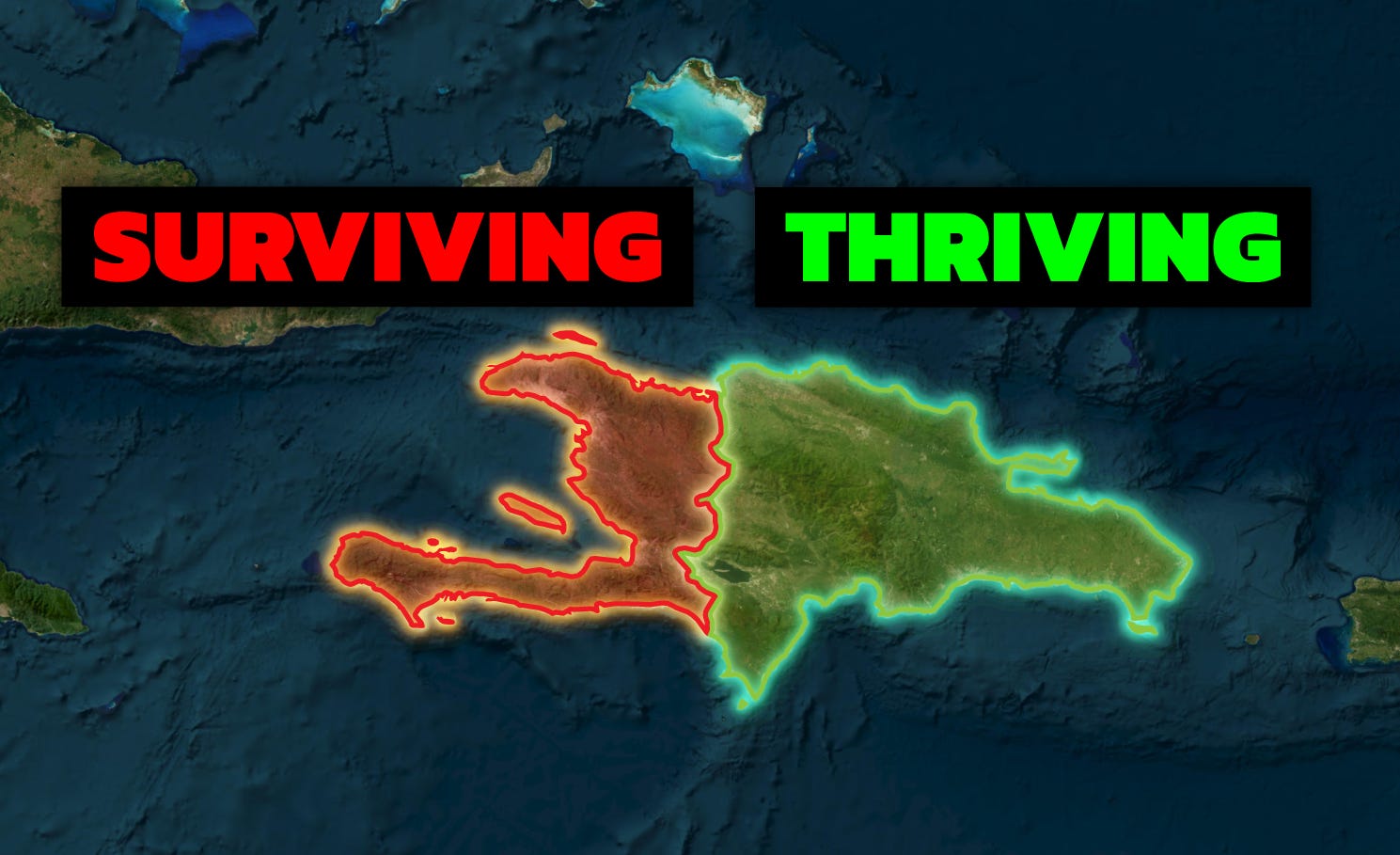
There are lucky countries in the world. Countries who happened to land upon a wealth of natural resources, happened to be in a spot where global trade flows through, or happened to steal as much land as possible at the exact moment in time to become a global empire. And then there are unlucky countries. Countries who just can never seem to get it going be that through external oppression or something else entirely. And then there’s Haiti. Haiti isn’t just an unlucky country. It is, perhaps, the unluckiest country in the world. A country who, at seemingly every turn throughout its history both as an independent nation and as a colony of France, has just never been able to make things work for the betterment of itself.
Which is weird because, Haiti is not an isolated country in a far corner of the world, completely out of the way of everything. Were that the case, Haiti would probably be much better off actually. No. What makes Haiti’s situation so bizarre is that it shares a rather large island with another, much, let’s say, luckier country: the Dominican Republic.
So why has Haiti failed so spectacularly over the decades, while the Dominican Republic has become one of the wealthiest countries in the Caribbean? Well, let’s go through some of the biggest unlucky strikes that Haiti has had to endure.
Unlucky strike #1: France
Okay so, despite sharing the same island, Haiti and the Dominican Republic are different from each other in almost every way imaginable. And many of these differences actually stem from the two countries’ split colonial history. But let’s go back in time… all the way to the original colonizer: Christopher Columbus.
The island of Hispaniola was first landed on by Columbus in 1492 (you all know the rhyme I won’t repeat it). And Columbus would actually set foot on what is today the northwest coast of Haiti. Which means, because Columbus was funded by the Spanish monarchy, he would claim the entire island for Spain. Never mind all those indigenous peoples living on the island who had been there for thousands of years prior. It was all Spain now.
Of course, being claimed by Spain was one thing. At this point in time Spain was busy gobbling up and slaughtering indigenous peoples all over the Americas. Which means they never really paid Hispaniola much mind. At least in the beginning. Instead Spain would treat it more as a backwater outpost to resupply Spain’s more lucrative colonies in central and South America. And this gave another European colonial empire an in to the lucrative markets of the Caribbean: France.
On the western half of the island, a region completely ignored by Spain, an “unofficial” French outpost would appear. Unofficial in quotes because a lot of things happening in the Americas was “unofficial” in that it wasn’t directly ordered but was instead highly encouraged. After French colonizers had success growing tobacco on their side of the island, many more French settlers began moving in, creating conflict with the Spanish who claimed the island to be theirs. In 1697, as part of the Treaty of Ryswick, which ended the Nine Years War in Europe, Hispaniola was officially split between France on the western part of the island, and Spain on the east.
From this point on, the two halves of Hispaniola would drift farther and farther apart.
You see, in the early 1700s, France was a far wealthier colonizer than Spain. And because of this, France imported hundreds of thousands of enslaved peoples from Africa to their side of Hispaniola over the course of just few decades. By 1788, Haiti’s population consisted of about 25,000 French citizens, 22,000 free multi-racial peoples, and over 700,000 slaves. By contrast, in the colony that would become the Dominican Republic, there were approximately 38,000 Spanish citizens, 38,000 free multi-racial peoples and fewer than 15,000 slaves. And this disparity in the amount of slaves would directly lead to Haiti becoming one of the wealthiest colonies in the world, and the wealthiest colony in the French colonial empire. By 1800, Haiti accounted for fully half of France’s foreign profit due to its sugar plantations. Which were only so profitable because of the slave labor involved.
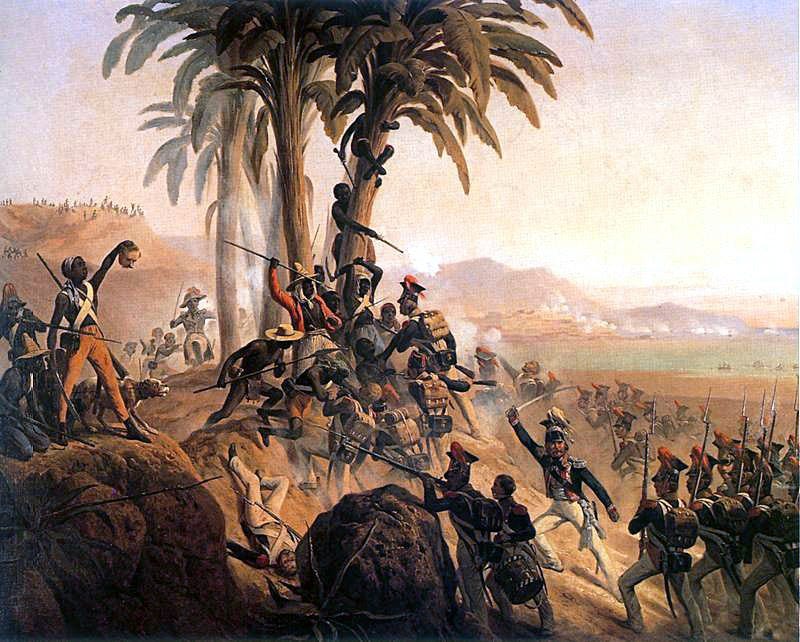
But this wealth didn’t flow to anyone but the French citizens. Certainly not the enslaved peoples. And, even worse, this was a brutal regime. Not that any slavery is good, but the stories uncovered by French slavers in Haiti are easily some of the most heinous, most tragically horrifying you’ll find. Which also means, after a long time of brutal oppression and slavery, the slaves would finally rise up and fight back and win their freedom in the early 1800s. But while victorious and now free, the repercussions would would be severe. France, it turns out, was very vindictive.
You see, Haiti, being a former slave colony that revolted and won its freedom, would be ostracized by both European and American government and business interests who didn’t want a former slave colony to succeed and give ideas to other regions around the world. And so, in order to eventually gain recognition, Haiti would agree to pay France 150 million Francs, a debt that it was never able to fully repay, but would irreparably damage the economic prospects of the new country.
On the other side of the island, the Spanish colony would remain relatively benign through much of this period. And because it wasn’t really managed all that much by Spain, the newly independent Haiti would actually take over the entire island of Hispaniola from 1822 to 1844. And during this rule, Haiti would tax the Dominican side of the island heavily in order to repay its French debt. This would inevitably lead to a second war for independence on the island, only this time from Haiti. By 1856, the Dominican Republic was its own country and the two halves of the island were finally settled. Haiti on the western 1/3rd and the Dominican Republic on the eastern 2/3rds.
But here’s the thing: while this is a single island, the two parts could not be more different from each other geographically.
Unlucky strike #2: The western half

Separating Hispaniola and the two countries from one another is a series of mountain ranges that effectively split the country in half geographically. And this has huge ramifications for how the two sides of the island function. On the eastern, Dominican side, storms blows in from the east bringing rain and precipitation to create a lush tropical forest. But because of the mountain range, Haiti exists in what we call a rain shadow wherein much of that rain and precipitation doesn’t actually make it over to them. So this means that Haiti is actually quite dry relative to its island neighbor.
And this has had a huge detrimental effect on the land itself. When it was a French slave colony, France embarked on a massive deforestation plan in order to ship lumber back on the very slave ships that brought over Africans. Gotta make money both ways, right? But because Haiti is much drier, it hasn’t been able to regrow its forests in the same way that the Dominican side has.
This obviously has had a cascading affect on the country as a whole. Less rain, means less vegetation. Less vegetation means less agriculture. Less agriculture means you have to buy more food from abroad leaving less money for infrastructure. And so on.
Which means Haiti’s infrastructure, in the best of times, isn’t great. Unfortunately, for Haiti, bad infrastructure doesn’t hold up well if you’re in a particularly shaky part of the world.
Unlucky strike #3: the Enriquillo fault
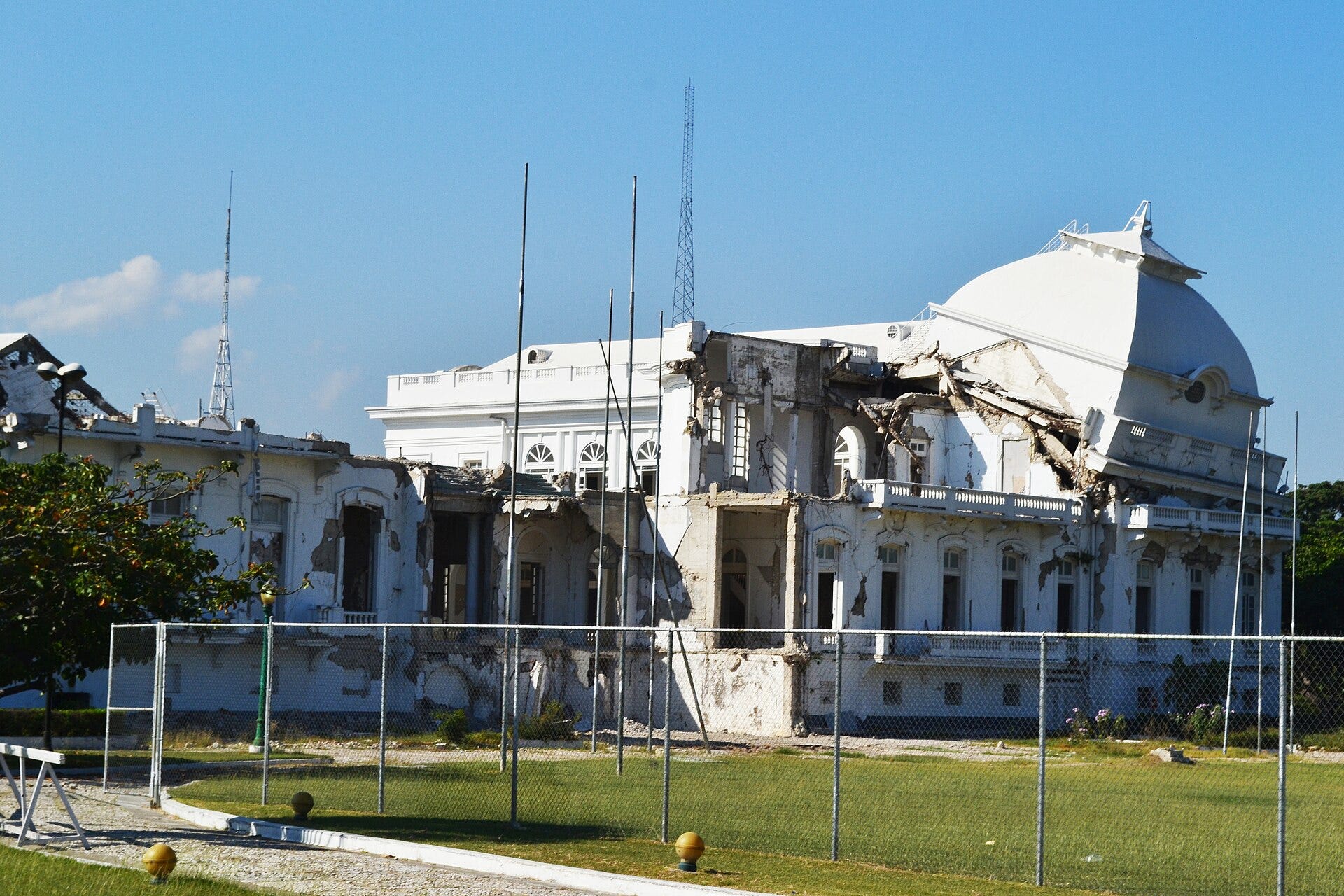
Haiti is the unlucky home of a particularly seismically active region we call the Enriquillo Fault. This exact region has been a consistent wrecking ball to Haiti throughout its existence. And while the Dominican Republic does host its own fault line, that specific fault has been much less active and runs through a region of the Dominican Republic that has far fewer people.
So, over its entire existence, Haiti has been subjected to frequent, large earthquakes that have consistently been something of a wrecking ball to its infrastructure. And then, in 2010, the country was struck by a 7.0 earthquake near Port-au-Prince, its largest city and capital. And because of wild mismanagement by previous rulers, the country was ill prepared to deal with such a large earthquake. Buildings came crumbling down and and estimated 300,000 Haitians are thought to have perished. This would be followed a decade later by another devastating earthquake that would hit the southwest part of the country.
So, with two major catastrophes so close to one another, the country sunk into its current state today. Still, after nearly have a decade since the last earthquake, Haiti is hanging on by a thread. But, at the same time, the Dominican Republic has done quite well for itself!
Haiti and the Dominican Republic today

Today, the two countries really could not be more different from each other in terms of stability and wealth. And while the Dominican Republic has had its own dealings with dictatorships in the past, its end result has been much different. The Dominican Republic has been able to diversify its economy and bring in a lot more money than its neighbor. As of 2025, the Dominican Republic had a GDP of about $353 billion with a per capita GDP of over $32,000. Meanwhile, Haiti has a GDP of about $38 billion with a GDP per capita of just $3,000. That’s an incredible difference! The Dominican Republic is nearly 10 times wealthier than Haiti. This is despite both countries having a very similar population (each are a bit of 11 million).
And I’ll grant you that GDP isn’t a great measure of “on the ground” success because wealth is rarely spread equally. But by every metric the Dominican Republic is doing very well for itself in 2026. But Haiti, as of 2026, is probably worse than its ever been in the modern era. There’s just no letting up for the country. And that’s incredibly sad because, if Haiti would just be able to catch a break, I believe its unique culture would truly thrive.
Maybe in the 2030s…