

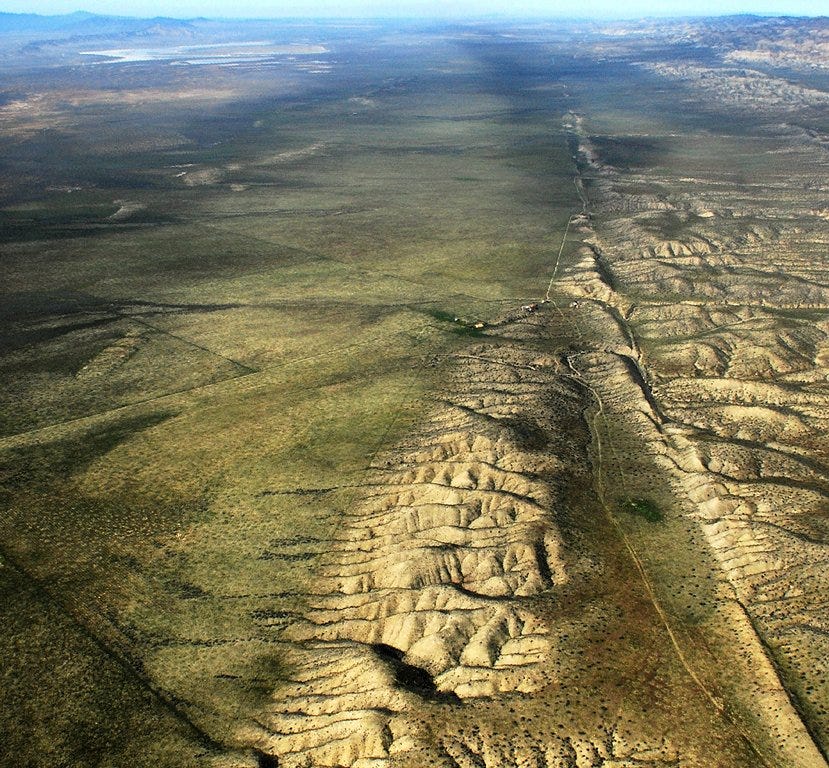
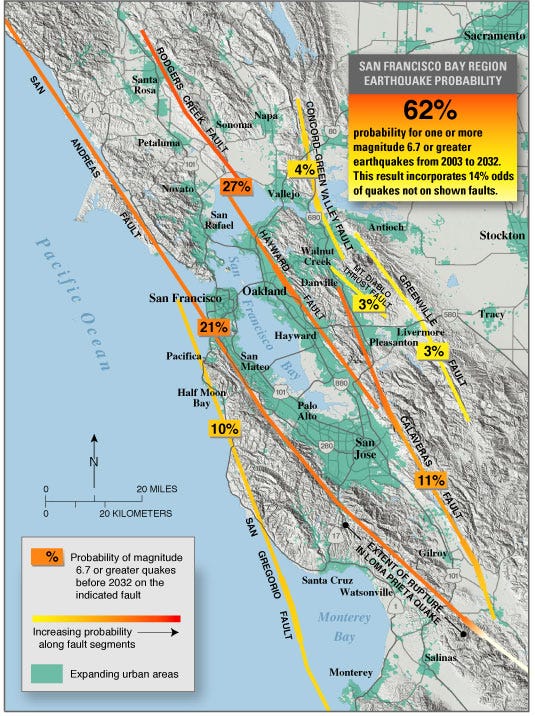
A few weeks ago a 5.6 earthquake rattled northern California in Mendocino County. If you’re not at all familiar with the San Andreas fault line, it basically runs most of the length of the state, from near the border with Mexico and all the way up to, well, Mendocino. Which means a place like Mendocino has a relatively high likelihood of getting hit by an major earthquake. But this earthquake wasn’t a big one. It was a medium one at best. There was some light damage, a few people were injured, but overall nothing major. Which is weird because… haven’t we been predicting the “big one” to hit California for what feels like decades?
The answer to that question is: yes, we have. In fact, in 2006 a study was released by the Scripps Institution of Oceanography that found that the amount of stress placed on the San Andreas fault line had reached a high enough threshold that a major earthquake (7.0+) was likely in the near future. In particular, the southern part of it (so not near Mendocino) was considered to be the area that was most likely to get hit if a major earthquake ever did rip.
Of course, 2006 was 20 years ago. And while they didn’t necessarily predict an exact date and the earth does move pretty slowly as far as our timeline goes, it still begs the question: where is California’s long predicted but completely missing major earthquake? Well, as it turns out, we do kind of have an answer to that. Or at least a theory.
The Salton Sea

So there are many theories out there that consider the delay in a major earthquake hitting the San Andreas fault. These include simply probability variables (not enough time, etc) to minor earthquakes releasing stress at key locations. But among these factors, the drying up of the Salton Sea has emerged as the most intriguing explanation in my opinion. Mostly because the Salton Sea is was entirely made by accident!
The Salton Sea, California’s largest existing lake, was formed in 1905 when a breach in the Colorado River irrigation canal system allowed water to flood into the Salton Basin. Over the years, the Salton Sea became an important ecological and recreational area, but today it’s shrinking steadily due to a combination of factors, including reduced inflow from agricultural runoff, increased evaporation rates, and water diversions for urban use. And while the drying up of the Salton Sea has had significant environmental impacts on the region at large, such as increased dust pollution and loss of habitat for migratory birds, it may also be playing a role in the region’s seismic activity.
You see, one of the reasons why the “Big One” hasn’t struck yet could be linked to the changing conditions around the Salton Sea. As the lake dries up, the weight of the water that once occupied the basin is significantly reduced. This reduction in pressure could potentially alter the stress distribution along nearby fault lines, including the southern section of the San Andreas Fault. Some scientists theorize that the decreased pressure could either delay or trigger seismic activity, depending on the complex interactions between the fault system and the changing weight of the Earth’s crust in the region.
Additionally, the shrinking Salton Sea has exposed new areas of the Earth’s crust, which could also influence local seismicity. The region around the Salton Sea is geologically active, with numerous faults and geothermal activity. As the water recedes, the Earth’s crust might be adjusting to the changing conditions, potentially releasing stress in ways that could either delay or precipitate earthquakes. This process, known as “post-glacial rebound” in other contexts, could be similar in principle, where the Earth’s crust slowly responds to the removal of large amounts of water.
Of course, this is just one explanation. It’s my personal favorite, but there are other factors at play too.
For one, earthquakes don’t occur at precise intervals but rather as a result of accumulated stress along fault lines reaching a critical threshold. So, while the southern San Andreas Fault is considered overdue for a major earthquake based on historic patterns, the exact timing remains uncertain. This unpredictability is due in part to the complex interactions between multiple faults in Southern California, including the San Jacinto, Elsinore, and Imperial faults, which can transfer stress and influence each other in ways that are difficult to predict. In 2019, a series of powerful earthquakes known as the Ridgecrest Earthquakes, struck in the eastern California Shear Zone. And this may have an impact on when the “Big One” eventually unleashes.
Moreover, recent research has suggested that smaller seismic events, known as “slow earthquakes” or “aseismic creep,” may be occurring along portions of the San Andreas Fault. These slower movements release stress gradually over time without producing a large, destructive earthquake. If this process is happening to a significant extent, it could also help explain why the Big One has not yet occurred, as the fault may be slowly relieving some of the stress that would otherwise build up and result in a major quake.
Finally, in addition to these geologic factors, human activities may also be playing a role. The extraction of groundwater, oil, and gas in Southern California can cause subsidence and potentially influence seismic activity by altering stress conditions in the Earth’s crust. And while the direct link between these activities and the delay of the Big One is not yet fully understood, they represent additional variables in an already very complex system.
The drying up of the Salton Sea, therefore, is just one piece of a larger puzzle that includes natural seismic cycles, geologic processes, and potentially human influences. So while it may be easy to write off scientists predictions of a “Big One” hitting California in the near future because it simply hasn’t materialized yet, the reality is that there are so many incredible variables at play that impact a fault like the San Andreas because it’s a land based fault line. And that means we humans have an outsized impact on it as compared to something like the Cascadia Subduction Zone which lies under the ocean.
I'm so glad you're following this. (Yeah, I know; among scores of others.) I lived in the Monterey Bay area from 1987 - 2021, in a Santa Cruz mountain town 10 miles from the epicenter of the 1989 Loma Prieta earthquake (6.9). That one took out a nice chunk of downtown Santa Cruz, up through the Bay Bridge and environs. We joke about the whole Left Coast tumbling into the ocean one day, but it would be beyond catastrophe.
Hey Geoff. I always find your stuff interesting. Re CA and aseismic creep, you should have mentioned Holister, CA … the earthquake capital of the state. Hollister averages around 26 earthquakes per month (magnitude 2.0 or higher), and up to 175 quakes per month across all magnitudes. Because it sits directly on the Calaveras Fault, the city experiences over 2,100 total tremors a year, though most are too small to be felt by residents.