

Why Amtrak failed
Is it the geography?

Let me get to this real quick: I love Amtrak. I’m a big train guy. I’ve ridden Amtrak across the country twice, from Chicago to Portland and from LA to Portland. I’ve also taken my regional train (the Amtrak Cascades) multiple times and will be doing so again in a couple weeks. Needless to say, I don’t have a problem with Amtrak. But that also doesn’t mean Amtrak has been a success. In fact, by any meaningful metric, Amtrak is a failure.
This is weird because, despite the common idea that the United States is simply too big to have successful passenger rail (hello… China?) the U.S. pioneered long range rail transportation in the 1800s. How could a country go from creating the transcontinental railroad, connecting the Atlantic and Pacific coasts of the United States, to a country where going from Denver to Albuquerque requires a transfer in… Chicago.
Well let’s go back in time a bit and see how this all played out. Back to before Amtrak was ever a thing.
Passenger rails’ rise and fall
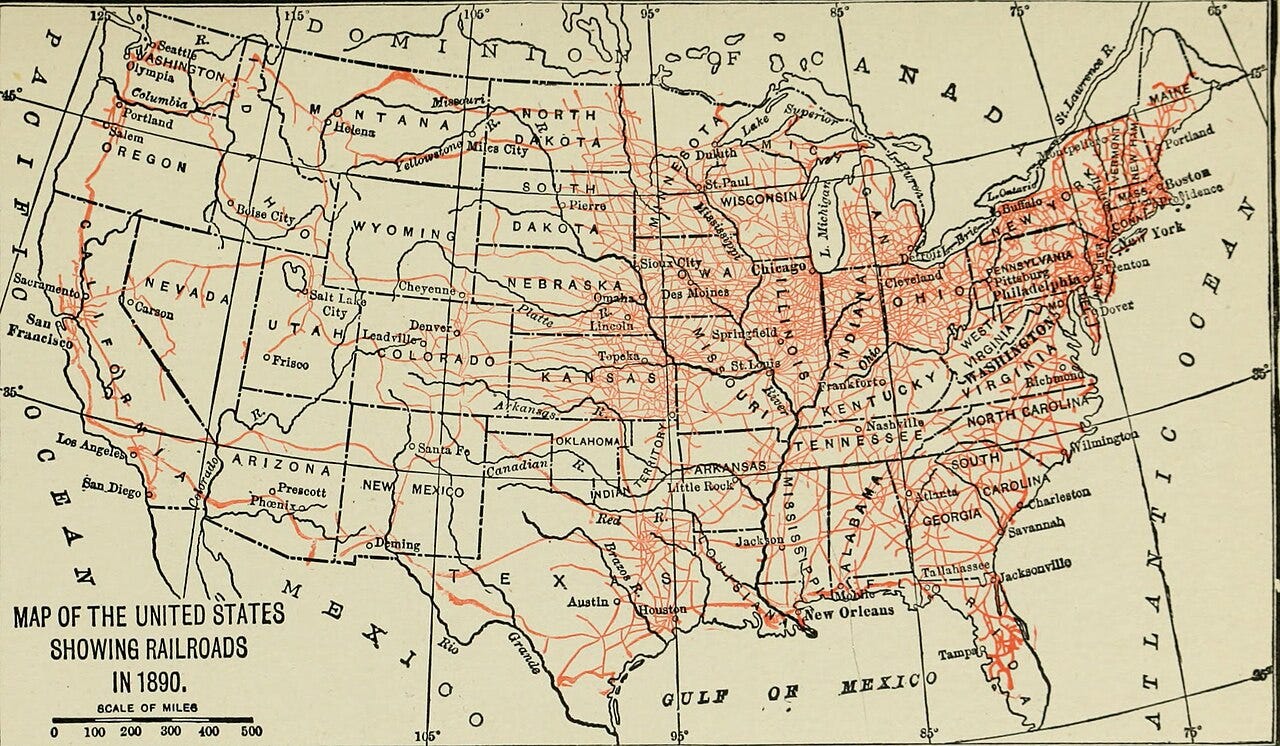
From about 1850 to 1920 the country raced to connect cities, towns, and rural areas by rail, in the hopes of pushing people west. At the time, railroads offered an unprecedented level of mobility, making cross-country travel not only possible but relatively efficient compared to earlier methods like stagecoaches. It’s hard to imagine now, but a trip across the country dropped dramatically from a 6 month, hard journey to a single week riding on a train. By the 1900s, the United States boasted one of the most comprehensive passenger rail systems in the world, with nearly every corner of the country accessible by train. I mean, at this point in time, it was the envy of the modern world. And it wasn’t just major city to major city, either. Small towns connected to other small towns which connected to medium cities which connected to major urban centers. It was vast.
Unfortunately, as the automobile industry expanded and air travel became more accessible, passenger rail began a steep decline in the United States. The rise of the Interstate Highway System in the 1950s, along with increasing car ownership, diverted travelers away from trains. And airlines, subsidized through government investments in airports and air traffic control, offered faster alternatives for long-distance travel. By the 1960s, passenger railroads were losing money, and private companies—originally responsible for passenger service—began cutting routes and focusing on freight, which was far more profitable.
Because of this, the federal government stepped in 1971 and consolidated almost every passenger rail line in the country into a single unified service: Amtrak. This sounds nice, but the reality was daunting. The new semi-public corporation inherited a patchwork of aging equipment and routes, and it lacked ownership of most of the physical rail lines. Instead, these tracks remained in the hands of freight rail companies, which prioritized their own cargo operations over passenger trains. This meant Amtrak had to negotiate access to rail, often relegating its trains to secondary priority, resulting in delays and limited expansion opportunities.
While some routes, like the Northeast Corridor between Boston and Washington, D.C., remain competitive with high ridership, much of its network serves less populated areas with infrequent service. The dwindling level of connectivity and the lack of investment in passenger rail have left large swathes of the country without viable train options, reflecting a stark contrast to the golden age of rail travel.
Amtrak in 2026

Amtrak today operates as the almost sole provider of passenger rail in the United States, managing a network that spans over 21,000 miles and connects more than 500 destinations across 46 states. That sounds nice, but despite this extensive reach, the reality is far less comprehensive than it appears. In reality, Amtrak isn’t all that accessible for much of the country and traveling by rail remains an afterthought in the vast majority of Americans’ travel plans, overshadowed by air and road options. Compare Amtrak to China which has 28,000 miles of high speed rail, or Europe with over 125,000 miles of passenger rail (much high or higher speed) and you can begin to see where Amtrak doesn’t hold up.
That’s not to say Amtrak is completely bereft of competitive service. The Acela Express (maybe just Acela now?), serves the densely populated northeast corridor and seems to run pretty well! In 2024, nearly 3.3 million people rode the Acela which is an extremely impressive number! To put this in perspective, the air route with the most annual ridership is between Atlanta and Orlando with about 3.5 million. But remember Acela is the exception in this case, not the rule. The vast majority of its regional routes get fewer than 500,000 annual riders with some getting fewer than 100,000. That’s pretty bad!
Meanwhile, iconic long-distance trains like the California Zephyr and the Southwest Chief offer scenic journeys but struggle with delays due to their long routes and even more limited ridership. The highest performing long distance route is the Silver Star between New York City and Miami and had only 388,000 riders in 2024.
Because of this Amtrak has begun charting a course for its future. Its ambitious “Amtrak Connects Us” plan aims to expand service to 160 new communities by 2035, adding over 30 new routes and improving service on existing ones. Proposed expansions include new corridors connecting cities like Atlanta and Nashville, Phoenix and Tucson, and Cleveland and Columbus, addressing gaps in the current network. Additionally, projects like the Gateway Program, which focuses on modernizing the critical rail infrastructure between New Jersey and New York, promise to improve reliability on one of its busiest corridors.
Unfortunately, for all its aspirations, Amtrak remains a system defined by compromise. And this is largely due to a combination of problems! But primarily, it’s the vast geography of the United States that presents the biggest obstacle.
It’s not Amtrak’s fault… mostly
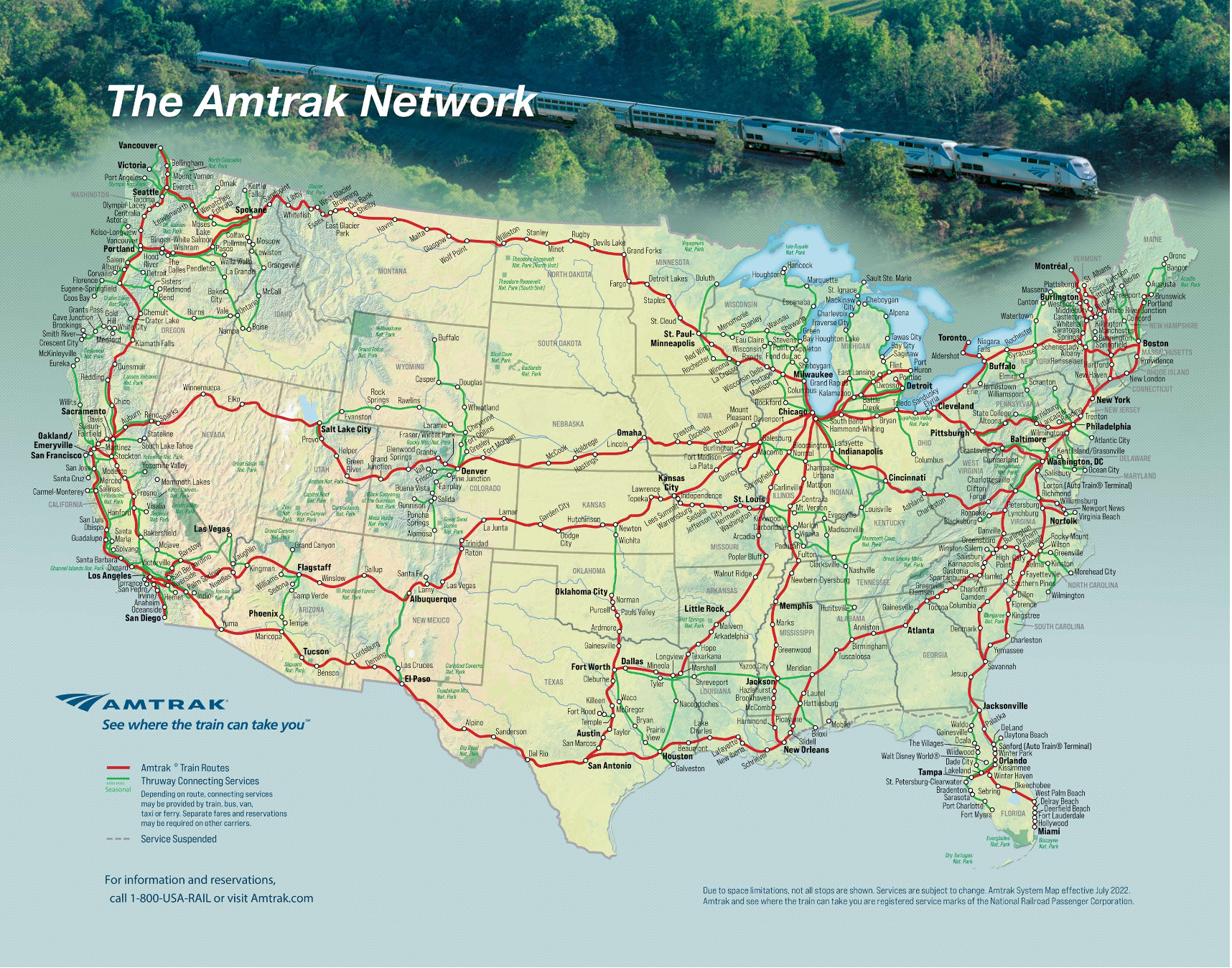
A common refrain among critics of Amtrak is that the United States should be able to replicate China’s success in building a high-speed rail network. After all, in 2008 China had just four short high speed rail lines, none of which were connected to each other. But by 2017, almost every major city in China was directly connected to each other by high speed rail. This dramatic transformation seemed impossible when China laid out its plans, but they proved that it was, in fact, very doable. Compared to Amtrak, which hasn’t introduced any new routes on the tracks it fully owns, and you can clearly see the big difference between the two countries.
Now, on the surface, the comparison seems reasonable, both countries are basically the same physical size, with sprawling populations and growing transportation needs. However, the similarities end there in my opinion. Mostly because the population density of the two countries is very different! At present the population density of the United States is just 91 people per square mile whereas China boasts a population density of 390 people per square mile. In essence, China is about four times as dense as the United States!
Moreover, while China’s high-speed rail network is indeed a remarkable feat of engineering, it’s primarily concentrated in the eastern half of the country, where the vast majority of its population resides. Western China, with its deserts, mountains, and very sparsely populated areas, has far fewer lines, reflecting the economic and logistical realities of building rail infrastructure in less dense regions.
In contrast, the United States’ population is more evenly distributed, with nearly a fifth of its population residing west of the Rockies. This means that China’s already far denser population, is, in actuality, far more dense when you just look at where its population lies. If we remove Xinjiang, Tibet and Qinghai from China based on their very low populations, China’s population density rises to over 600 people per square mile. Which means, it’s far easier to connect the overwhelming majority of China’s population than it is in the United States.
But the United States has another problem: the physical geography of the country presents a major challenge in building high speed rail. The western half of the country is dominated by the Rocky Mountains, vast deserts with their own mountain ranges, and then, of course, the coastal mountain ranges. These features make constructing and maintaining rail infrastructure both costly and complex. While historic railroads managed to carve routes through these formidable landscapes, those lines were designed primarily for freight and slower, scenic passenger travel, not the high speed and efficiency required by modern rail.
But even in the eastern half of the United States, where population density is higher, the challenges of creating a cohesive rail network persist. You see, unlike in China or even Europe, property rights in the United States are incredibly strong. For new track to be laid, Amtrak would need to buy the land from a vast swath of different people with different interests. And this often balloons costs in the best scenarios, and outright stalls development in the worst, such as when one property owner simply doesn’t want to sell their land for a train. Now imagine Amtrak building a line from the east coast to the west coast. Simply navigating property rights makes the problem exponentially more challenging.
Of course, Amtrak does operate several routes that connect the coasts, such as the California Zephyr and the Southwest Chief, but these long-distance lines are poorly integrated with each other mostly because they rely on freight-owned tracks. Because of all this, the future of rail in America likely doesn’t lie with a single national carrier like Amtrak. Amtrak is spread too thin, with far too few resources, under a geography that is both politically challenging, economically impossible, and physically unforgiving.
Amtrak was created to solve a problem: stop the hemorrhaging of privately run passenger rail routes. In that problem, it’s actually been a success! There’s even new privately run and state run rail lines being built out today (Brightline and California High Speed Rail). So maybe it’s a bit harsh saying Amtrak failed. But, as a national rail transportation carrier, Amtrak has definitely failed at being a viable third option for transportation. Even for myself, a train fan who loves taking trains as often as possible, I find it hard to justify the expense and time required to go to the limited places available.
I’m riding The Crescent in September for the second time more than a decade after my first trip. I’ll make a note to try and report on that experience.
Excellent post 🙏
Geography is destiny in so many ways: trying to wrangle passenger rail in Canada is an even bigger challenge, for precisely the same reasons (though if we ignored everyone >100km from the US border, it starts to look conceivable again.
The question I have for you & for @wallsandbridges is whether a well-designed intermodal higher speed cargo + passenger service expansion might be more economically feasible in either the US or Canadian contexts — let’s assume for the sake of it that each car (whether passenger or cargo) is a self-contained electric locomotive, allowing for individual cars to shunt themselves (as a physicist by education, I am compelled to refer to this as a “spherical train car” 😊).
I’d love to hear your thoughts …