

Why almost nobody lives in Mongolia
It controlled the world at one point

I just did a huge deep dive on Mongolia. Like just the other day. Mostly because I had to write a script for a facts video we’re going to make about Mongolia in the next few weeks. But also because, more than almost any other country, Mongolia just fascinates the hell out of me. It’s one of those places that’s kind of easy to forget about until you see it on a map and you’re like “what goes on in Mongolia?”
Anyways, this article isn’t about Mongolia broadly and how fascinating I find it. I’ll have a whole video dedicated to the country soon and you can watch it here ad and sponsor free if you’re a paid subscriber! Or over on YouTube if not. This article is about one aspect of Mongolia that I don’t really talk about in the video: Mongolia’s absolutely insane population sparsity. Or rather the lack of population density.
If you didn’t know any better, Mongolia, as of today, in the least densely populated country in the world with just 2.2 people per square kilometer (5.7 people per square mile). To put that in perspective, your average American suburb (so not even a core city) has a population density of somewhere around 1,000 people per square kilometer (2,700 people per square mile). And this is for a WHOLE country.
And yes, technically there are other political units with fewer people. Greenland would be have the lowest population density in the world at 0.026 people per square km (0.067 per square mile), but Greenland isn’t technically its own country. It’s part of the Danish Realm. Same with the Pitcairn Islands and Falkland Islands with the UK and Western Sahara with… Morocco I guess? Their situation is complicated. All this is to say, the next nearest actual country would be Australia (who knew?) with nearly twice the population density.
So, Mongolia is definitely unique here! I’ve made a living out of explaining why places are seemingly empty and devoid of major population centers. Usually this comes with a huge caveat that goes something like: “there actually ARE people living here, this is just relative to its region or neighbors or x, y, z” and so on. But in Mongolia’s case, it really is a mostly empty country and that’s kind of weird when you think about it.
But let’s not just think about it, let’s actually dig in and figure out why Mongolia is so empty!
Agriculture is everything
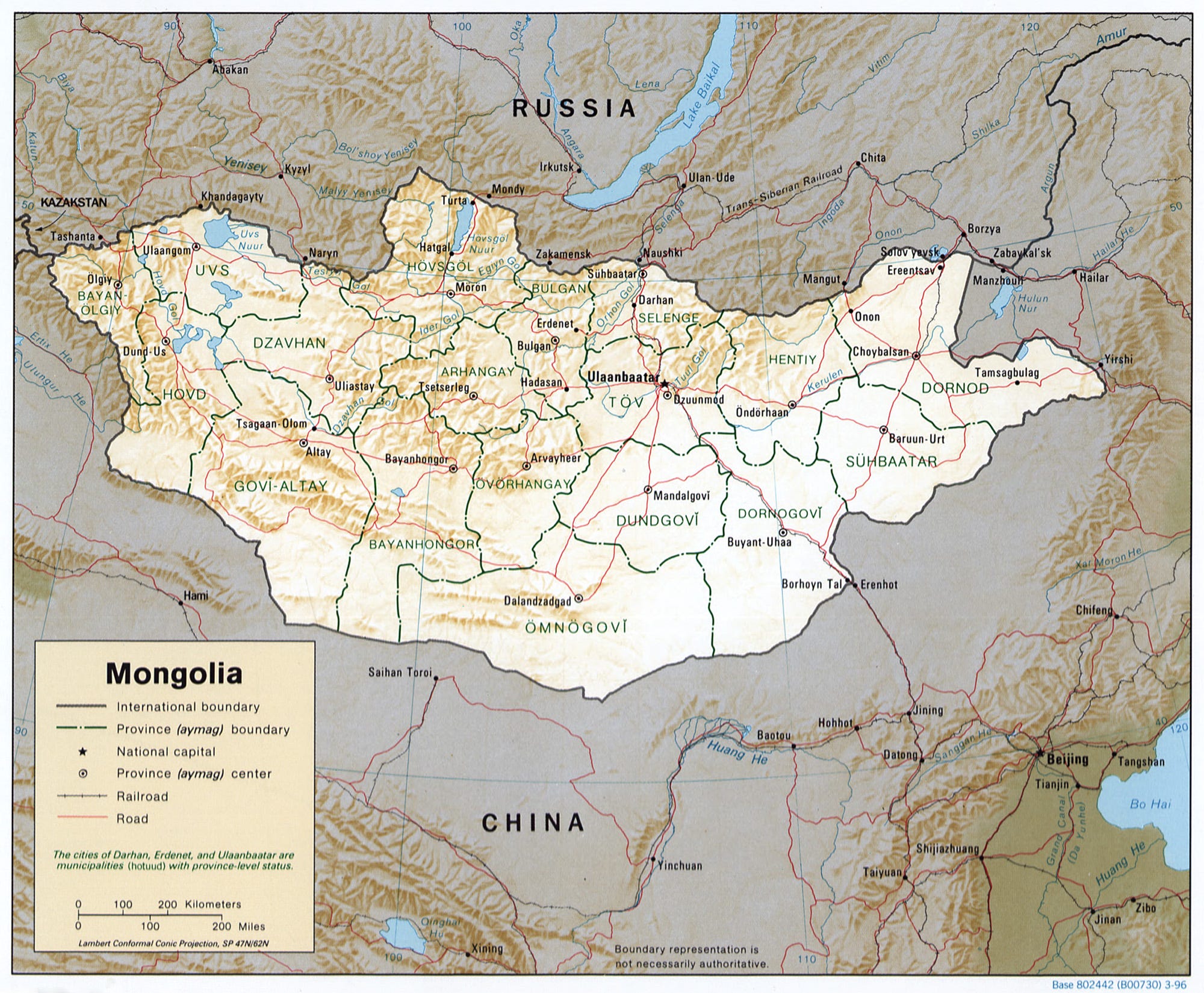
Okay so, first off, let’s talk about the land that Mongolia lives on. There’s no better way to explain this than if you were playing a city-building video game, Mongolia is the map you choose when you want to play on “Expert Mode.” Because, at the end of the day, the real killer for population density here is the dirt. Or rather, what you can’t grow in it.
You see, historically, population booms require one fundamental thing: a massive surplus of calories. You get that through large-scale agriculture. Think about how the introduction of the potato changed the population of Ireland as an example. Unfortunately for Mongolia, less than 1% of the land is arable.
In the south, you have the Gobi Desert, a massive expanse of rock and sand where surface water is basically non-existent. In the north and west, you have rugged mountains. The rest of the country is the steppe which is basically just grass. Now, grass is great for feeding animals, but terrible for feeding humans directly. And because they couldn’t farm, the people who settled this land had to rely on animals (horses, sheep, goats, camels, and cattle) to turn that grass into meat and dairy.
And that dictates a very specific lifestyle: you have to keep moving to find fresh pasture. Which means, historically, you can’t build a city of a million people when your food supply constantly has to walk to the next valley over.
But here’s the thing: at one point Mongolia was the most powerful country on the planet. Surely, even back then, they could have diverted endless resources to their home, right?
Why didn’t the Empire build a mega-capital?

In the 13th and 14th centuries, Genghis Khan and his successors conquered the largest contiguous land empire in human history. To this day it has not been matched! It stretched from the Pacific Ocean in the east all the way to Eastern Europe around the Danube River. Of course, how much the actually controlled is always up for debate. Regardless, it was still a lot of land and a lot of power. And you’d think that with all the power, wealth, technology, and enslaved artisans pouring in from conquered empires, the Mongols would have built an ancient mega-metropolis back home, right? That’s what Rome did. That’s what London did. I mean, pick an ancient or even modern empire and you can find the playbook!
But the Mongols simply didn’t operate that way.
Even at the absolute height of their global dominance, the Mongols were fundamentally nomadic. They did build a capital city, Karakorum, but it was largely an administrative hub and a massive pavilion of tents rather than a sprawling stone metropolis. It turns out, when you’re a nomadic warrior culture, wealth isn’t measured in real estate or even gold, it’s measured in livestock, silk, mobility, and military power.
More importantly, the harsh geography of the Mongolian steppe hadn’t changed. Even with all the wealth in the world, the land back home couldn’t support a massive, sedentary population of millions. And once the empire eventually fractured and fell, the Mongols who returned to the steppes simply reverted to the only lifestyle that made sense for the geography: nomadic herding.
An empty country and a crowded city

Fast forward to today, and that ancient nomadic DNA is still very much alive. A staggering 30%-ish (estimates vary because… of course it’s hard to track nomads) of Mongolia’s population still lives a nomadic or semi-nomadic lifestyle. They live in yurts (where they call gers), moving their herds across the open steppe with the seasons just as their ancestors did centuries ago. I mean, you can’t have a densely populated country when a third of your citizens require vast tracts of open land just to survive. The population math isn’t mathing.
But there is one final, fascinating twist to Mongolia’s population sparsity: the Soviet era and the rise of the ultimate “primate city.” Which, if you’re unfamiliar with the concept, a primate city is just as it sounds: it’s a city within a political unit (most often a country) that takes up the majority of the economic output, population and cultural influence. Mexico City is considered one the prime examples. But Ulaanbaatar is probably the most poignant.
During the 20th century, Mongolia was heavily influenced by the Soviet Union, which pushed for industrialization and urbanization. This led to the rapid expansion of the capital city, Ulaanbaatar. Today, this creates one of the most bizarre demographic anomalies on the planet.
Mongolia has a total population of about 3.4 million people. Almost half of them live in Ulaanbaatar. Think about that for a second. Almost half of an entire country’s population is within one city. This might make sense for some micro-states like Singapore, but for a country as large as Mongolia… it’s staggering! This would be like if 160 or so million people in the United States lived in New York City.
At the end of it, it all comes back to urbanization. When you look at Mongolia’s staggeringly low density, it’s not because people are spread thinly and evenly across the entire map of Mongolia. It’s because half the country packed up and moved into Ulaanbaatar, while the other half is constantly on the move across a landmass larger than the UK, France and Germany combined.
So, yes, Mongolia is practically empty. And in many ways, its emptiness is surprising! Typically large, empty countries, tend go the way of the do-do bird and fall into control by a larger rival power (China or Russia for example). After all, how do you protect and hold on to land when you physically don’t have enough people to protect it? Well, that’s a story for another day. But don’t worry… Mongolia is perfectly safe!