


Today’s article is brought to you by a recent warning by the Canadian government: do not travel to certain states in the United States if you identify as LGBTQ+. It’s a little more nuanced than that, but not by much. Regardless, this got me thinking about how quickly the map can change for those who identify as LGBTQ+ as they prepare for their summer travel plans. So let’s take a look at the evolution of countries and places that once were safe to travel to but no longer are, and vice versa!
Now, there are a lot of ways you can measure this. But to keep it relatively simple for this article, I’ve chosen to go with the presence of “public morality” laws that target non-traditional sexual relations. These would be laws that make something like flying a rainbow flag an illegal propaganda act. There are other ways to measure this, of course, but I feel like these laws serve as a good barometer for where the world is heading, unfortunately.
Also side note here: I just want to call out the privilege that someone like myself has when I go traveling. There’s not really a need to study the ever shift politics of a region and how that affects my safety.
Okay let’s get to the list, starting with data from the year 2003!
2003
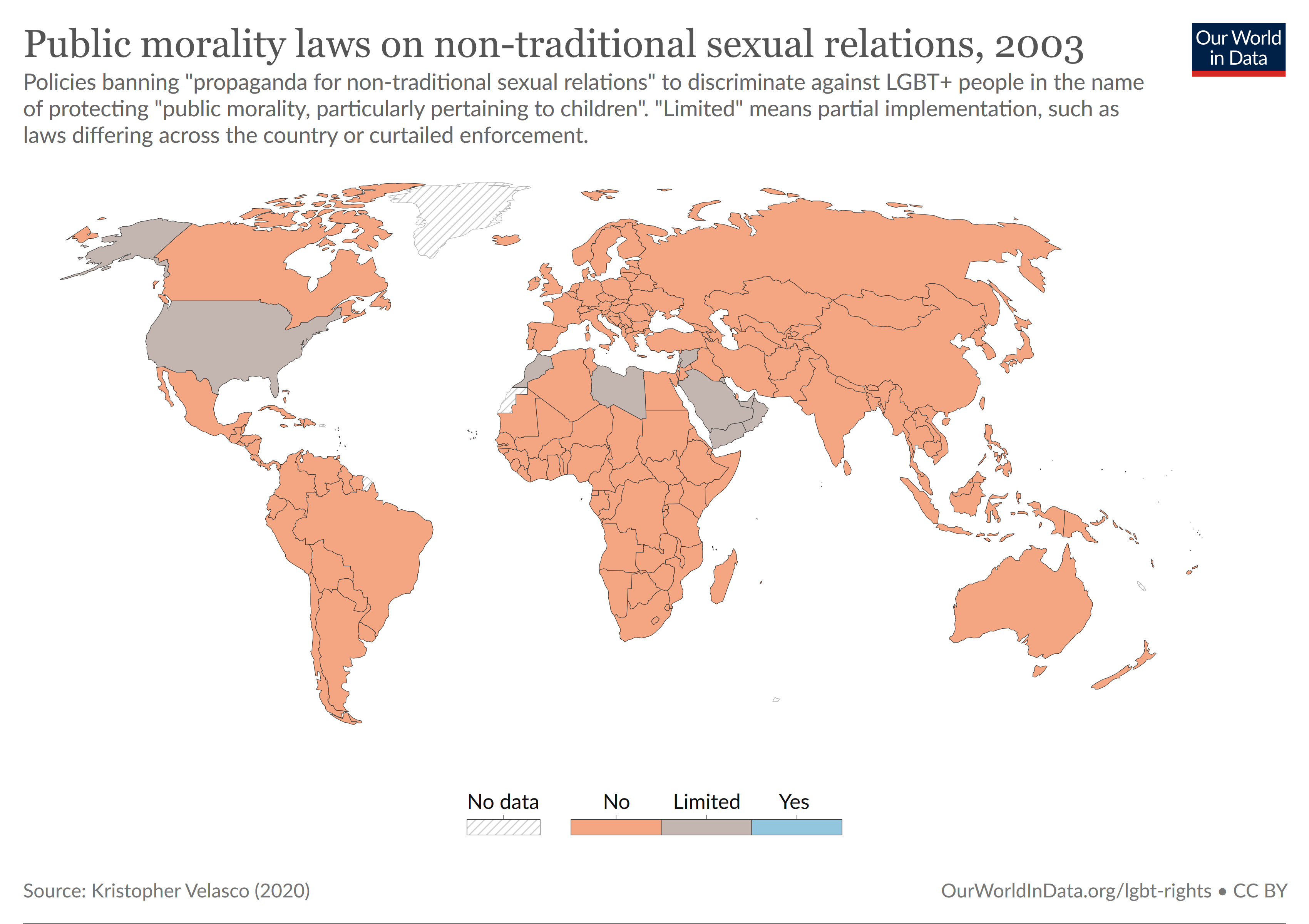
Back in 2003, the world was relatively innocent in this area. While I’m sure LGBTQ+ people wouldn’t feel safe in many countries listed here that otherwise don’t have laws banning their right to be themselves, it’s at least nice to know that there weren’t all that many laws outright banning things like a rainbow flag.
The United States, probably to nobody’s surprise, will be an ever present country on these maps. Given the country’s unique state system, some states have had public morality laws on the books for decades or even centuries and they’re applied to large swathes of people until the Supreme Court strikes them down. So yesterday, people of color, today LGBTQ+.
2008
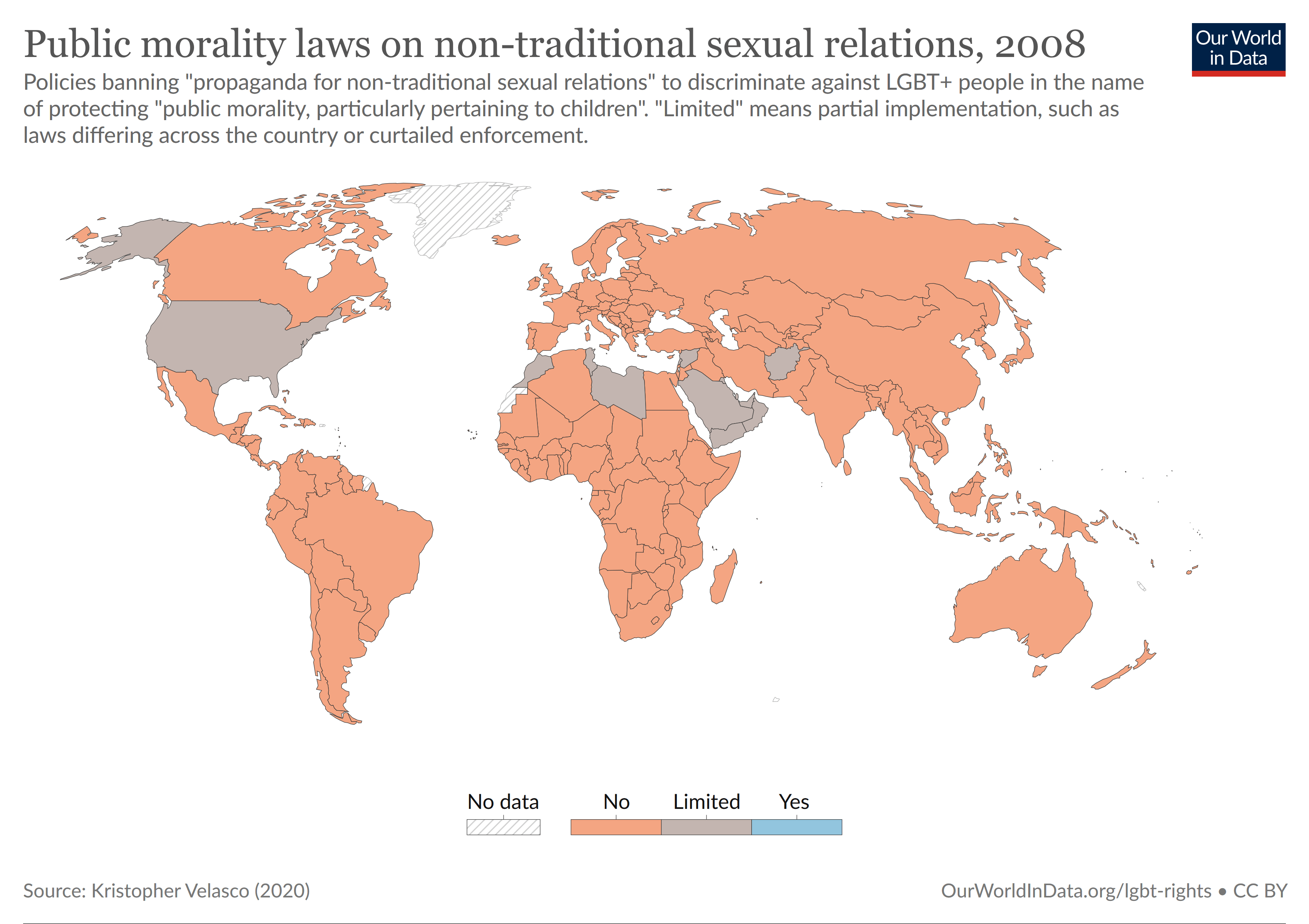
Changed to “Yes”: None
Changed to “Limited”: Afghanistan
Changed to “No”: None
Probably not a huge surprise, but the deeply conservative country of Afghanistan would start to implement limited public morality laws in the years after the U.S.-lead invasion. While I’m 100% sure the Taliban would have done something similar, I guess it just wasn’t on their radar before. Today, of course, the country is back in the hands of the Taliban and they’re very much on a culture war crusade against women and LGBTQ+ identities.
2013
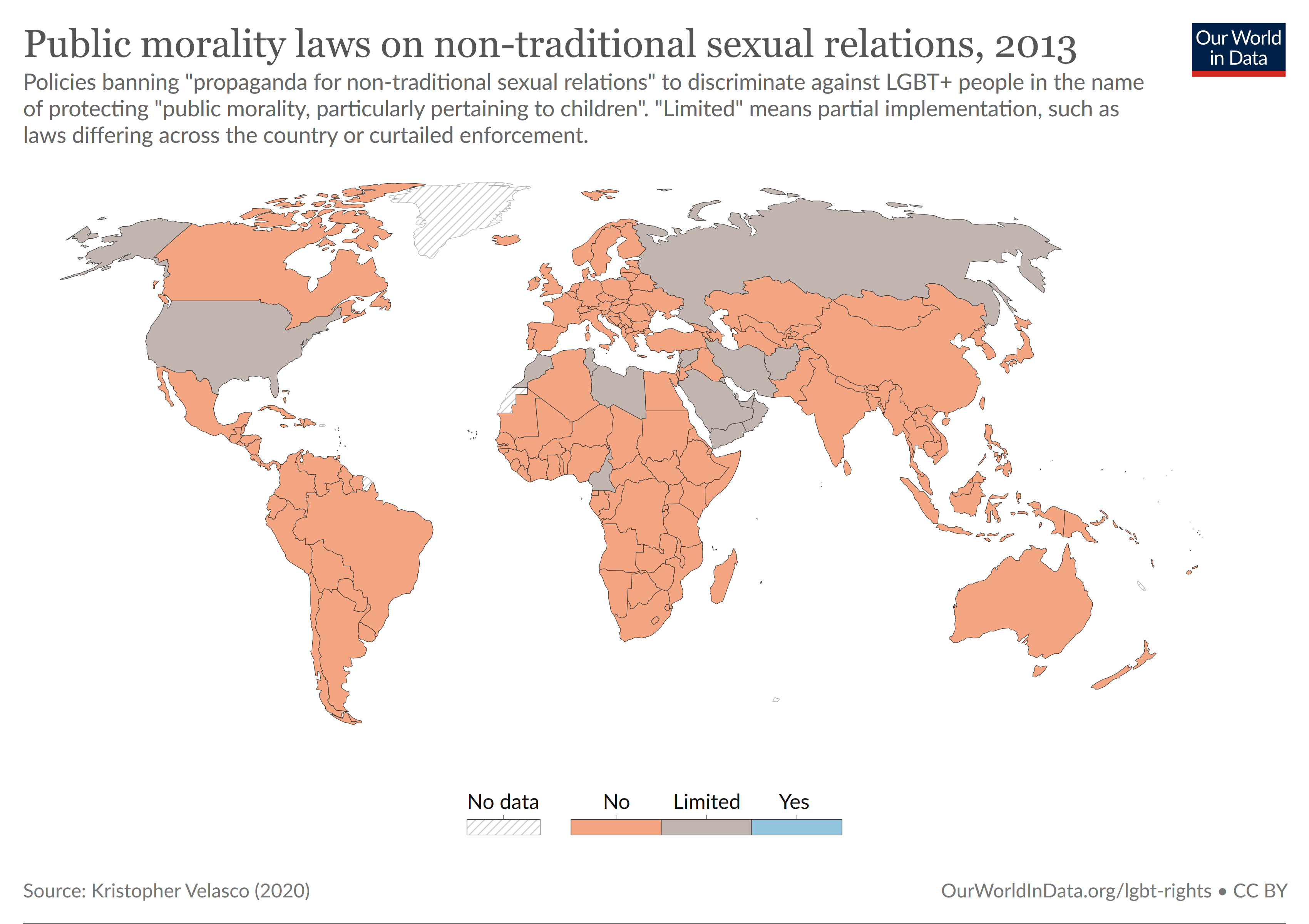
Changed to “Yes”:
Changed to “Limited”: Camaroon, Iran, Russia
Changed to “No”:
A few more places start to introduce more “public morality" laws. Iran is probably not a surprise. Again, prior to these laws, it was probably still very much illegal. But these serve as a good proxy for where the country is heading and who they’re targeting.
This is also the time when Russia starts to grow more conservative as Putin consolidates his rule and the country shifts back to a dictatorship-style government. LGBTQ+ people, amongst others, will almost always serve as a scapegoat for a societies’ problems.
Cameroon is an interesting one though! Maybe not surprising. I’m not all that caught up on Cameroon’s governmental leanings, but it just feels a little out of place. That said, many African countries are, by and large, much more conservative overall.
2018
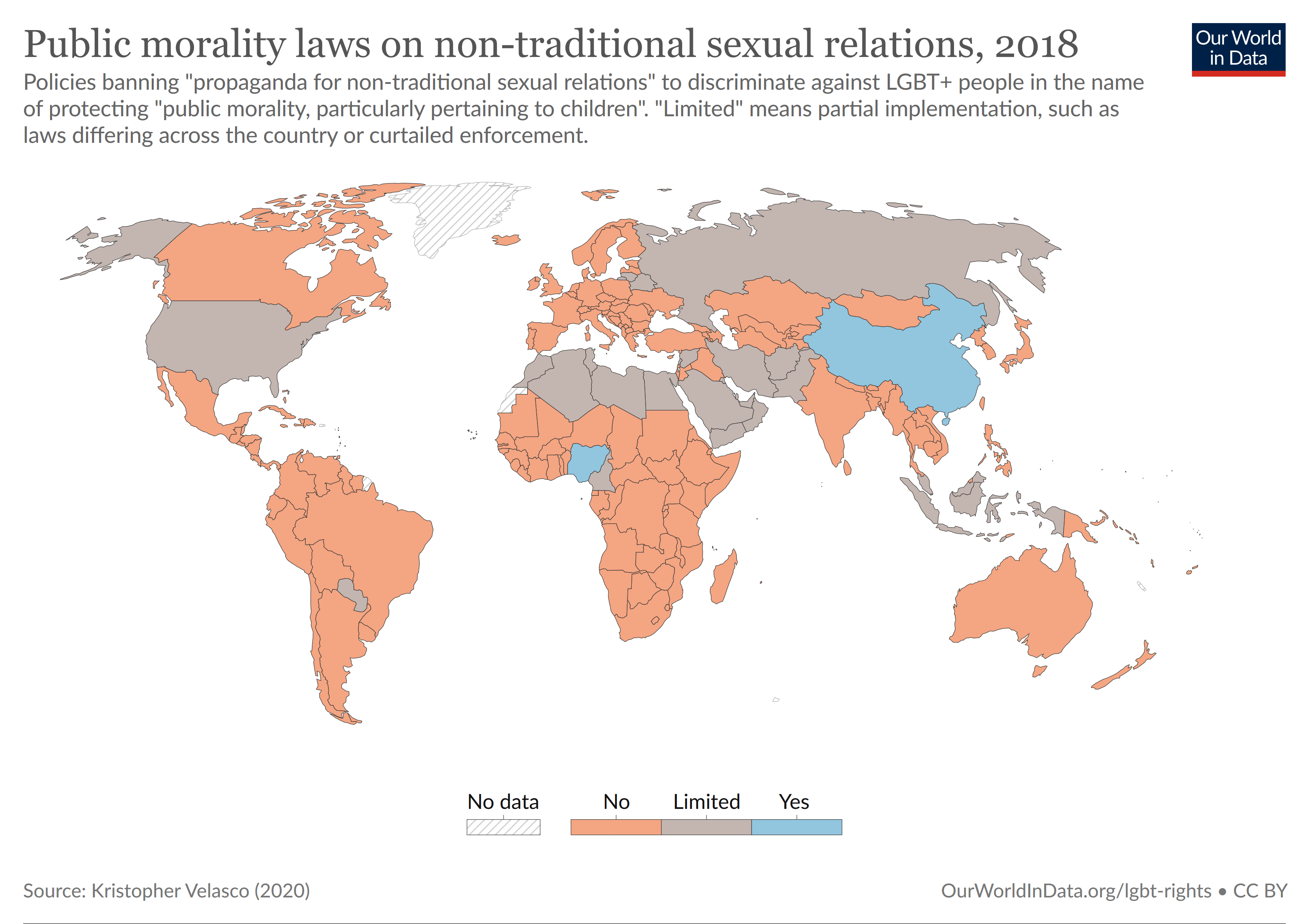
Changed to “Yes”: China, Nigeria
Changed to “Limited”: Belarus, Egypt, Indonesia, Lithuania, Malaysia, Pakistan, Paraguay
Changed to “No”:
Oof! Lots of change between 2013 and 2018. China and Nigeria passed some of the first comprehensive morality laws targeting LGBTQ+ people. Belarus and Lithuania joined Russia in having some limited forms of it. More north African countries hopped on the train. And Paraguay became South America’s first country with public morality laws on the books, albeit in a limited fashion.
2023
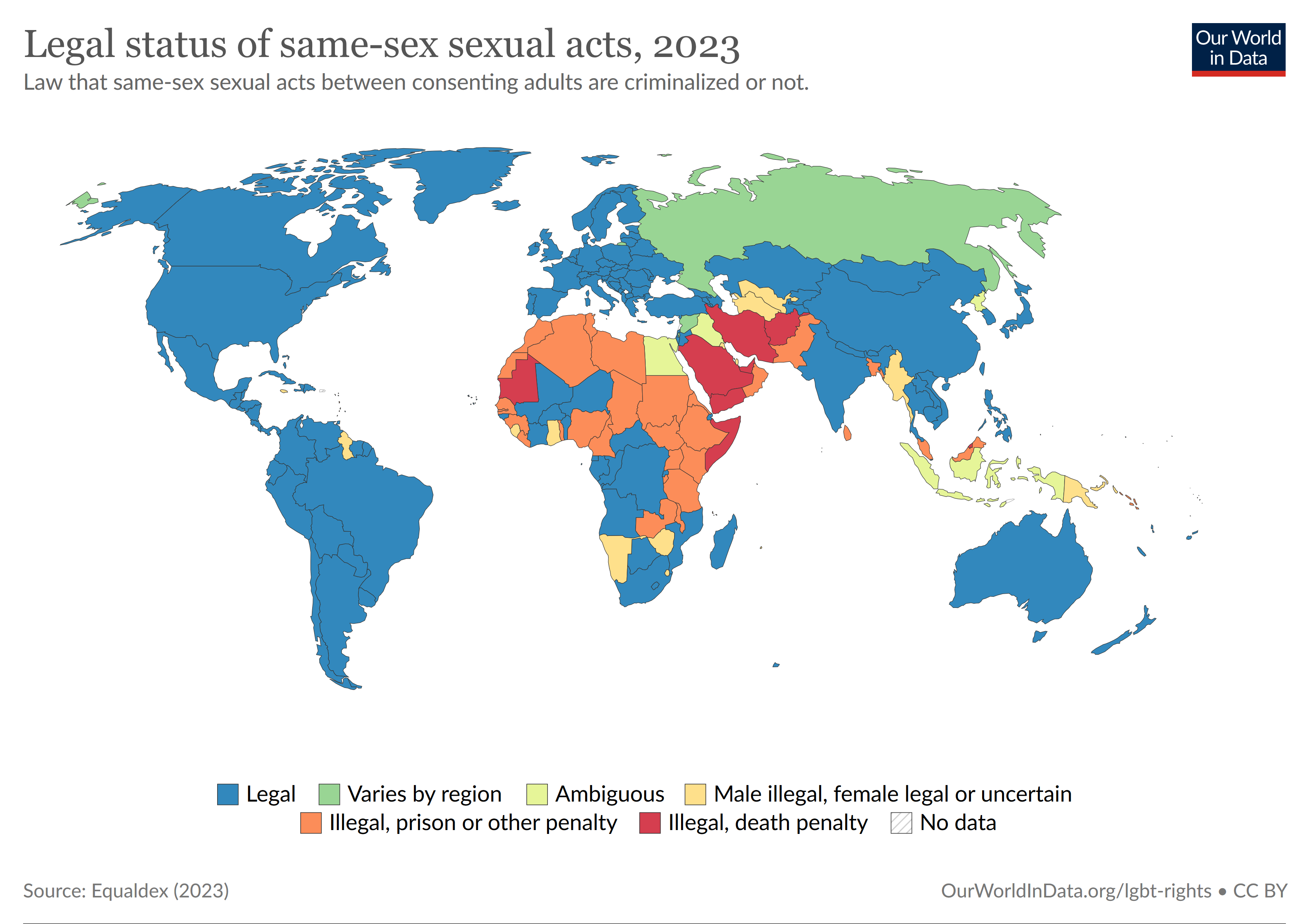
Unfortunately, I don’t have data after 2019 for public morality laws, so instead what I thought might serve as a poignant end to this article was a 2023 map showing the legality of same-sex sexual acts and the punishments levied on them.
As you can see, it’s not great for LGTBQ+ travelers. While North America, Europe and Oceania are generally safe, there exists a web of intricate laws that make it challenging to even find out where within a country might be safe. And while this map shows the legality of same-sex sexual acts, it’s worth highlighting that there are discrepancies here where a country might show as perfectly legal, but still have some form of morality law that could pose other dangers, and vice versa. For example, much of Africa (as of 2018) still didn’t public morality laws, but as we can see here, many of them promise prison time for anything above and beyond.
And that’s really that. As the world has slid more and more into conservatism over the last decade, things have gotten just a little worse and a little harder for those who identify as LGBTQ+. Which is a shame, because travel should be fun! And someone’s sexual orientation — or any variation of that — should be a complete non-issue for every single country.
Is it because “As the world has slid more and more into conservatism over the last decade, things have gotten just a little worse and a little harder for those who identify as LGBTQ+”? Or is it because as the LGBTQ+ movement has become stronger and people have felt freeer and able to identify as they wish, that countries have decided to make where they stand on LGBTQ+ clearer to avoid any misunderstandings of what is allowed?