

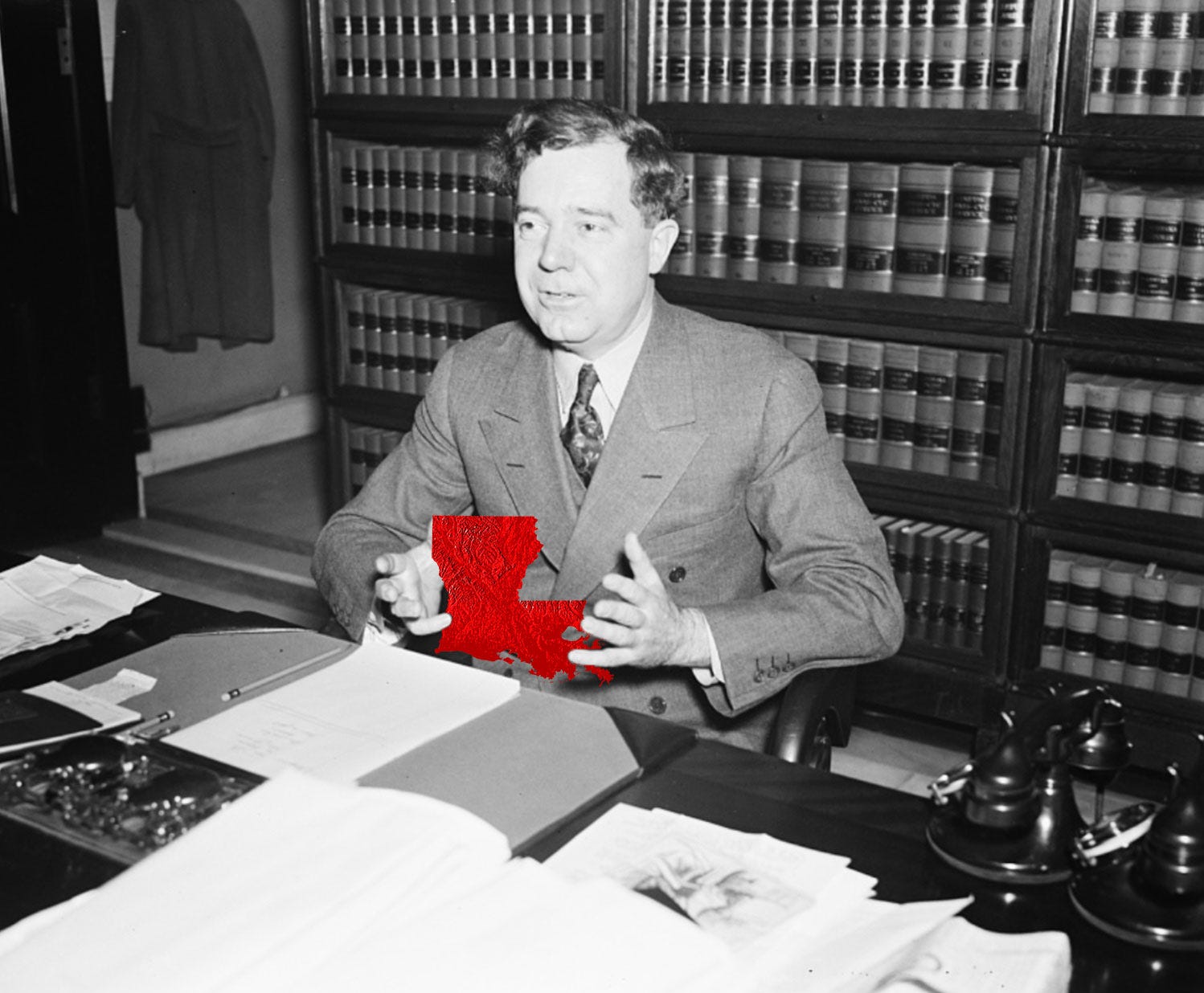
The early 1900s was an interesting time for politics in the world. Usually we fixate on Europe during this period as colonial imperialism began dying out and new ideologies like fascism and communism rose in their place. The collective memory for the United States during this time was that it was a stable democracy and one that helped the Allies win not one World War, but two. Of course, history is far more complicated than that. In particular, the idea that the United States was a picture perfect democracy is certainly incorrect. While there are many angles I could take this article in, I want to focus on one particularly geographically constrained example: the great state of Louisiana.
You see, during the late 1920s and early 1930s, Huey P. Long (aka “The Kingfish”) built what historians widely consider the closest thing to an absolute dictatorship ever to exist within the United States. But Long didn’t conquer Louisiana with an army, he conquered it with populist rhetoric, ruthless political mechanics, and a whole lot of concrete.
Here’s the story of how an American state became a quasi-dictatorship, and the lasting geographic scars and monuments it left behind.
The rise of the machine
So, first things first, Long’s rise to power wasn’t an accident. He didn’t just luck into it. He also wasn’t some unwitting buffoon being used by a group of powerful people. No, instead it was a highly calculated exploitation of deep-seated inequality. You see, in the 1920s, Louisiana was essentially an oligarchy run by a wealthy coalition of planters, New Orleans ward bosses (the “Old Regulars”), and Standard Oil executives. The rural poor (both white and Black) were largely ignored, disenfranchised, and left to live in crushing poverty.
Long stepped into this void with a simple, explosive message: Make Every Man a King. And because of that simple promise he was elected governor in 1928. And once governor, he immediately set about dismantling the old establishment and replacing it with something entirely new: himself. How did he consolidate this power?
Total Legislative Control: Long treated the state legislature like a rubber stamp. He routinely stalked the aisles of the statehouse, personally shouting down opponents and physically intimidating lawmakers. He pushed through bills at breakneck speeds, sometimes passing dozens of laws in a single afternoon without anyone but Long having read them.
The “Deduct Box”: Long required every state employee to “donate” a percentage of their salary directly to his political war chest. This untraceable cash funded his campaigns, paid off allies, and bankrolled a massive propaganda newspaper, Louisiana Progress.
Abolished Local Autonomy: The Kingfish systematically stripped local governments of their power. He gave the governor the authority to hire and fire schoolteachers, police officers, and firefighters across the state. If a mayor defied him, Long could simply cut off their town’s funding or replace their municipal workers.
Militarized State Police: Long expanded the state highway police into a heavily armed personal militia. He used them to raid illegal gambling houses run by his political enemies, guard ballot boxes to ensure “correct” counts, and intimidate opposition.
By 1930, Long was elected to the U.S. Senate, but he didn’t give up control of Louisiana. Instead, he installed a puppet governor, Oscar K. Allen, and continued to run the state from Washington D.C., flying back constantly to direct legislative sessions.
But dictatorships don’t just change laws, they change landscapes. And Long’s absolute control resulted in massive, unprecedented geographic and physical transformations across Louisiana.
Before Long, Louisiana’s geography isolated its people. The state had roughly 300 miles of paved roads. Rural parishes (what we call counties in most states) were cut off from major cities by swamps, rivers, and impassable mud during the rainy seasons. The geography of the state inherently fractured political power into localized, isolated fiefdoms.
Long realized that to centralize power, he had to physically connect the state to his capital. And so he went about doing just that:
1. Terraforming the transit system
Long launched one of the most aggressive infrastructure programs in American history. In just a few years, he paved over 5,000 miles of highway and built over 100 bridges. This wasn’t just public service though, it was a political ploy. By connecting isolated farmers to markets in New Orleans and Baton Rouge, Long bought their unshakeable loyalty. He also bypassed local parish bosses, linking the populace directly to the state government. Diabolical? Yes. Genius? Also yes.
2. The Huey P. Long Bridge
Believe it or not, but before Long, there was no bridge crossing the Mississippi River south of Vicksburg. Getting trains or cars into New Orleans meant relying on slow, inefficient ferries. Long, wielding the power that he did, forced through the construction of the massive Huey P. Long Bridge in Jefferson Parish. It permanently altered the economic geography of the Gulf Coast, turning New Orleans into an even more dominant logistical hub.
3. The skyscraper capitol
Perhaps the most glaring geographic monument to Long’s ego and power though is the new Louisiana State Capitol in Baton Rouge. Long hated the old, crumbling gothic capitol building. So he ordered the construction of a massive, 34-story Art Deco skyscraper. It remains the tallest state capitol in the United States. Towering over the flat Louisiana landscape, it was designed to be a constant, visible reminder of Long’s absolute dominance over the state.
4. The expansion of LSU
Long essentially adopted Louisiana State University (LSU) as his pet project. He drastically expanded its campus geography, tripling its enrollment, building a massive football stadium, and even hiring and firing the band director. He transformed a small regional college into a sprawling, modern university campus, shifting the cultural and educational center of gravity in the state.
The end of the Kingfish
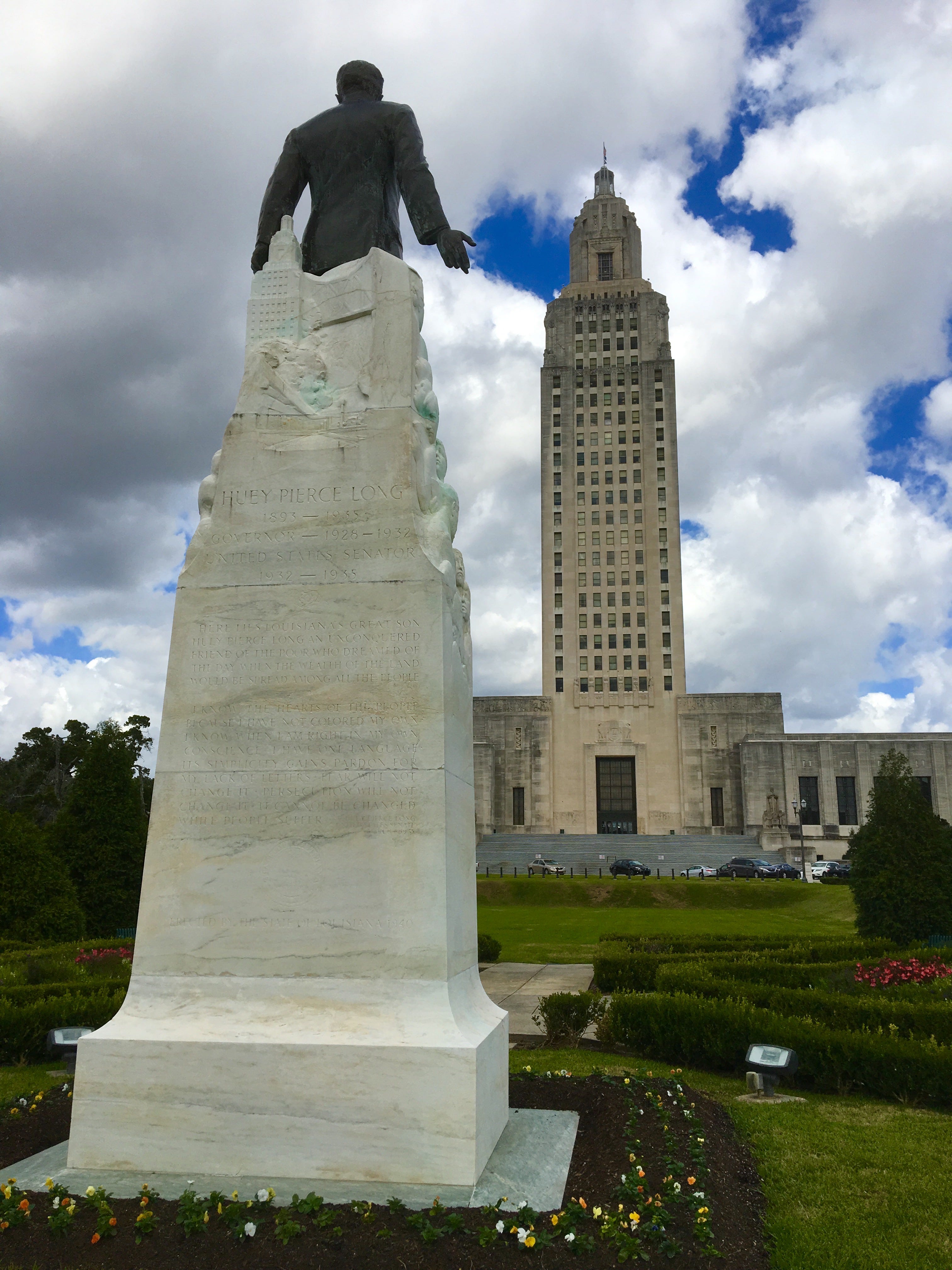
The tragedy of Huey Long is the age-old paradox of the benevolent dictator. He built the hospitals, handed out free schoolbooks, and paved the roads that brought Louisiana into the 20th century. He did almost everything he promised. It’s fair to say that, without him, Louisiana would have had a much harder time becoming a modern state than it did. But the price was democracy itself.
Long’s rule ended the only way a dictatorship’s rule usually can: with violence. On September 8, 1935, Long was shot in the halls of the very skyscraper capitol he built, allegedly by Dr. Carl Weiss, the son-in-law of a political rival Long was attempting to gerrymander out of office. Long died two days later at the age of 42. But despite being more than bit of a dictator, his legacy is one that is more often than not celebrated. In many ways, Long proves that America has always liked its strong man-like dictator figures.
Today, if you drive through Louisiana, you’re driving on Long’s roads, crossing Long’s bridges, and looking at Long’s monuments. The Kingfish is gone, but the geographic and political landscape he violently reshaped remains. For better or worse.
What a story.
According to Chuck Giancana, Long's assassin was sent by Chuck's brother Sam to kill Long, because Long had double-crossed the Mob, who had put him in power in the first place.
Long 'wasn’t some unwitting buffoon being used by a group of powerful people.'..... I can't think who might fit into that category??