

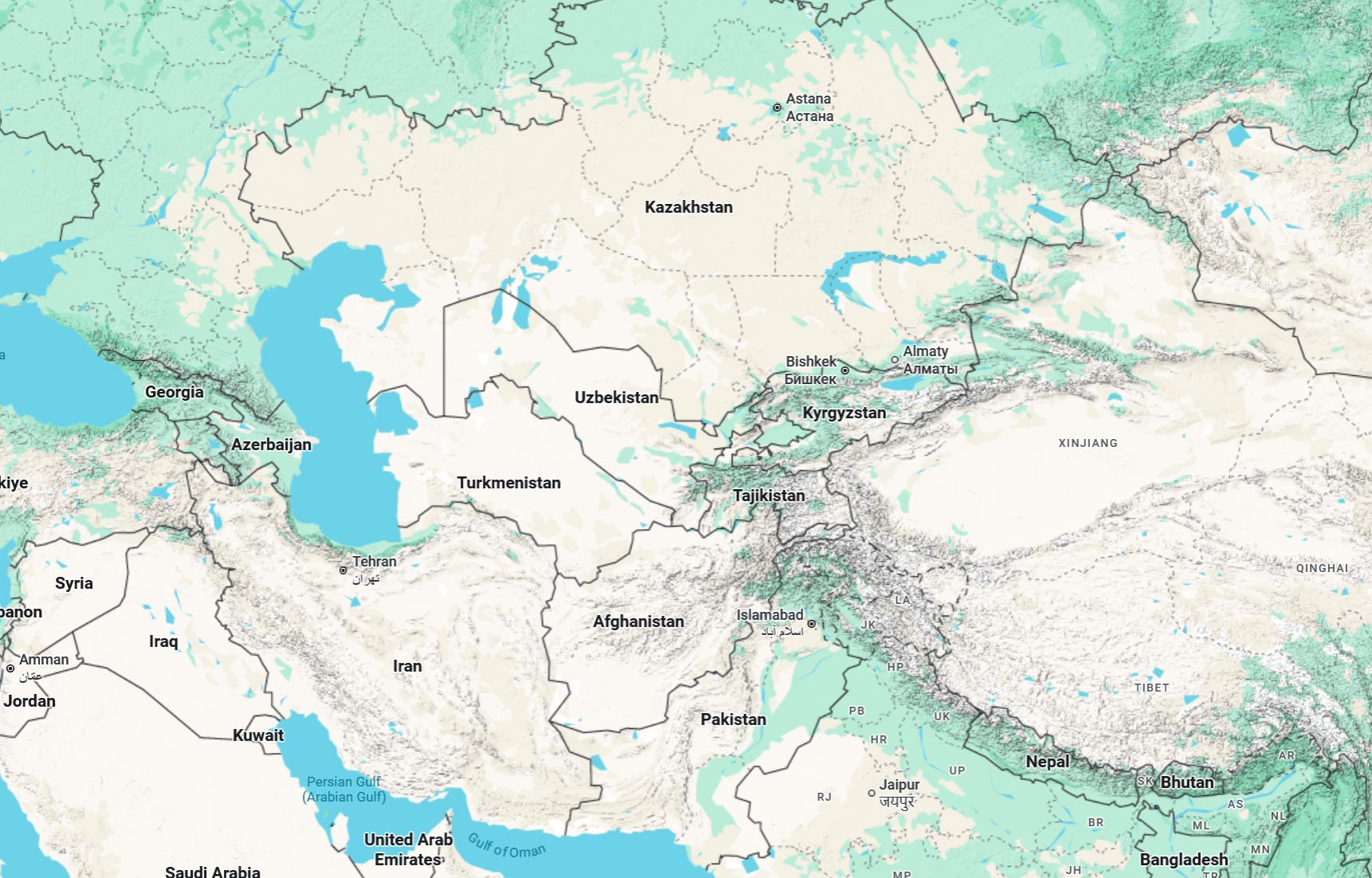
There’s basically only one commonality across the various countries of Central Asia. I mean, even within the countries, people and cultures change much more drastically and radically than even in many places in Europe. But, as far as whole countries go there’s one thing that binds Kazakhstan, Kyrgyzstan, Tajikistan, Turkmenistan, Uzbekistan, Afghanistan, and Pakistan together… at least etymologically: the STAN.
To the uninitiated, let’s say, western eye, these countries can sometimes blend into a monolithic block that have been terms “The Stans.” But this suffix isn’t a quirk of geography, it is a linguistic fossil that tells the story of empires, nomads, and the roots of the English language itself.
So, let’s decode the “Stan.”
The etymology of “stan”
So the suffix -stan is Persian in origin. It’s not English, or even Latin or Germanic in origin. And its actual meaning is pretty simple. It effectively means “place of” or “land of.” Which is then the simplest answer, right? The land of the Tajiks. The land of the Kazakhs. The land of the Afghans. And so on. But there are some unique geographic complexities here.
So, if you want the more complicated answer (which I’m guessing you are because otherwise, why are you here at all?) then read on.
Basically, “stan” is a cousin to the English word stand. And both words trace their lineage back to the Proto-Indo-European root *sta, meaning “to stand.” Even in modern Russian, a stan can refer to a settlement or a camp.
So, when you see a country ending in “-stan,” you are simply seeing a “Land of [People].” In this way, “land” at the end of so many European countries is no different.
England is the Land of the Angles.
Finland is the Land of the Finns.
And so, therefore, Uzbekistan is the land of the Uzbeks. Or maybe the “stan of the Uzbeks” but you get the picture.
The “Stans” roll call

But while all these countries share a suffix, the stories behind the names are distinct. So here’s a quick breakdown of the “Seven Stans.”
1. The Central Asian five
These five countries are all former Soviet Republics that were lumped together in one LARGE Stan called Turkestan. When the USSR dissolved in 1991, they emerged as independent nations, keeping the names that defined their dominant ethnic groups.
Kazakhstan: “Land of the Kazakhs.” The word Kazakh comes from an ancient Turkic word meaning “independent” or “wanderer.” It’s the same etymological root as the word Cossack.
Uzbekistan: “Land of the Uzbeks.” The Uzbeks likely derive their name from Öz Beg Khan, a leader of the Golden Horde. Öz means “self” and Beg means “master/leader,” so it roughly translates to “master of oneself.”
Kyrgyzstan: “Land of the Kyrgyz.” The word Kyrgyz is thought to mean “forty,” referring to the forty clans of Manas, a legendary hero who united the people.
Turkmenistan: “Land of the Turkmen.” Simply, the land of the Turkic people of that specific Oghuz branch.
Tajikistan: “Land of the Tajiks.” Unlike their neighbors who speak Turkic languages, Tajiks speak a variety of Persian. This name reflects their historic connection to the Iranian world.
2. The southern neighbors
These two are not former Soviet republics, but they are geographically and culturally linked to the region.
Afghanistan: “Land of the Afghans.” Historically, the term “Afghan” referred specifically to the Pashtun people, the founders of the modern country.
Pakistan: This one is the outlier. This is the only “Stan” that is an acronym. Yes, you read that right. Pakistan, the country, is actually an acronym. Crazy! It was coined in the 1930s by independence activist Choudhry Rahmat Ali to represent the regions of the proposed state: Punjab, Afghania (North-West Frontier Province), Kashmir, Sindh, and Baluchistan. Conveniently, Pak also means “pure” in Persian and Urdu, giving it a double meaning: “Land of the Pure.”
The ones that got away
Now, the suffix has historically been used for many more places than just these seven. It’s just that these nations don’t really exist in the same way, or are slightly different, or are simply a region. And so on. The point being: there are more stans out there!
Hayastan: This is what Armenians call Armenia.
Hindustan: A historic (and often current) name for the northern Indian subcontinent.
Kurdistan: The mountainous region inhabited by Kurds, spanning Turkey, Iraq, Iran, and Syria.
Registan: Not a country, but a famous square in Samarkand. Reg means sand, so it is a “place of sand.”
Why does any of this matter?
We often treat names as arbitrary labels, but in Central Asia, the “Stan” is a reminder of Persian cultural dominance. For centuries, Persian was the lingua franca of the Silk Road: the language of poets, courts, and commerce from Turkey to India. It was the dominant language for the world really.
Even as Turkic conquerors (like Genghis Khan’s descendants) took power, and even as Russian bureaucrats drew borders, the Persian way of naming the world stuck. It’s a testament to the region’s identity. And that’s why we still have so many Stans today!
Geology, geography and etymology in one post. Cool! You are a multifaceted man, Geoff.
I visited Uzbekistan and Turkmenistan in 2000 as part of my Silk Road travels. I spent a month in those countries at a time when tourism was very new, so some (not all) of the hotels were kind of dicey, with holes in the wall, grey towels, brown or grey running water, and a TV where the cockroachs lived. In Ashkabad, meanwhile, the Turkmenbashi was building a magnificent capitol with giant golden statues of himself. All in all it was a fantastic trip, visiting the mosques and madrasas. People generally spoke Russian along with their native languages. The following year I followed up the Silk Road trip with three weeks in China, traveling from Kashgar to Shanghai.