

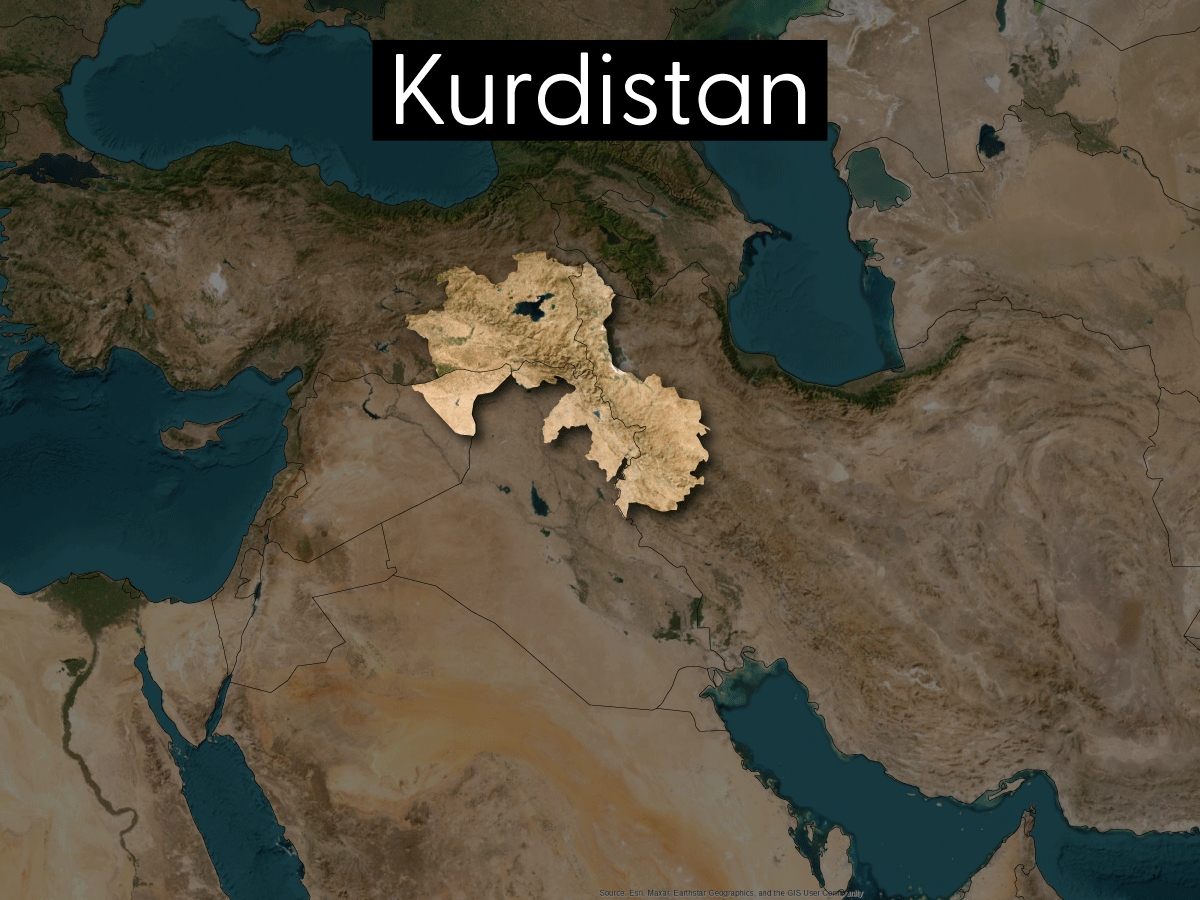
Becoming an independent country is a fun fantasy for some, and a desperate hope for many others. Our drive for self determination, as well as the desire to be recognized by the world as a significant cultural region, is very strong. You need to look no farther than Scotland to see this in action today. And that’s not to say it’s a bad thing, but it is a very complicated thing!
The reason why I’m writing about this today is because I’ve been doing quite a bit of research on “stateless” peoples. These would be culturally defined groups that don’t have land or self-managed borders to themselves. I think the most obvious example of this would be the nation of Kurdistan which is found within the countries of Turkey, Syria, Iraq, and Iran. But others exist as well! The nations of Catalonia and Basque within Spain. The nation of Tibet within China. The Navajo nation within the United States. And so on and so on…
(Note: I’m using the word ‘nation’ in the geographic sense which is to define a specific people, not an independent state)
In my own neck of the world’s woods, the Pacific Northwest of the United States, there’s a fairly consistent undercurrent of the idea of Cascadia (listen to our podcast episode on it!), which is a speculative independent country largely based around the U.S. states of Oregon and Washington and the Canadian province of British Columbia. Cascadia, of course, isn’t a nation defined by a specific people, but it’s still a highly desired idea for a lot of people up here.
But while it’s can be a fun thought experiment, or a realistic goal, as it turns out becoming a new country is incredibly challenging. And we’ll use Kosovo as an example…
The Kosovo conundrum

Kosovo, if you’re unfamiliar, is a relatively small nation that, at one point, made up a part of former Yugoslavia. This would largely be the region we would consider to be the Balkans today, though not quite. All in all, Yugoslavia has been broadly broken out into 7* separate countries today: Slovenia, Croatia, Bosnia and Herzogovina, Montenegro, North Macedonia, Serbia and Kosovo*. The reason for that little asterisk is the precise thing I’m writing about now.
Kosovo officially declared independence February 17th, 2008. So, by their timeline, they’ve been a wholly independent country for very close to 15 years. And, true to their efforts, over 100 independent countries have recognized their existence. That’s a lot of countries that formally recognize you as having the right to self-determination and it absolutely can’t be understated. This would include most of the European Union, most of NATO, and a majority of G20 countries. It would also include all of its immediate neighbors, aside from one: Serbia.
While this is all very impressive, it’s still not quite enough. As it turns out, a big part of being your own country is simply having recognition from the world’s other countries. And this is largely done through the global body of countries we know as the United Nations which, unfortunately, does not recognize Kosovo as of today. The reasons for this basically boil down to the fact that neither Russia, nor China recognize Kosovo and therefor Kosovo hasn’t been recommended for admittance into the U.N.
This isn’t to say that formal recognition never happens, but it usually requires very specific circumstances. And one of those circumstances is: does your neighbor approve and do they have enough power or influence to effectively stop you from getting recognition?
Serbia today, of course, is still staunchly opposed to any form of recognized Kosovan government. Their current president is consistently threatening military action for otherwise fairly benign decisions that any government makes (such as issuing their own vehicle license plates and drivers licenses). It’s for this reason that NATO has a permanent military force stationed within Kosovo.
Independence is hard

As I already mentioned, there are plenty of countries that want to be independent today. Scotland is probably the most well known given that they held a formal referendum in 2014 and are hoping to have another in the very near future. Currently the U.K. government is opposed to giving the nation a second chance at becoming independent (most likely because it seems very likely that Scotland would actually leave if given a second vote). But there are other hopeful countries as well:
Kurdistan
Catalonia
Basque
Taiwan (this is a whole other article!)
Tamil
Quebec(Maybe not as hopeful as I thought)
And many, many more. South Sudan, the world’s newest officially recognized country, only came about due to a series of terrible, bloody civil wars that proliferated throughout the 20th century.
It’s for this reason that, in order to become truly independent and recognized — which would allow for things like international treaties and trade — any hopeful country will need the blessing of their former owner. Catalonia, for example, have very real reasons for desiring independence from Spain. But if Spain doesn’t ultimately recognize their independence, then Catalonia is going to have a really difficult time.
I don’t really have an end to this post. I’m certainly not trying to take away anyone’s validity towards independence. But I do think it’s worth pointing out that it’s harder than I think most people realize. Geopolitics are, if nothing else, extremely convoluted.
Hunter and I recorded an episode on the broader concept of international borders. If you’re interested, I encourage you to give it a listen. It’s fascinating how we go to our current global situation.
North Cyprus is another one.
Desire for catalonian independence did go down in a recent referendum, which is interesting