

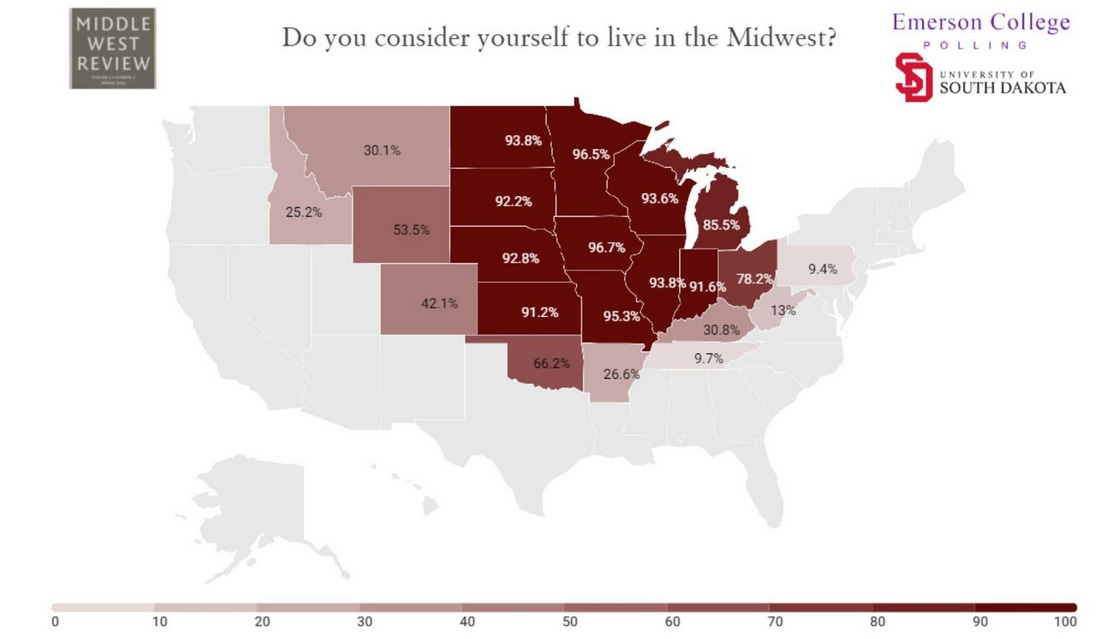
Ask anybody to define the Midwest, and you’ll likely get a pretty confident answer. But that confidence usually fades, once you ask them to draw it on a map. Is Missouri Midwestern? What about Kansas? Does it include the industrial cities of Western Pennsylvania or the suburbs of Northern Kentucky which are connected to Cincinnati?
Of all geographically defined regions in the U.S., the Midwest is, in my opinion, the most ambiguous. It’s a place defined less by precise geography and more by a shared cultural “feeling”. And the confusion over its borders isn’t a failure of geography; it’s a direct result of the region’s complex history, internal diversity, and fuzzy cultural boundaries.
There is an “official” designation

On paper, the U.S. Census Bureau offers a clear-cut answer. It officially designates 12 states as the Midwest. This region is neatly split into two divisions: the East North Central states (Ohio, Indiana, Michigan, Illinois, and Wisconsin) and the West North Central states (Minnesota, Iowa, Missouri, North Dakota, South Dakota, Nebraska, and Kansas).
This definition, created for data collection, is the closest we have to a formal boundary. Yet, for many, this list feels too big, too small, and not quite right.
All that said, most people do agree on a “Core Midwest.” These are the states that almost universally “feel” Midwestern and are included on all definitions you can find. These states are: Iowa, Illinois, Indiana, Ohio, Michigan, Wisconsin, and Minnesota. These states largely share a similar history, climate, and economic blend of agriculture and industry. The real debate begins at the edges.
Outside the ‘core’
So if there’s already an official designation and most people agree on the what the core of the Midwest is then any arguments about what constitutes it happens on with the states that the core borders.
The most debated state is arguably Missouri. It’s a classic “border state” in every sense. Its geography and culture are a gradient. St. Louis feels distinctly Midwestern, yet Kansas City feels a bit more like a prairie city and the southern portion of the state, particularly the “Bootheel,” shares both cultural and historic ties with the American South.
Then there are the Great Plains states: Kansas, Nebraska, and the Dakotas. The Census Bureau groups them in, but many argue they form their own distinct region as “prairie states”. While eastern Kansas and Nebraska are agrarian in a very Midwestern way, their western halves become drier, higher, and more sparsely populated, feeling much more like the “West” than the rolling hills of Ohio.
The confusion also extends eastward. Western Pennsylvania, particularly the area around Pittsburgh, is often culturally included. It shares the same “Rust Belt” industrial heritage as Cleveland or Detroit, and its landscape and people often feel more aligned with neighboring Ohio than with Philadelphia, hundreds of miles to the east. By that same logic, parts of West Virginia and Northern Kentucky (which is functionally a suburb of Cincinnati, Ohio) are often lumped in culturally, despite being officially “Southern” states.
And, of course, I have even seen some make the argument that Kentucky as a whole is part of the Midwest as well.
Why is all this so vague?
Here’s the thing. I’m fascinated by cultural regions because, in many ways, they’re more important than state or even national borders. But I don’t have a dog in this race. I’ve always lived on the west coast and I’ve only ever looked at it from the outside. I’m also not going to make a grand proclamation in this article. But I do think it’s important to lay out some of the reasons for why there’s not a simple definition here.
First is its historic name. The term “Midwest” is itself a relic from almost 200 years ago. In the late 1700s, this area was known as the “Northwest Territory,” as, at the time, it was the northwestern frontier of the young United States. As the country expanded past the Rocky Mountains, this “northwest” region became the “middle west.” Its name is trapped in a 1800s perspective, defining it by what it’s not (the East Coast or the Far West) rather than by what it is.
Second is its internal diversity. The Midwest is not a monolith. The “Rust Belt” of the Great Lakes, centered on massive industrial cities like Chicago, Detroit, and Cleveland, has a very different economic and social history than the “Farm Belt” of Iowa, Kansas, and Nebraska. A factory worker in Michigan and a corn farmer in Iowa are both Midwesterners, but their daily lives and landscapes are worlds apart. This internal split makes a single, unifying identity difficult.
Finally, and most importantly, the Midwest is a cultural construct. Its borders are not defined by mountains or oceans but by a slow blending of accents, economies, and identities. It’s a transition zone. The line where the Midwest “ends” and the South, the East, or the Great Plains “begins” is a blurry gradient that can change from one county to the next.
And, in truth, you can say this about almost every cultural region of the United States. Where I’m located, the Pacific Northwest, is often debated as well. Does it include British Columbia in Canada? Does it include Idaho? What about parts of Montana and Wyoming that began as parts of the original Oregon Territory? What about the southern panhandle of Alaska that shares similar ecology and climate? What about the northern part of California that also shares similar climate and even political leanings?
That said,, the Midwest may be America’s largest and most important region without a clear-cut border. It remains a vast, complex, and evolving heartland and I, for one, look forward to the debate every time it pops up on social media.
The Midwest is a state of mind and should not, other than for government statistical reasons, be confined by state boundaries.
For example, I think Buffalo has much more in common with Chicago, Detroit and Cleveland, culturally, than the rest of NY state and has always felt Midwestern to me. And Covington (and maybe Louisville?) also feel Midwestern to me. But drive literally just a few miles south of either of those two cities and you are clearly in the South, culturally.
Eastern Kansas and Nebraska: Midwest. Western parts of both state: no.
The interesting question is how is this state of mind defined such that such granular distinctions can be made?
I've always been confused about this!!! Thanks