


I got weirdly interested in volcanoes the other day when I was pulling together my latest episode on YouTube around the what I call the “Empty West.” I ended up diving deep into Mt Shasta, Crater Lake and Oregon’s Three Sisters, all of which have a long history of volcanic eruptions. Though none of this should be that surprising given that this area is a part of the Pacific’s “Ring of Fire” that houses most of the world’s volcanoes. Still, the U.S. Geological Survey compiled an assessment of the highest threat volcanoes and so I decided to write a bit about the top ones.
Oh and point of clarification here: this isn’t just an article about which volcanoes are likeliest to erupt. That would be kind of boring because many, many volcanoes are in the middle of nowhere and therefore don’t have that much of an impact even if they do blow their top. These are the volcanoes which have the highest threat to people and our way of lives. So while there are a dozen or so volcanoes that are actively being watched for eruption along the Alaskan Aleutian Islands, if they do, it won’t actually impact much of anything. This would be in contrast to Mount Rainier erupting which has quite a lot of people (including Seattle) nearby!
1. Kīlauea, Hawaii

Contrary to my tagline above, this one very well could blow tomorrow! But that wouldn’t really be all that unusual. But I digress…
Kīlauea, the most active of the five volcanoes that form the Big Island of Hawaii, has been continuously erupting from 1983 until 2018, and then again beginning in December 2020. The volcano is believed to be between 210,000 and 280,000 years old and emerged above sea level about 100,000 years ago. Its name in the Hawaiian language means "spewing" or "much spreading," in reference to its frequent outpouring of lava. So, yeah… kind of a regular occurrence for Hawaii.
Reason for High Threat:
Kīlauea's status as a high-threat volcano is primarily due to its frequent and potentially unpredictable eruptions. While these eruptions are often non-explosive and feature slow-moving lava flows, they can (and have!) cause significant destruction to property. Furthermore, they can result in hazardous conditions such as poor air quality due to volcanic smog, also known as "vog."
2. Mount St. Helens, Washington

Situated in Skamania County, Washington, Mount St. Helens is probably most famous for its catastrophic eruption on May 18, 1980. It's a part of the Cascade Mountain Range, a segment of the Pacific Ring of Fire that includes over 160 active volcanoes (The Cascades are featured two more times in this article!). The 1980 eruption was the most deadly and economically destructive volcanic event in the history of the United States, causing 57 deaths and significant damage to property and infrastructure.
Fun fact: I can see Mount St. Helens pretty clearly from a nearby park.
Reason for High Threat:
This one is probably pretty obvious. Mount St. Helens' 1980 eruption serves as a stark reminder of its explosive potential. Even smaller eruptions could pose significant threats to human life and property, particularly due to pyroclastic flows (fast-moving current of hot gas and volcanic matter), ashfall, and lahars (destructive mudflows).
Luckily for Portland, Oregon, during the 1980 eruption, the mountain happened to blow in a northward direction meaning most of the destruction actually went towards mostly empty areas rather than towards a city of millions. If it blows again and has a more southern direction, it will be much worse.
3. Mount Rainier, Washington

Mount Rainier, also in Washington State, is the highest peak in the Cascade Range and is considered one of the most dangerous volcanoes in the world. It's located around 54 miles southeast of Seattle, a major population center. The volcano's last major eruption occurred about 1,000 years ago.
Reason for High Threat:
Mount Rainier is deemed a high threat due to the substantial glacial ice it holds. In the event of an eruption, this ice can melt, leading to massive lahars that could reach as far as the densely populated areas around Seattle and Tacoma. The volcano's proximity to these populated areas heightens its risk factor.
4. Redoubt Volcano, Alaska
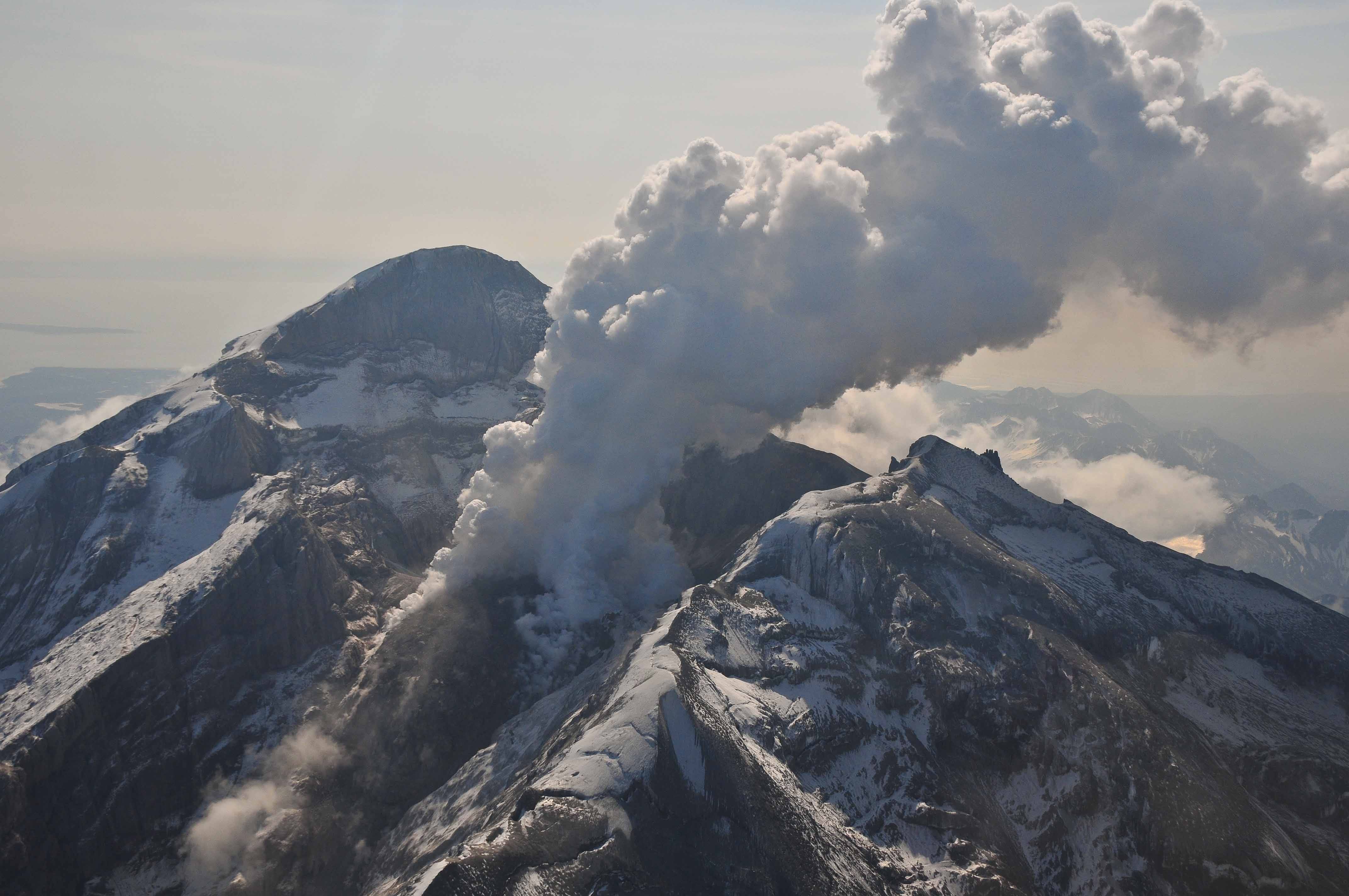
Redoubt Volcano, or Mount Redoubt, is an active stratovolcano in the largely mountainous Aleutian Range of Alaska. Its last eruption occurred in 2009, following a period of significant activity in 1989-90. Redoubt Volcano towers over the west side of Cook Inlet, 110 miles southwest of Anchorage.
Reason for High Threat:
The main threats posed by Redoubt Volcano are ash plumes and lahars. The ash plumes can reach high into the atmosphere and pose a significant risk to air traffic. The 1989 eruption, for example, resulted in a Boeing 747 aircraft flying into the ash cloud, causing temporary engine failure. If this volcano were to erupt again, we could see a halt to air traffic between North America and Asia. This would be similar to the Eyjafjallajökull volcanic eruption in Iceland in 2011 that stranded millions of travelers when flights were cancelled between North America and Europe. Lahars, on the other hand, can cause flooding and damage to infrastructure downriver.
5. Mount Shasta, California

Mount Shasta is located at the southern end of the Cascade Range in Siskiyou County, California. It's the second-highest peak in the Cascades and the fifth-highest in California. While Mount Shasta hasn't erupted in historical times, geologists have identified at least 11 episodes of cone and dome growth in the past 340,000 years.
Reason for High Threat:
Mount Shasta is ranked as a high-threat volcano primarily because of its history of significant eruptions over the past few thousand years. These eruptions are explosive and can produce pyroclastic flows and lahars. The volcano's location near populated areas and important infrastructure further contributes to its threat level.
There are, of course, additional volcanoes in the United States that could blow. My own nearest mountain, Mount Hood, narrowly escaped the top five. Still, the likelihood of any of these mountains posing any real sort of danger to you is slim, even if you happen to live near one. The U.S.G.S. maintains active monitoring of all of them and any nearby communities would have a lot of warning ahead of time.
I became really interested in volcanoes, especially those more powerful than Mt. St. Helens 1980, early on during Covid - not in spite of the pandemic but because of it. (While superficially pandemics and eruptions are completely different, they're strikingly similar when it comes to disrupting global supply chains as well as extremely widespread effects.) I've done enough research to say that the dormant Edgecumbe and Churchill volcanoes in the Alaska panhandle are others to watch out for in terms of a very large-scale eruption, even though they're in underpopulated areas. This is because should either of them blow up really really big, ash clouds can travel quite far and/or can interfere with air travel, not to mention cool the climate of much of the world for at least 1-2 years to come.