


Let me get this out of the way right now: earthquakes terrify me. Which is probably not good for someone traveling through Japan, Taiwan and southeast Asia at the moment, nor is it great for someone who lives in the Pacific Northwest. At this point in Portland, we’re all just waiting for the Cascadia Subduction Zone earthquake to hit. At which point my house, all my stuff, and probably my body, will just going bouncing around the neighborhood. As cartoony as they might sound, the reality is very scary!
I think the reason why earthquakes scare me so much is that they largely strike without warning. Hurricanes can be scary of course, but at least you know it’s coming, often with days or weeks notice! Now, all that said and contrary to their sudden and uninvited appearance, certain regions are far more likely to get hit due to their unique geographical and tectonic features. Which means I should probably live in Kansas or something… Nah.
Anyways, because I’m so terrified of earthquakes, I end up reading a lot about them. And now I’ve pulled together a list of my top five most infamous earthquakes in modern history.
Note: You’re going to notice there’s one very large earthquake missing: the 2004 Indian Ocean earthquake. While that was a very tragic and horrendous event, the tsunami was really the culprit in that devastation, not the earthquake. That might seem like a minor distinction, but had there been active tsunami warnings in the Indian Ocean at the time, the outcome of that event would have been drastically different. That makes it a bit different in my own phobia from the other earthquakes on this list.
2011 Christchurch, New Zealand
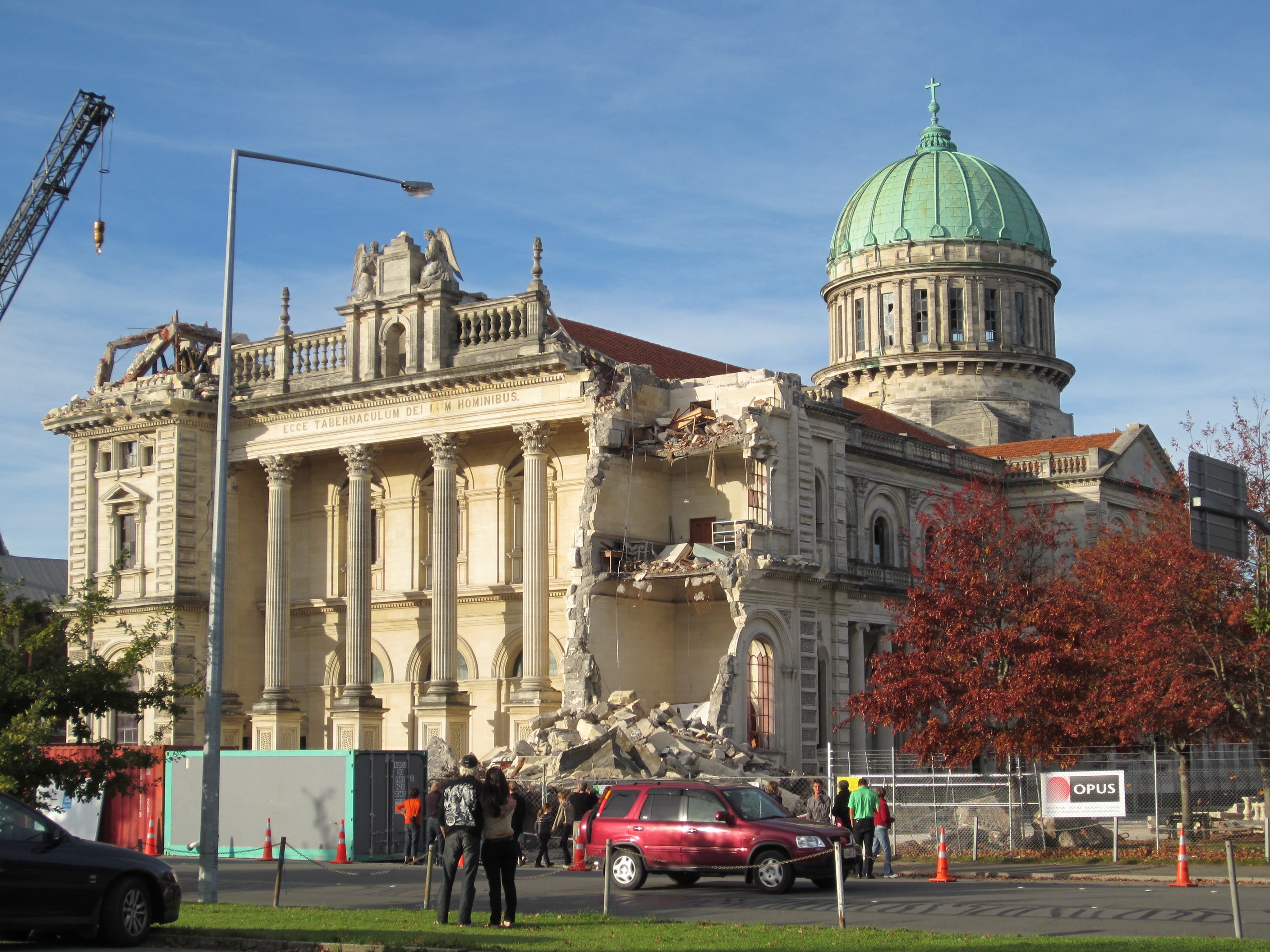
On February 22, 2011, a devastating earthquake struck Christchurch, New Zealand’s second-largest city and the largest on the country’s south island. Although the magnitude was only 6.3, its shallow depth of just 5 kilometers made it exceptionally destructive. Depth, as it turns out, is a huge determining factor in the overall destructiveness of earthquakes.
The earthquake was centered near Lyttelton, 10 kilometers southeast of Christchurch, and was technically an aftershock of the larger 7.1 magnitude Darfield earthquake from September 2010. But given its shallowness and area of impact, it was far more destructive. In my head this just demonstrates that aftershocks can be as destructive, if not more so, than the main quake. So even after the big event is over, you’re definitely not out of the woods yet! 😬
Christchurch’s central business district (CBD) bore the brunt of the destruction, with many buildings, including the iconic Christchurch Cathedral, suffering severe damage or collapse. Liquefaction turned parts of the eastern suburbs into uninhabitable wastelands, with entire neighborhoods like Bexley and Avonside becoming permanently unfit for living. Landslides and rockfalls in the Port Hills further exacerbated the devastation. The earthquake claimed 185 lives and left thousands injured.
The aftermath saw years of rebuilding. A state of national emergency was declared, and international assistance poured in. The government designated a Red Zone, where over 7,000 homes were demolished due to unstable ground conditions. Reconstruction efforts focused on seismic resilience, leading to new, stringent building codes and urban redesigns emphasizing open spaces and low-rise structures. Though Christchurch has largely recovered, scars from the disaster remain visible.
1994 Northridge, California
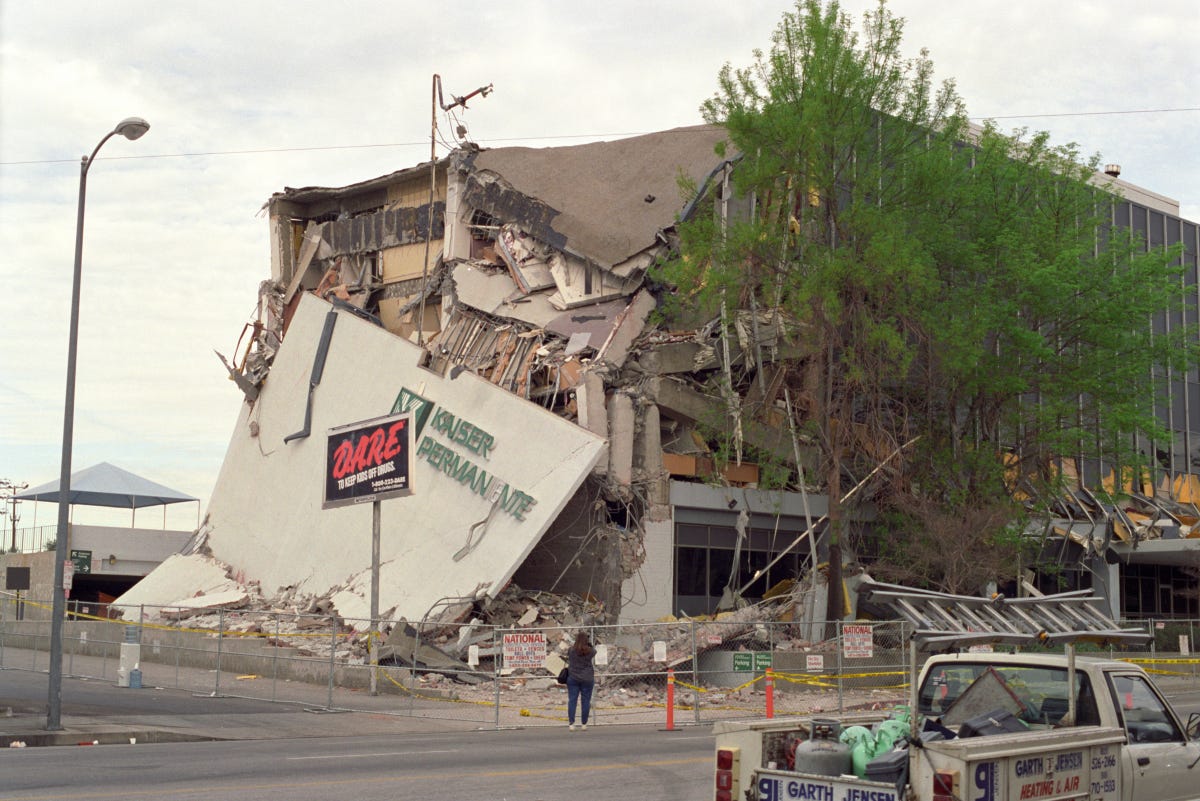
On January 17, 1994, the Northridge earthquake struck the San Fernando Valley region of Los Angeles, causing widespread destruction. With a magnitude of 6.7 and a shallow depth of 19 kilometers, the earthquake’s impact was severe despite its moderate magnitude. The epicenter was located near Northridge, and the event occurred along the previously unknown Northridge Blind Thrust Fault, highlighting the hidden seismic dangers beneath California.
This one was especially fun for me because I was living in LA at the time! I don’t have any strong memories of the event, but now that I think of it, this could be where my phobia stems from. That’s the Substack therapy right there.
Anyways, the damage was particularly severe in the San Fernando Valley and surrounding areas, with freeway overpasses collapsing, including those on Interstate 5 and State Route 14, causing major transportation disruptions. Residential neighborhoods saw extensive structural damage, with many soft-story buildings (those with open parking or commercial spaces on the ground floor) collapsing. In total, 57 people died, and over 9,000 were injured.
Recovery efforts were swift, with federal, state, and local agencies providing billions in disaster relief. Los Angeles implemented stricter building codes, requiring retrofitting of vulnerable structures. The earthquake also advanced seismic research, enhancing the understanding of blind thrust faults. With an estimated $44 billion in damages, the Northridge earthquake remains one of the costliest disasters in U.S. history.
2010 Port-au-Prince, Haiti
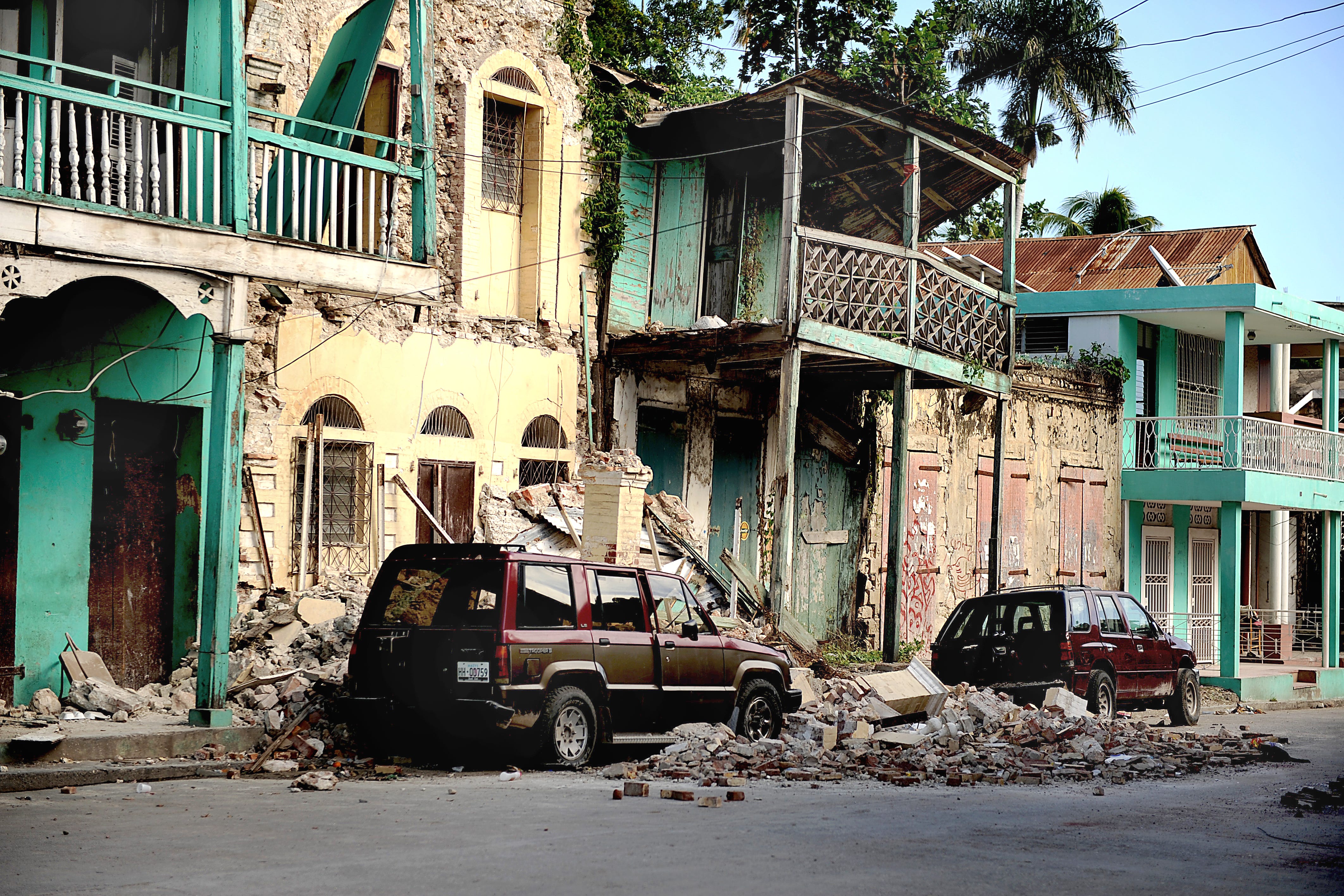
The 2010 Haiti earthquake struck on January 12, delivering one of the deadliest blows in modern history. With a magnitude of 7.0 and a shallow depth of 13 kilometers, the earthquake’s devastation was magnified by Haiti’s poor infrastructure and economic instability. The epicenter was near Léogâne, 25 kilometers west of Port-au-Prince, along the Enriquillo-Plantain Garden Fault, part of the Caribbean and North American tectonic boundary.
Port-au-Prince was hit hardest, with entire neighborhoods flattened. Iconic structures like the National Palace and the Cathedral of Our Lady of the Assumption were destroyed. The estimated death toll ranges from 100,000 to 300,000, making it one of the deadliest earthquakes in history. Over 1.5 million people were left homeless, and more than 300,000 were injured.
The international response was overwhelming, but logistical challenges such as damaged infrastructure and poor coordination hindered aid efforts. The aftermath was further complicated by a cholera outbreak that claimed over 10,000 lives. While billions were pledged for reconstruction, progress has been slow due to political instability and mismanagement. Over a decade later, parts of Port-au-Prince still bear the scars of the disaster, and Haiti’s ongoing struggles have only deepened since.
2023 Turkey and Syria
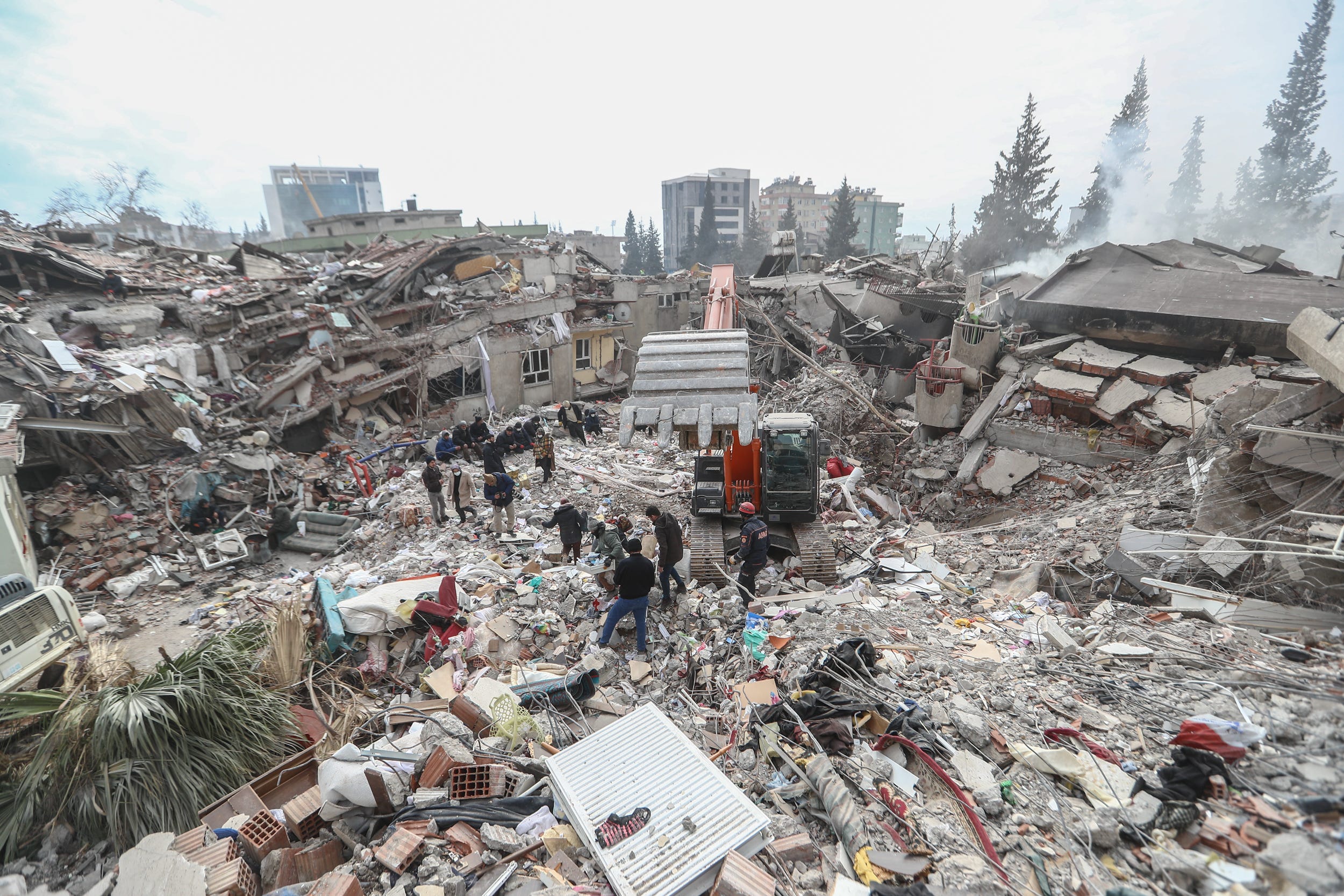
On February 6, 2023, a powerful earthquake struck southern Turkey near Gaziantep, near the border with Syria. The event consisted of two major quakes: an initial 7.8 magnitude earthquake, followed by a 7.5 magnitude aftershock. The earthquakes occurred along the East Anatolian Fault, a tectonic boundary between the Anatolian and Arabian plates.
The devastation was vast, affecting 10 provinces in Turkey and large parts of northwestern Syria. Entire neighborhoods were reduced to rubble, and in Syria, where civil war had already weakened infrastructure, the devastation was particularly severe. The combined death toll reached around 60,000, with millions displaced, forced to endure freezing winter conditions in makeshift shelters.
The international response was extensive, but challenges arose, particularly in Syria, where political divisions and ongoing conflict complicated aid delivery. In Turkey, criticisms emerged over the enforcement of building codes, as many of the collapsed structures had ignored seismic regulations. Rebuilding efforts continue, but the scale of destruction has made recovery slow and complex. In Syria, the reconstruction process remains stalled due to political instability, economic sanctions, and lack of access to affected areas.
2011 Tōhoku, Japan
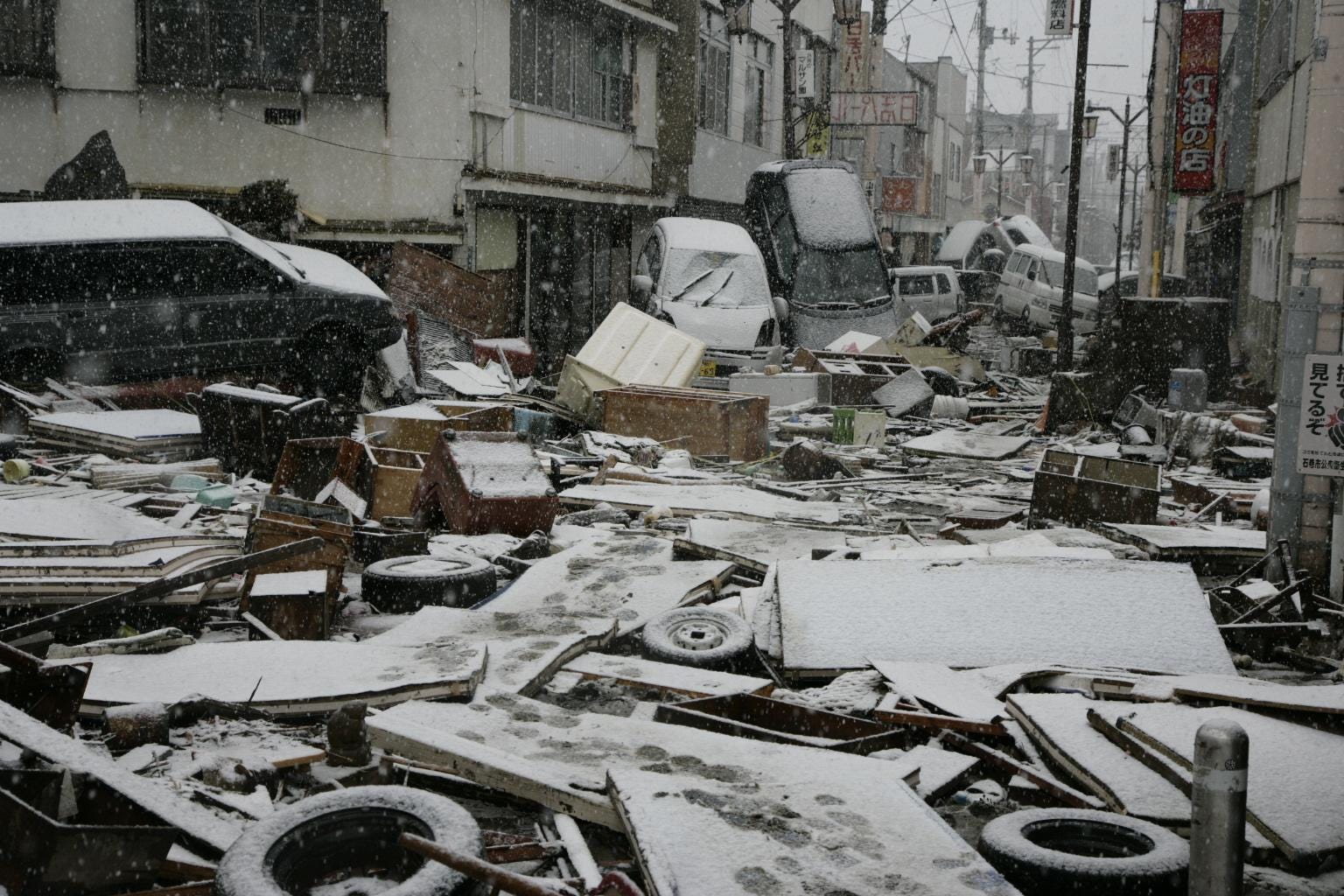
On March 11, 2011, the Tōhoku earthquake and tsunami struck Japan, becoming one of the most powerful and destructive natural disasters in history. The earthquake had a magnitude of 9.1, making it the fourth most powerful quake ever recorded. It occurred along the Japan Trench subduction zone, where the Pacific Plate is forced beneath the North American Plate. The quake’s shallow depth of 29 kilometers and its accompanying tsunami intensified its catastrophic impact.
The earthquake itself caused widespread destruction, but it was the subsequent tsunami that proved most devastating. Waves reaching up to 40 meters high traveled up to 10 kilometers inland, wiping out entire coastal towns. The tsunami also triggered the Fukushima Daiichi nuclear disaster, releasing radioactive material and forcing tens of thousands of people to evacuate. In total, over 19,000 lives were lost, 2,500 people remain missing, and 450,000 individuals were displaced.
The response was immediate, with Japan deploying its Self-Defense Forces and receiving aid from over 160 countries. Reconstruction efforts have included building tsunami-resistant infrastructure, raising entire towns, and continuing the decontamination of Fukushima. The disaster prompted Japan to rethink its nuclear energy policies and invest in new safety measures. With an estimated $235 billion in damages, it remains the costliest natural disaster in history.
Scary stuff.
I agree, because they seem so inescapable compared to weather events or most fires. I was quite surprised at the first earthquake I experienced though I knew about the New Madrid Fault. What I didn't know was that my college campus (and alleged on 4 tower high rise dorm in particular) was built over one of its related fault lines. In September 1968, we saw a relatively minor quake on a Saturday morning. The reaction in my men's dorm was a chorus of hoarse male voices all up and down the corridor yelling, "quit shaking the ...damn bed!" I've sense experienced one of the minor shakes that have hit Virginia in recent decades - one from the 'bang' that emanated from the basement foundation wall my desk was sitting next to.
Earthquakes are indeed quite destructive and inspire fear - but they're relatively localized and even the strongest ones don't have massive global repercussions beyond perhaps supply chain disruptions (if they hit a major metropolitan area), with maybe a couple of exceptions here and there. If they lead to widespread tsunamis, then they do have semi-global impacts in terms of affecting an entire ocean basin, like the Indian Ocean in late 2004.
Volcanic eruptions, on the other hand, can create ginormous global repercussions, not the least with supply-chain and aviation disruptions (in addition to the more localized damage from the direct effect of the eruptions). Plus, depending on where they erupt, they can change the global or hemispheric climate for a good couple of years. Just look at Tambora's 1815 eruption (with the Year Without A Summer the following year) or, to a somewhat lesser extent, Krakatoa's 1883 eruption. (Pinatubo's 1991 eruption and certainly Hunga Tonga's early 2022 eruption fall just short.)
In summary, as I learned during the Covid pandemic of 2020-22 (yet another global disaster), earthquakes are on the whole a local and regional hazard (and strike without warning) whereas volcanic eruptions at least have the potential to be a global as well as local and regional hazard. Thus, geological disasters - and especially gigantic volcanic eruptions - absolutely deserve consideration as threats to global security alongside pandemics, wars, depressions, cyberattacks, solar storms, etc.