

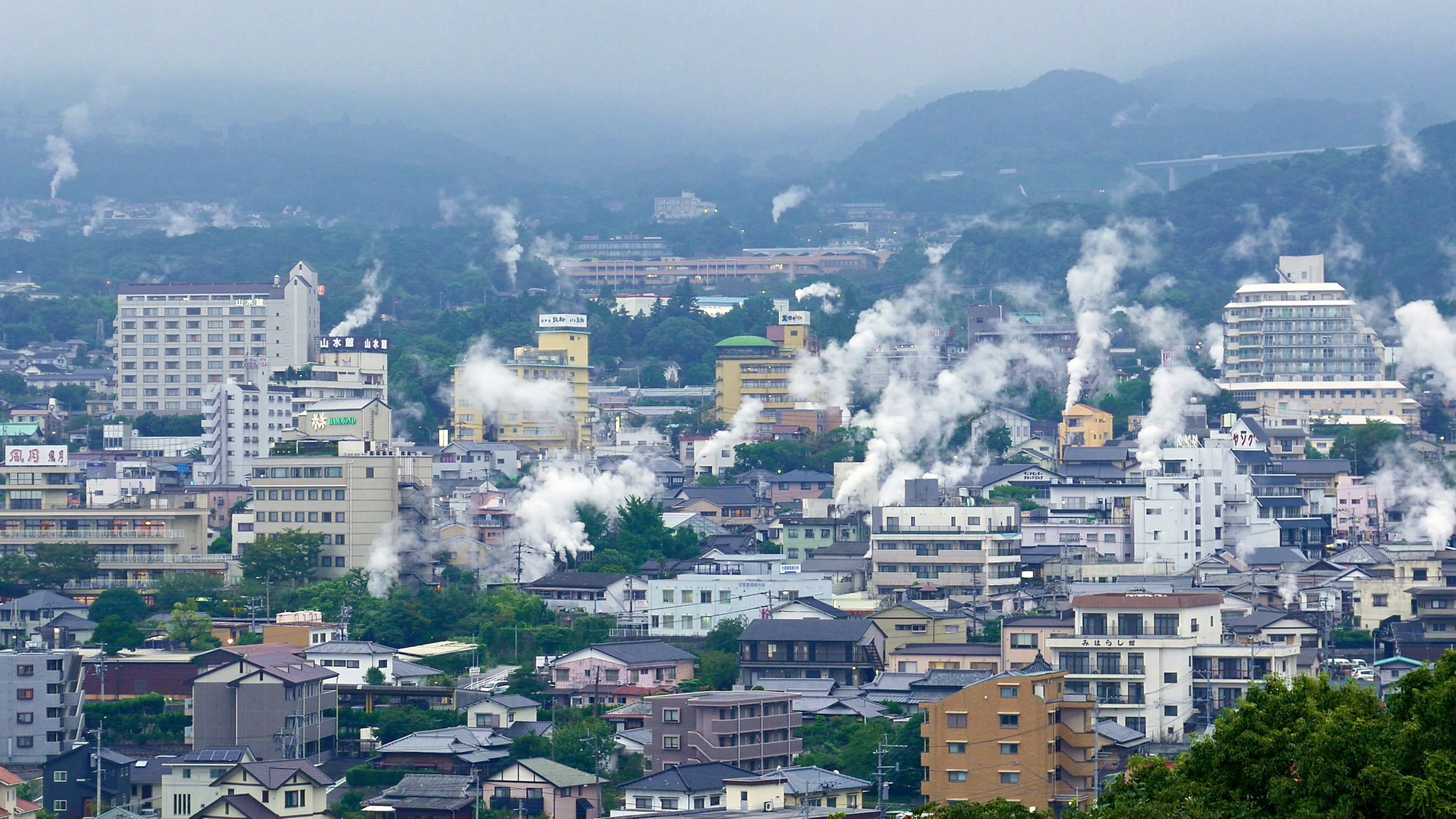
I’m in Beppu, Japan this week! Well technically, I’m in Da Nang, Vietnam but given that there’s a considerable lag between when I film videos and when videos are published (due to editing and post-production stuff, yada yada) for the purposes of today’s newsletter, I’m in Beppu! And let me just say, this is an interesting place.
Of course, if you want to see what Beppu is like in person, well, I now have a whole video for you!
Beppu, a city located on the southern island of Kyushu in Japan, is filled with hot springs, also known as onsen in Japan. Nestled between the mountains and Beppu Bay, the city, which only has about 110,000 people living in it, sits in an area of intense geothermal activity, producing more hot spring water than any other location in Japan. In fact, Beppu's steamy reputation comes from the fact that it releases more geothermal water than any other place in the world, apart from Yellowstone National Park, making it the steamiest inhabited place on Earth, a distinction to be sure, but an important one. Yellowstone National Park isn’t exactly a city! What’s even cooler though is that throughout the city thick clouds of steam rise from the ground (see the photo above), billowing out from bathhouses, natural vents, and bubbling pools, creating an otherworldly atmosphere. In truth, only a relatively small part of Beppu is like this, but it’s still pretty cool when you’re there.
Of course, Beppu's geography contributes to its extreme geothermal activity. It sits within a volcanic zone shaped by the tectonic activity of the Philippine Plate, which generates the underground heat needed to produce its onsen. Something that has been naturally occurring for thousands, perhaps tens of thousands of years. In fact, Beppu’s onsen have been used for centuries by Japanese, with records dating back to the 8th century during Japan’s Nara period. By the Edo period, the area had developed into a popular destination for travelers seeking relaxation and medicinal healing. However, it wasn’t until the 20th century, with the expansion of railways and tourism, that Beppu truly transformed into the onsen capital of Japan. Today, the city boasts over 2,000 hot spring sources and eight major onsen areas, collectively known as the "Beppu Hatto."
Now, here’s the thing about onsen. There are onsen that are for bathing, which can be very relaxing. Alexa and I both tried it out while we there and it was a very pleasant experience. But there are also onsen that are not for bathing. They are way too hot and spew out water that would scald you if you actually got close to it. The most well-known of these non-bathing onsen are the "Hells of Beppu," a collection of visually striking, highly acidic and boiling hot springs that are only meant for viewing rather than bathing. These include the cobalt-blue Umi Jigoku, the blood-red (looked more orange to me to be honest) Chinoike Jigoku, and the violently bubbling mud pools of Oniishibozu Jigoku. There are actually seven Hells in total, but some are better than others and two are, in my opinion, kind of depressing. There’s one that has crocodiles in very small enclosed areas and another one that has a bunch of large tropical fish which are also in tanks that are way to small. It’s kind of depressing. The other Hells are pretty cool to see, but those two left me with a bad feeling.
Despite its heavy reliance on geothermal activity, Beppu has maintained a delicate balance between tourism and nature. The city is also home to sand baths, mud baths, and steam baths that showcase the variety of ways in which hot springs can be enjoyed. In recent years, Beppu has gained international attention for its creative approach to promoting its onsen culture, including viral campaigns like the "Spamusement Park" concept, which envisioned a theme park where visitors could ride attractions while submerged in hot spring water.
Now, all that said, the actual city of Beppu is very interesting and, dare I say, weird. It has all the trappings of a resort city whose best days are long behind them. The city’s hotels look a bit run down and its downtown area was noticeably absent of thriving storefronts. Something you can tell was definitely booming 10 or 20 years ago. That might seem like a bad thing, but I actually think it makes Beppu quite charming! While there were still plenty of tourists, it wasn’t nearly as crowded as it might have been in the past and that meant it was kind of easy getting around. Though the English proficiency in Beppu was basically non-existent. So if you do make it down to soak in some onsen, be sure to have Google Translate ready to go!
Next week I’m off to Taiwan which will come with some more fun articles. So stay tuned for that!
A positive side to tectonics as well as dealing with energy issues
Great stuff for the A levellers IMO