



If you learned anything about Greenland and Iceland well in primary school, you likely heard the famous paradox “Iceland is actually green, and Greenland is actually ice” and the reason why their names seemingly fly in the face of reality.
This is one of geography’s favorite anecdotes, a story of Viking deception and trickery that has survived for a millennium. The popular legend claims that the Vikings deliberately swapped the names to fool pirates and unwanted settlers. As the story goes, they named their lush, beautiful island “Iceland” to scare people away, and the frozen wasteland “Greenland” to lure enemies to their doom.
It’s a fantastic story. It’s clever, it’s ironic, and it paints the Vikings as master trolls of the medieval world.
There is just one problem:
It ain’t true!
While the names are indeed a bit of a mismatch today, they weren’t the result of a coordinated conspiracy to switch the labels. The real story involves a depressed sailor, a PR-savvy exile, and a global shift in climate.
Why we love the “bait and switch” myth
Why has the “conspiracy theory” version of history remained so popular? Basically, as humans, we love irony! The idea that a name is the exact opposite of reality is naturally memorable. For example the Holy Roman Empire was neither holy, nor Roman, nor really an empire in the traditional sense.
The myth also appeals to our perception of Vikings. We like to imagine them not just as brutes, but as cunning strategists. The idea of a “medieval marketing scam” where pirates are tricked into sailing toward glaciers while the locals enjoy green meadows is simply too entertaining to fact-check.
The reality of Iceland

The reality is that Iceland wasn’t named to trick anyone. It was named by a man who was having a terrible year and he was pretty grumpy about it.
In the 9th century, a Viking named Flóki Vilgerðarson (often called Raven-Flóki) set out to settle the island. At the time, the island had other names, including Snæland (Snowland) and Garðarshólmur (Garðar’s Isle).
Unfortunately, Flóki’s trip was a disaster. According to the legend, his daughter drowned en route. So a pretty rough beginning. But upon arrival, he was so enchanted by the good fishing that he forgot to harvest hay for his livestock which lead to all his animals starving to death once winter rolled around.
Depressed and ruined, Flóki hiked up a mountain in the spring to check the weather. He looked out into a fjord (likely Vatnsfjörður) and saw it choked with drift ice from Greenland. In a fit of bitterness, he renamed the country Ísland (Iceland).
When he returned to Norway, he told everyone the land was worthless. However, his crewmen disagreed, spreading rumors that “butter dripped from every blade of grass.” The “butter” rumor won out, and settlers flocked there anyway, keeping Flóki’s bitter name despite the lush summer landscapes. Which isn’t surprising because the Vikings were, if nothing else, always looking for more places to settle.
The reality of Greenland

Now if Iceland’s name was born of depression, Greenland’s name was born of ambition.
About a century after Flóki, a volatile Viking named Erik the Red was exiled from Iceland for manslaughter (a habit he had picked up from his father, who was exiled from Norway for the same reason, yada yada no need to get into the details). So Erik sailed west and discovered a massive landmass.
Unlike the “Bait and Switch” myth suggests, Erik wasn’t trying to protect Iceland. After all, he was banished from it. For all we know, he greatly disliked Iceland at the time. But he did want to start his own colony where he could be a chieftain.
Erik knew that to build a settlement, he needed people. And so he returned to Iceland after his exile and pitched the new land to his fellow Vikings. The Saga of Erik the Red explicitly states his reasoning:
“He called the land Greenland, for he said that people would be more tempted to go there if it had an attractive name.”
It was, effectively, a real estate scam. It very well may be the oldest real estate scam in history.
But it was once greener
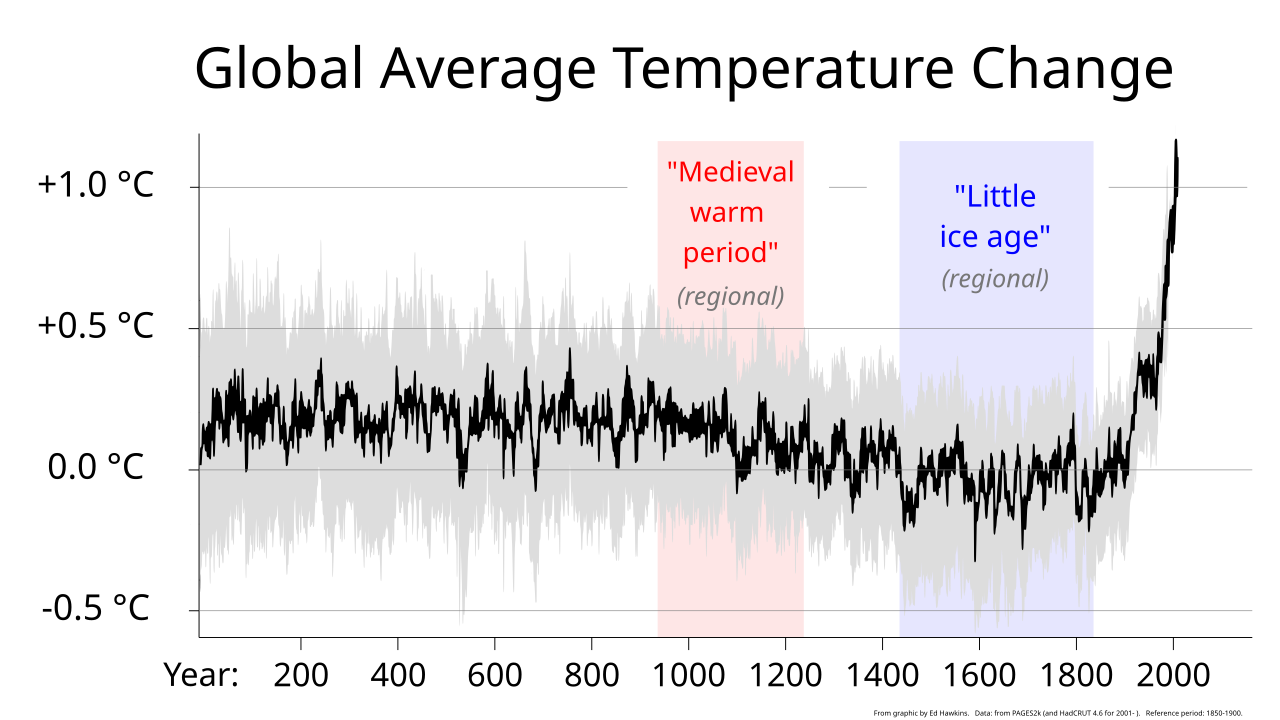
There is a crucial piece of the puzzle often missed: The Medieval Warm Period.
When Erik the Red arrived in Greenland (around 985 AD), global temperatures were significantly higher than they would be until basically today. In fact, a study found that average temperatures in Greenland exceeded the average temperature between 1961–1990. So the southern fjords of Greenland were likely much greener, potentially supporting birch forests and grazing land for sheep and cattle.
At the same time, the drift ice that Flóki saw in Iceland was a real threat to navigation. So, to a Viking in the year 990 AD, Iceland was a place where you might get trapped by sea ice in the winter and Greenland was a place with green, grassy fjords ripe for farming.
So the names weren’t really a trick to swap settlers. Though I supposed Greenland may have been a small trick. A diet trick if you will. They were named by two different men, 100 years apart, with totally different motivations.
The irony we see today is largely due to the cooling climate that followed (the Little Ice Age), which buried Erik’s green settlements under ice, leaving us with the confusing map we have today. And, perhaps in another level of irony, we very well may come full circle once again and Greenland will become green due to the current climate change that’s seeing the arctic regions warm and more than twice the global average.
Apparently the southern extreme of Greenland still will support some tree growth (there's one official "forest" in a protected valley) but in general the appropriate species haven't evolved or arrived there naturally. I'm surprised, though, that since the climate used to be warmer, more of the original forests haven't held on till the present day.