

First, an apology! I’ve neglected this Substack for a few weeks. As you all know, this newsletter is a labor of love for me. I don’t charge anything for it. It’s simply here because I like writing and I like writing about geography. Unfortunately, this also means that when life gets busy (which oh boy has it been busy!) this is one of the first things I need to drop to make space for the things in my life and business that need to be prioritized. Also, admittedly, since I always try to tie my weekly Tuesday video topic in with whatever I’m writing about, sometimes I just don’t have a good topic that matches up. Or I’ve said all I want to say in the video about that topic. Maybe it’s a sign I need to brand out a bit. Anyways, I’ve droned on long enough. Sorry for the lack of articles, but here’s a fun one about the North Sea which is just way weirder than I ever thought.
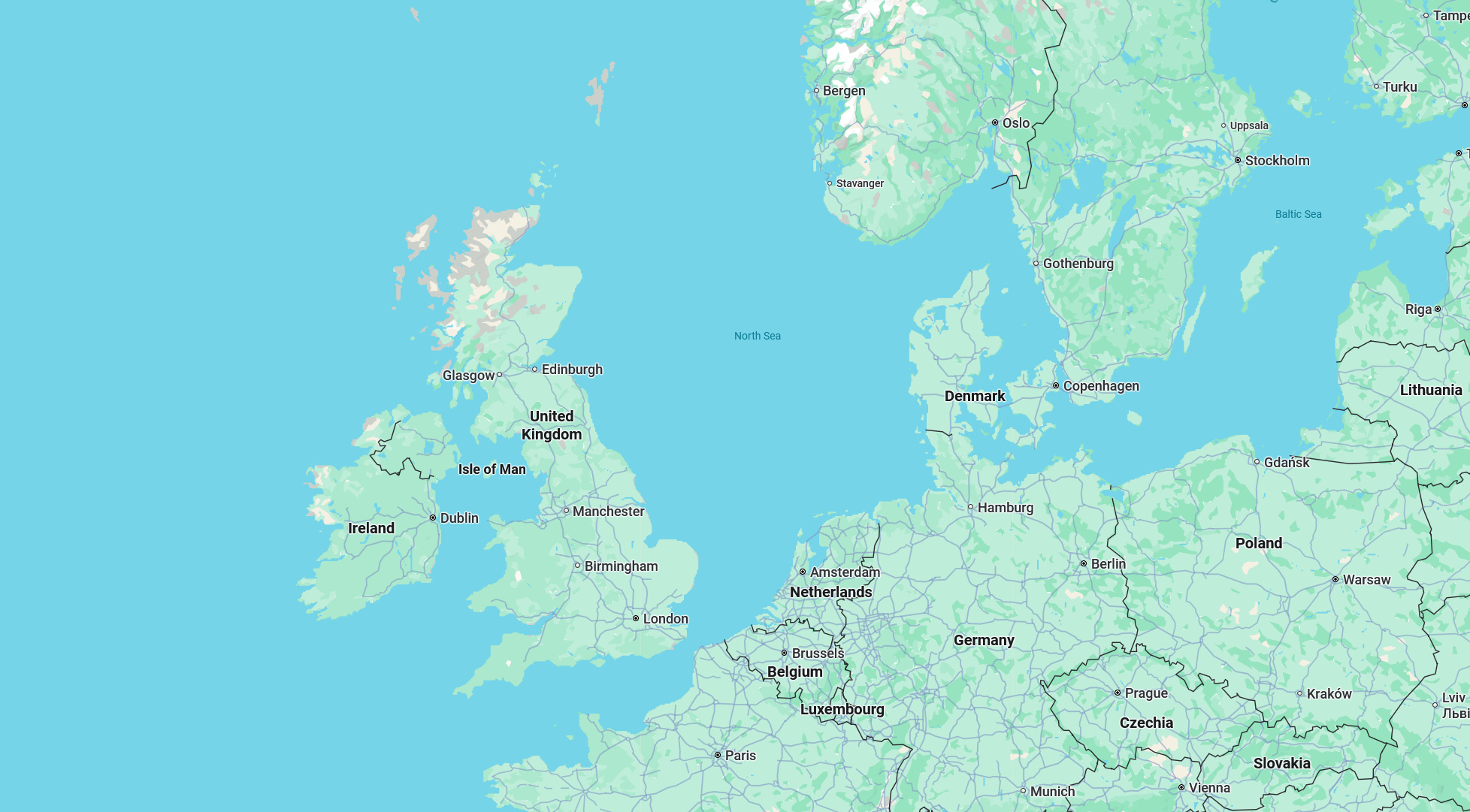
At first glance, the North Sea seems pretty standard. It’s a big body of water separating the UK from Scandinavia and mainland Europe. But the North Sea is actually incredibly weird, surprisingly violent, and it’s built like a giant trap for water.
The secret to its strangeness? It all comes down to its shape. The North Sea is essentially a massive, continent-sized funnel. A quick glance at literally any map will confirm. It’s one of those things where, once you see it, you’ll never not see it. And when you mix a funnel with angry Atlantic storms, things get chaotic fast.
The top of the funnel (the north end)
Alright, so to understand the North Sea’s weirdness, we have to look at its borders (as we always do). At its northern end, spanning the gap between Scotland and Norway, the sea is wide open. This northern boundary is broad, deep, and directly exposed to the brutal, churning waters of the Norwegian Sea and the North Atlantic Ocean.
When a deep winter depression or a massive storm rolls in from the Atlantic, roaring northwesterly winds push colossal amounts of ocean water right through this wide-open door.
But here’s the thing: if the water had a clear path to just keep flowing, it wouldn’t be a problem. But it doesn’t.
Which leads us to…
The bottom of the funnel (the sound end)
So, as that massive surge of Atlantic water travels south toward mainland Europe, two things happen with respects to the continental shelf:
First, the sea floor rises and the water gets progressively shallower. This is basic land-ocean stuff. The sea gets shallower until it’s not longer under water. This probably doesn’t need to be pointed out, but it is an important aspect for what goes on in the North Sea because there’s something else that is quite unique to this area: the coasts of England and mainland Europe taper toward each other.
At the very bottom of this funnel is the English Channel, specifically the Strait of Dover. At its narrowest point, the Strait is just 21 miles wide. That is incredibly small compared to the hundreds of miles of open water up north. People have literally swam across this strait.
The funnel overflows
So, what happens when billions of gallons of water are violently shoved into a wide opening, only to find that the exit door is practically closed?
The water piles up. It over flows. It back flows. It bursts at the seam. Whatever analogy you want. It does all the same things as when you put too much water into an actual funnel.
Basically, it can’t squeeze through the English Channel fast enough, so the water has nowhere to go but up. And this creates what meteorologists call a storm surge. The shallow bottom forces the incoming waves to grow taller and steeper, while the narrow shores compress the water, drastically raising the sea level.
This funnel effect makes the North Sea one of the most volatile and dangerous bodies of water on the planet. It’s the exact reason why the North Sea is famous for terrifyingly choppy, unpredictable waves. It’s also the reason why countries at the bottom of the funnel—most notably the Netherlands—have spent centuries building the most advanced sea walls and flood barriers in human history. They aren’t just fighting regular ocean tides, they’re fighting the pressure of an entire ocean getting wedged into a funnel. Honestly the way Amsterdam has managed to stave off the ocean is already impressive enough, but given this context… dang!
This is also why the coast of northwest Germany happens to consist of mostly mud flats. The subject of my video today which you watch at the link above.
Alright, that’s all. Nice to be back! See you next week.
Yo, What is a Funnel ?
I enjoyed watching the video yesterday. This was a fantastic follow up. Keep up the good work!