

The Métis people of Canada are neither European nor Indigenous
They're both!
In the vast interior of North America, a new group of people emerged. This wasn’t a new European colonizer and it wasn’t a new indigenous tribe. Well, actually, they kind of were on both accounts. These people were born not of a single origin, but from the meeting of two worlds: the Indigenous nations who had thrived on the continent for millennia and the European newcomers who arrived in search of fortune. These are the Métis, a distinct Indigenous people of Canada whose story is woven into the very fabric of the nation's history and geography.
I became interested in the Métis because of my recent video all about Manitoba where they featured prominently. Which, if you’re interested in Manitoba, check out the full video right here:
Now, in many ways the Métis are the Canadian equivalent to the Mestizo peoples of Mexico. That’s not to say they’re the same, but the combination between European and indigenous ancestry is certainly a unique factor. But the genesis of the Métis people lies in the fur trade (as opposed to Spanish conquest), the economic engine that drove European expansion across the continent from the 17th to the 19th centuries. European men, primarily French-Canadian voyageurs and Scottish and English traders, journeyed deep into lands inhabited by Cree, Ojibwe, and Dene peoples. And because they were so far from the European colonial settlements in the east, these men formed relationships and families with Indigenous women. These unions, known as marriages à la façon du pays or "according to the custom of the country," were more than simple arrangements; they were strategic alliances that bonded the trading companies to the Indigenous communities who were essential for their survival and success.
But it would be the children born of these unions who would become the first Métis. These children grew up in a unique space, possessing an intimate knowledge of the land and Indigenous ways of life from their mothers, while also being exposed to the languages, religion, and economic practices of their European fathers. Not all, of course, but many were expert hunters, trappers, and guides, fluent in multiple languages and culturally adept in both worlds. Yet, at the same time, they didn’t fully belong to either. Rather these children were the beginnings of a new nation and, like most nations, they would also seek to carve out land for themselves.
This burgeoning identity found its geographic space in the Red River Valley of what is today Manitoba. Here, the Métis established their first major settlements, creating a society that was uniquely their own. And despite being half European, their settlements were not organized in the uniquely square survey system later imposed by the Canadian government. Instead, the Métis organized their communities around the river lot, or seigneurial, system inherited from their French-Canadian ancestors. Each family received a long, narrow strip of land that fronted a river, typically the Red or Assiniboine. This ingenious design provided equitable access to the river for transportation and water, riverbank land for a home and garden, open prairie for farming, and a wooded area at the back for fuel and lumber.
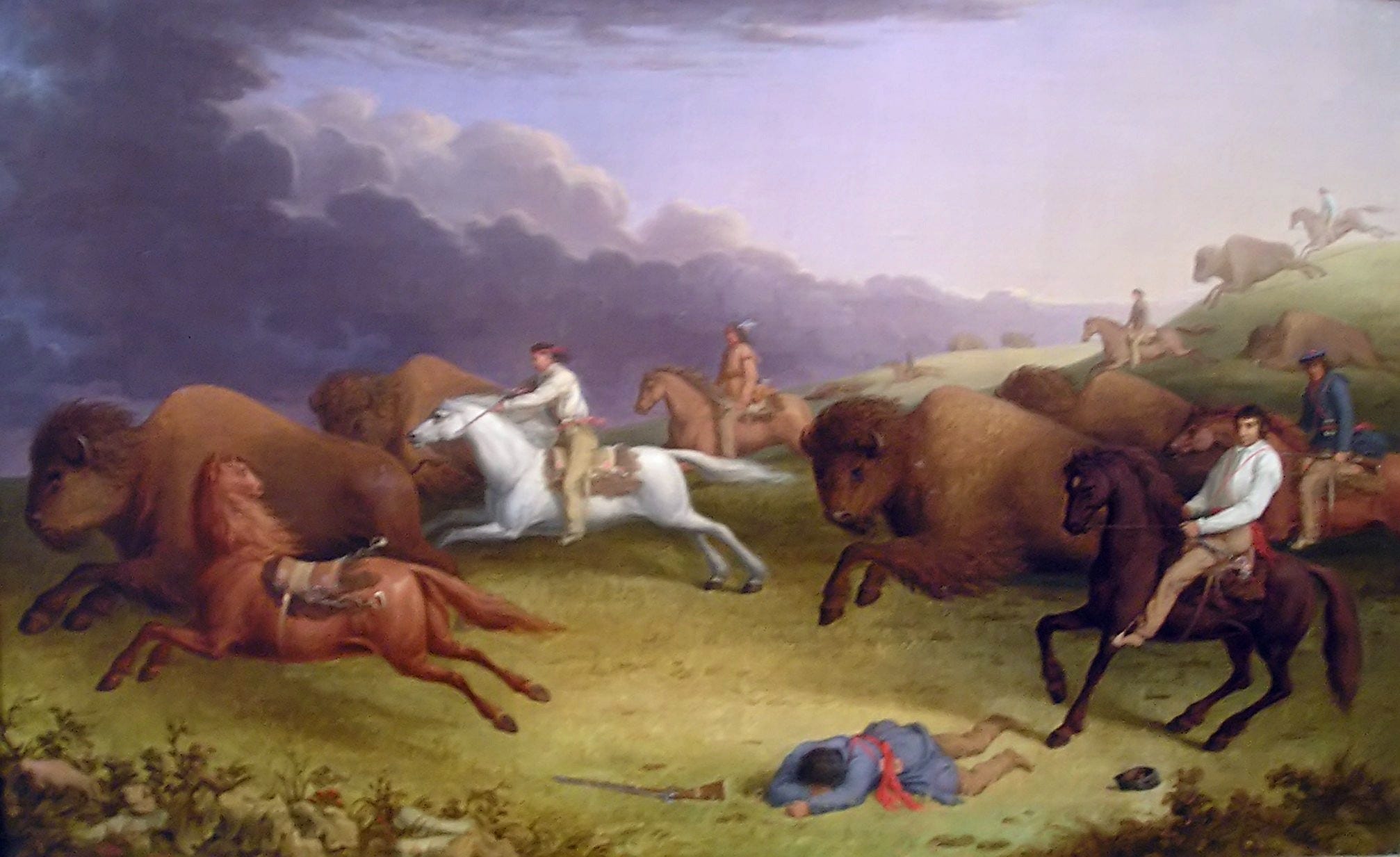
Now, life in the Red River settlement was anchored by two great pillars: the river lot farm and the bison hunt. The semi-annual bison hunt was the defining event of Métis society. It was a massive, highly organized communal endeavor that involved hundreds of families. Led by a democratically elected "Captain of the Hunt," the community established elaborate rules and laws governing the procession. The hunt was not merely for sustenance; it was a military-style operation that reinforced social bonds, fostered leadership, and provided the pemmican and hides that were the lifeblood of the regional economy. It was on these great hunts that the Métis truly solidified their sense of themselves as a cultural nation.
Of course, what truly distinguishes the Métis from both their First Nations and European ancestors is this synthesis of cultures into something entirely new. This is most powerfully illustrated in their language, Michif. A truly unique mixed language, Michif is primarily composed of French-origin nouns and Cree or Saulteaux-origin verbs, woven together with its own distinct grammar. Unfortuantely, as of 2021 only about 1,800 native speakers existed.
Finally, as with everything else, Métis culture also blended indigenous and European traditions. The spirited fiddle music of their Scottish and French heritage combined with the intricate footwork of Indigenous dancing to create the Red River Jig. Their iconic woven sash, the ceinture fléchée, became a symbol of their identity, a multi-functional and beautiful piece of art. Métis artisans developed a distinctive style of floral beadwork, combining Indigenous techniques and materials with European designs, often referred to as "the flower beadwork people." Their spirituality often blended Roman Catholicism with Indigenous beliefs, creating a worldview that was uniquely Métis.
This is geography at its heart for me. I had heard about the Métis people before but never truly dived into who they were as a culture. But the more I read on them, the more fascinated I became. In truth, this article doesn’t do them justice but I wanted to distill who they are in some way because they’re truly unique amongst the story of North America.
Oh and there are Métis people within the United States, but their numbers are far fewer and, as far as I know, not really recognized by the U.S. government in any way. Certainly their impact on the United States is relatively light compared to Canada where they basically created the entire province of Manitoba.
The word Métis is cognate to Mestizo, who are the majority in Mexico and some other Latin American countries.
https://substack.com/@collapseofthewavefunction/note/p-165533740?r=5tpv59&utm_medium=ios&utm_source=notes-share-action