

The geographic tragedy of the Colorado River
And the Gulf of California 😢
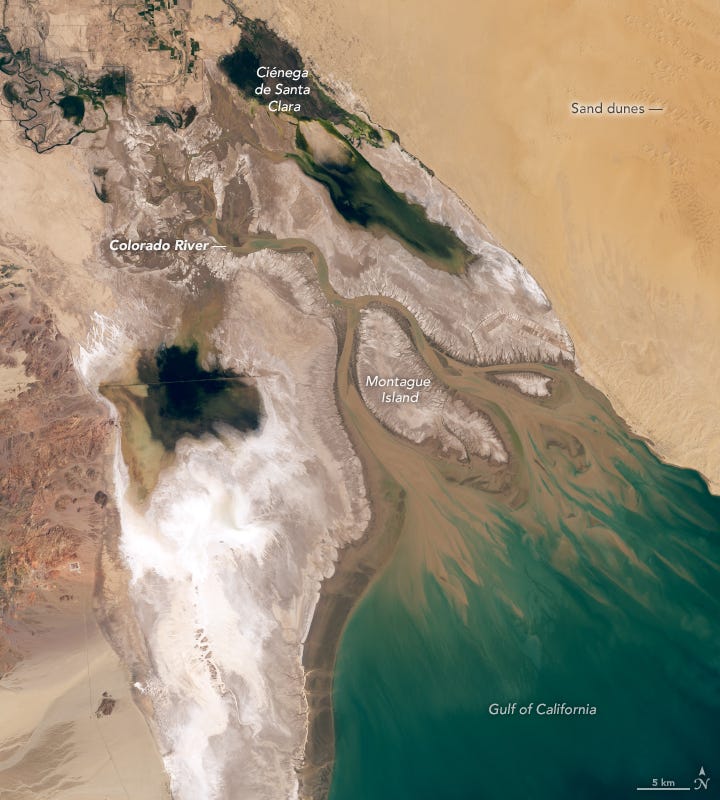
Make no mistake: the Colorado River is one of the great rivers of North America. Even if its overall (and maximum) discharge is far less than that of the Mississippi, St Lawrence, Ohio, Columbia, or many other rivers. After all, it’s the Colorado River that gave us the Grand Canyon, what of the great natural wonders of the world. And, at its height, the Colorado River roars fiercely as if its an unstoppable, unbeatable force of nature. Of all things, the Colorado River is the architect of the American West, a hydraulic engine that has moved literal mountains.
Unfortunately, while the river might feel unstoppable at times, for most of the last 60 years, this gigantic force of nature has whimpered out into the sands of the Sonoran Desert, roughly 50 to 100 miles short of its natural destination: the Gulf of California. This is the artery that connects the Rockies to the sea… and it’s been severed, turning one of the planet’s most vibrant aquatic ecosystems into a desolate salt flat.
The southwest is mighty thirsty

So how does a river that drains 246,000 square miles simply vanish into the sand? The answer lies in a metaphor that has been used time and again for this exact geographic scenario: a bank account that is perpetually overdrawn.
The first line of credit that was tapped into the Colorado River occurred in 1922 with the signing of the Colorado River Compact. And, just so we’re clear, a “Compact” is a basically a state-to-state treaty that is managed by the federal government of the United States. Without one, there’s no way for a state to sign a treaty with another state. It’s against the constitution.
Anyways! The bureaucrats and politicians of the era sat down to divide the river’s water between seven US states and Mexico. Working with data from an unusually wet period, they allocated roughly 15 million acre-feet of water annually. But again, this was during an unusually wet period of time. The river rarely actually carries that much water. So, from the beginning, people promised away water that doesn’t exist most of the time.
Today, that structural deficit is colliding with a thirsty reality because roughly 40 million people rely on this water. And you can roughly divide it into two categories:
Agriculture: Roughly 70-80% of the river’s flow is diverted to grow alfalfa, cotton, and winter vegetables in the Imperial and Coachella Valleys.
Urban Sprawl: Phoenix, Las Vegas, Los Angeles, and San Diego all siphon massive amounts to sustain desert metropolises.
On top of this over-consumption, we have “aridification.” As the West heats up, the snowpack shrinks and the soil gets thirstier, absorbing runoff before it even hits the riverbed. The river is being squeezed from both sides: less water coming in, and more straws sucking it out.
Which ultimately means one thing… because America simply isn’t going to not use up its promised share of the water.
The death of the delta
The political squabbling over water rights often obscures the physical reality of what we have done to the geography of the continent. Basically, we’ve erased a landscape.
In 1922, the conservationist Aldo Leopold explored the Colorado River Delta by canoe. He described it as a “milk and honey wilderness, ”a jungle of green lagoons, jaguars, deer, and millions of migratory birds. It was an oasis the size of Rhode Island, a riot of life in the middle of a burning desert.
“The river was everywhere and nowhere, for he could not decide which of a hundred green lagoons offered the most pleasant and least speedy path to the Gulf.” — Aldo Leopold4
Today, that “green lagoon” is gone.
Without the fresh water pushing out to the sea, the Delta has become a hyper-saline desert. The native willow and cottonwood forests have died off, largely replaced by invasive, salt-tolerant tamarisk (salt cedar) or bare mud.
The damage extends into the ocean itself. The upper Gulf of California relies on the brackish mix of river water and seawater to act as a nursery for shrimp and fish. Without the river’s nutrients and silt, the marine food web crashes. The Vaquita porpoise, the world’s most endangered marine mammal, is teetering on extinction partly because the ecosystem it calls home has been fundamentally altered.
But the death of the river is not just an ecological disaster, it’s a cultural one as well.
The Cocopah people have lived in the Delta for thousands of years. Their name literally translates to “People of the River.” Their culture, diet, and spiritual life were built entirely around the river’s flow and the fishing it supported.
When the Hoover and Glen Canyon dams choked off the flow, they effectively destroyed a way of life for an indigenous culture. And while the people are still there today, the Cocopah are often left with a dry riverbed and a fight for cultural survival, forced to dredge murky channels in hopes of finding fish that once thrived in abundance.
Why this matters to you
But why should someone in Denver, Salt Lake City, or Los Angeles care about a dry delta in Mexico? It’s distant. It’s another country. It doesn’t directly affect the people living in those cities or regions.
But a closed basin is a dying basin. You see, a river system is designed to flush. It carries salts and minerals from the mountains down to the ocean. When you stop that flow, the salt has nowhere to go but into the soil and the groundwater. As the water is used and reused upstream, salinity rises, damaging crops and forcing expensive desalinization efforts. And that salinity builds up as the river increasingly doesn’t make it as far.
Basically, yhe dried-up Colorado River Delta is a canary in the coal mine. It’s the physical manifestation of our unsustainability as a species. If the river doesn’t reach the sea, the system is broken. It proves we are living beyond our ecological means.
Is there any hope?
The story of the Colorado is grim, but it’s not over! There is some hope, albeit a distant one.
In 2014, the US and Mexico agreed to a localized experiment known as Minute 319. As part of it, they released a “pulse flow” of water from the Morelos Dam to mimic a natural flood. And for a brief, glorious moment, the river made it to the sea again. Vegetation bloomed, birds returned in droves, and communities in Mexico held festivals on the banks of a river they hadn’t seen in decades.
It proved that the Delta can be healed and that nature, despite appearing dead, can be revived. The ecosystem is resilient, but it’s also thirsty. And saving it requires us to value the Delta as much as we value our lawns and alfalfa fields. Until then, the Delta and the Colorado River at large will remain a literal ghost of its former self.
This is so sad. I live next to Lake Michigan, and water is so important. So many of us are terrified something will eventually happen to our beautiful and amazing Great Lakes.
As fate would have it I was just sitting down to write up the “millisphere” of COLORADO. I’ll send it to you when it’s done. Keep up the good work