

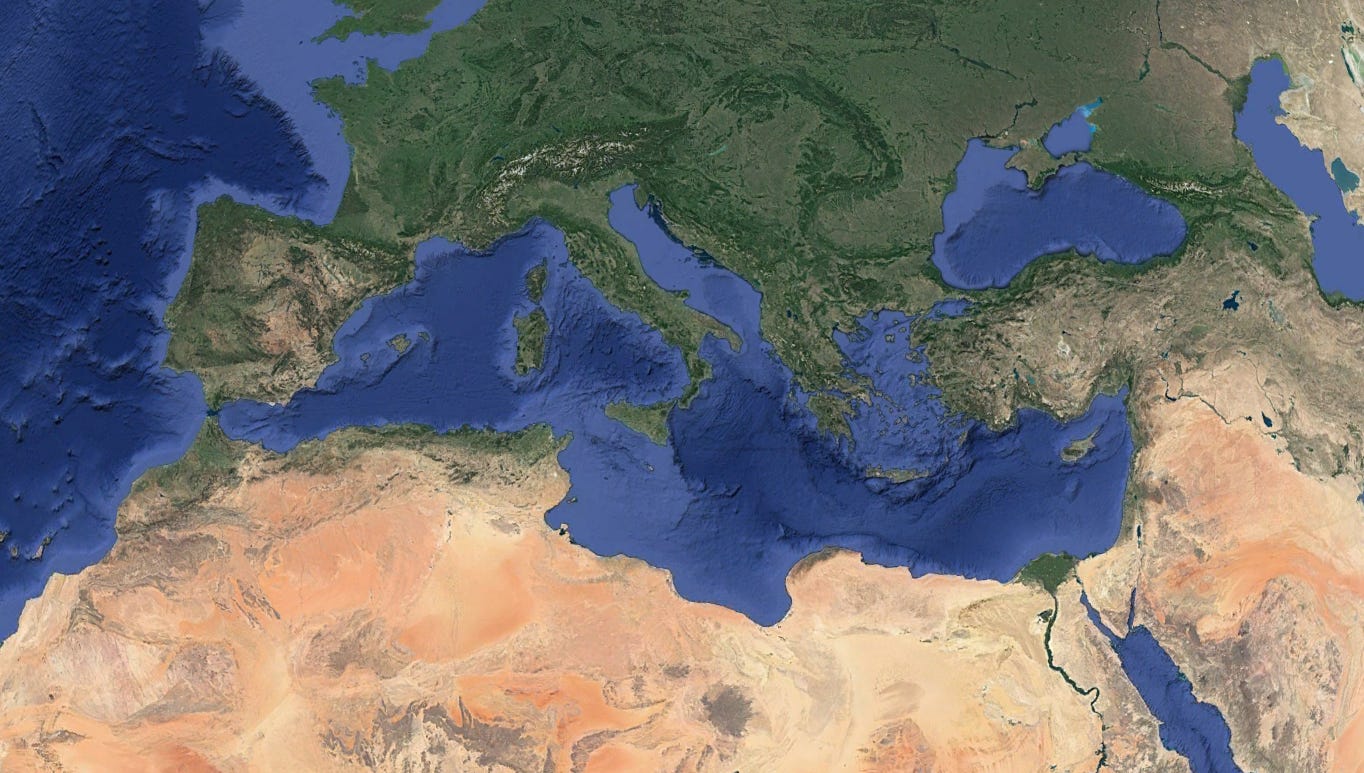
Did you know that, at one point, there was a plan to dam the Mediterranean Sea? I don’t think it was ever taken too seriously, but the mere fact that someone thought it might be a good idea is just incredible! And because I’m feeling whimsicle this week, we’re going to devote our Tuesday article entirely to this terrible, no good, very bad idea. Welcome to Atlantropa.
Oh and in case it wasn’t super clear, this idea never had any realistic chance of happening. There’s never been any serious evidence that any European country was interested in carrying out the plan. The Wikipedia article on the subject mentioend that after World War II, the Allied countries considered it as a way to prevent Marxist ideologies from spreading to Africa, but the source they have for this claim doesn’t mention this at all. So, again, I don’t think it was ever a serious plan.
The historical background of Atlantropa
Atlantropa, a goofy mish-mash word made up of "Atlantic" and "Europe," is a concept that is more fiction than fact, yet still stands out for the sheer amount of crazy its proposing. It was an audacious idea that centered around a massive engineering project aimed at reshaping the geography of Europe and Africa. The project was the brainchild of the German architect Herman Sörgel, who first proposed it in the 1920s and continued advocating for it until his death in 1952.
In the aftermath of World War I, Europe was economically devastated and seeking ways to rebuild and avoid future conflicts. Sörgel viewed Atlantropa as a means of uniting European and African nations in a shared project that would also solve resource scarcity issues. Apparently he believe that a united, “utopian” supercontinent would bring about an era of peace and prosperity, though I doubt this prosperity was for the benefit of Africans. That said Sörgel's plan was nothing if not ambitious. Not many are able to propose this kind of geographic engineering and have it stand the test of time. So let’s run through more exactly what Atlantropa would do.
The vision of Atlantropa
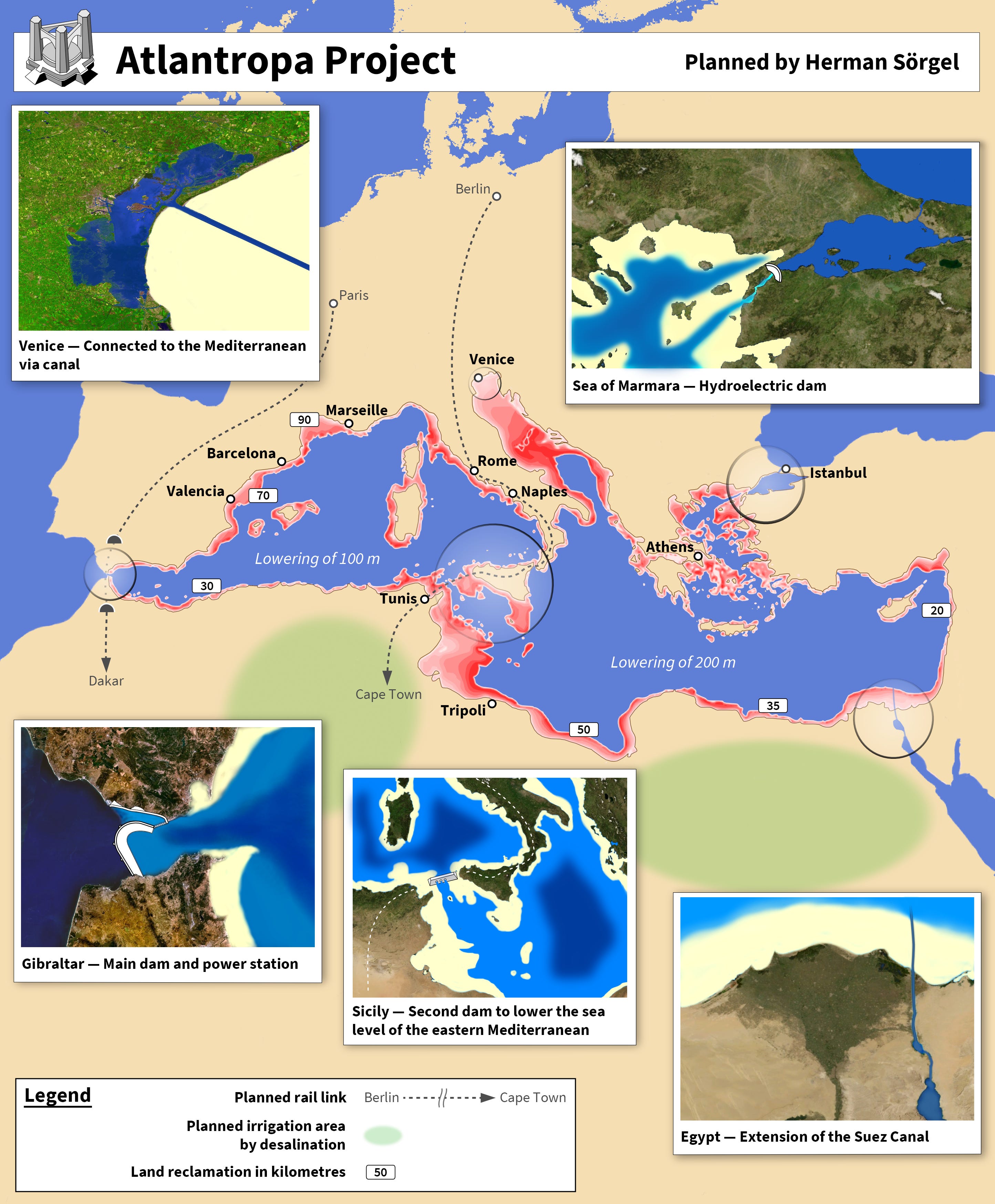
The Atlantropa project's central idea was to build an absolutely massive hydroelectric dam across the Strait of Gibraltar. This dam would both generate enormous amounts of electricity and lower the Mediterranean Sea's level by about 200 meters. By doing so, vast new lands would emerge from the Mediterranean's basin, creating new territories that could be colonized and cultivated.
Fun, side fact: apparently it the book version of Star Trek: The Motion Picture, Atlantropa, Capitain Kirk is standing on a hydroelectric dam on the Straight of Gibraltar. So while the idea of Atlantropa is infeasible at best, clearly it had a huge impact on science fiction writers.
But the engineering feats wouldn't stop at building a dam on the Straight of Gibraltar. Additional dams were proposed for the Dardanelles to control the Black Sea's water level, across the Congo River to form a massive lake that would then irrigate the Sahara Desert, and even between Sicily and Tunisia to further control the Mediterranean's water levels.
The idea was also steeped in automobile-centric design as well. Apparently, one of the primary “benefits” of the plan was that you could connect Europe and Africa by two large mega-highways. One that stretched from Paris, France to Dakar, Senegal and another that connected Berlin, Germany to Cape Town, South Africa. WIth the Mediterranean Sea lowered by 200 feet, a road would connect Italy to Tunisia without the need for a mega-bridge.
According to Sörgel, this series of projects would create new land for settlement, offer increased resources, and foster unity among nations involved, thereby averting wars over scarce resources. A noble goal, but also a very naive one.
Atlantropa is a very bad idea
Despite its visionary nature, Atlantropa faced numerous criticisms and challenges throughout the last few decades.
Firstly, the technical and engineering challenges of the project were completely infeasible. The Gibraltar dam alone would have been one of the largest structures ever built by humanity. The amount of material and energy needed, not to mention the time, workforce, and technological capabilities, were far beyond the reach of mid 1900s technology at the time. Even today it would be a stretch.
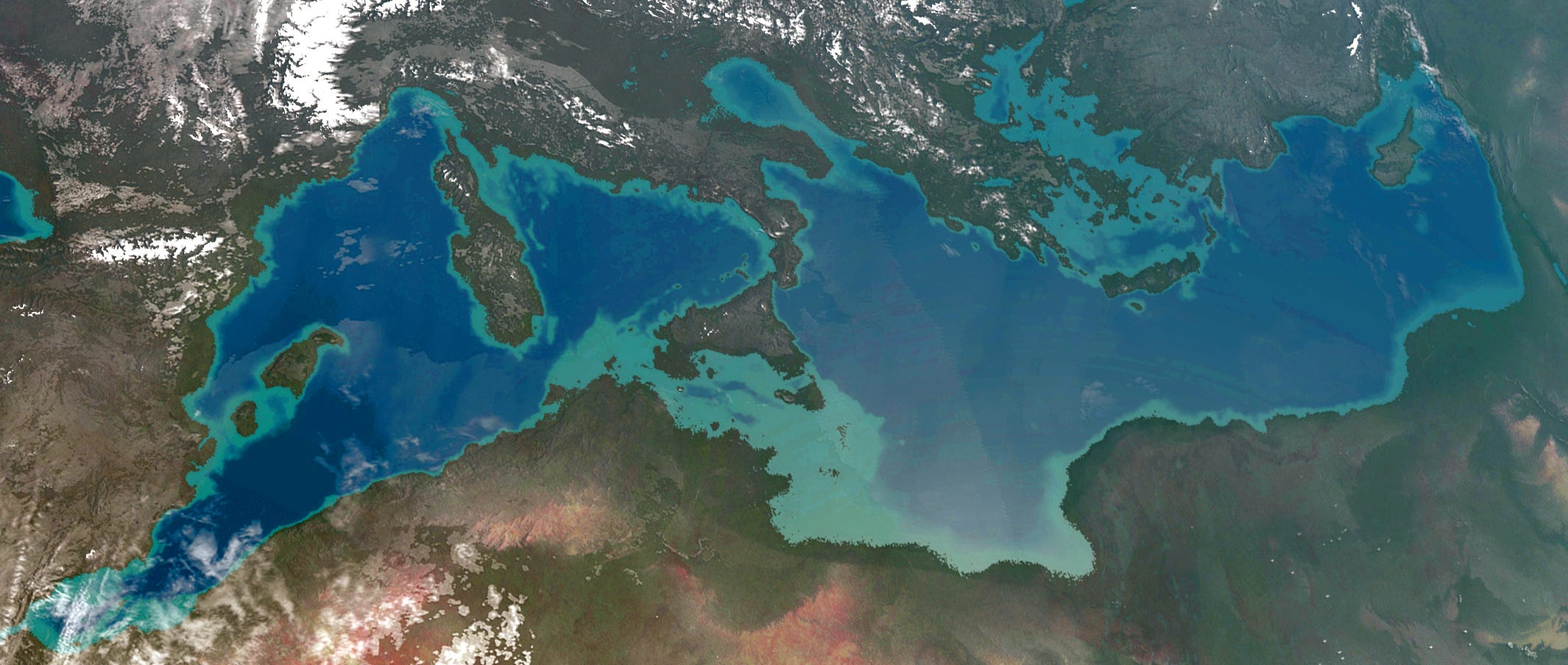
Secondly, the environmental impact would have been enormous. Lowering the Mediterranean's level by 200 meters would drastically alter climates and ecosystems across the region. Millions of people would be displaced, and numerous coastal cities would be left stranded inland. Venice, for example, would absolutely not exist in the same way it does today. Other cities and towns that are reliant on the ocean either for tourism or fishing would be completely upended. Moreover, the massive change in the volume of water would likely have affected ocean currents and possibly even global weather patterns.
Thirdly, there were considerable political and ethical issues, obviously! The project assumed European domination over Africa and was inherently imperialistic, envisioning new lands primarily for the benefit of European powers. None of this is probably surprising given the timing of when this idea was proposed. This colonial aspect of the project was criticized, particularly in the post-World War II era when many African nations were gaining independence.
Lastly, Sörgel's idea that Atlantropa would lead to peace was also challenged. Critics pointed out that such a massive project could just as likely lead to conflict over resources and territories, contrary to Sörgel's utopian vision.
Atlantropa: a geoengineered nightmare
Atlantropa, as a concept, tells us much about the time in which it was conceived. It reflects the early 20th-century faith in technology and progress, a time when humans believed they could shape and control nature to their will. It also echoes the geopolitical realities of the era, particularly European colonialism and the quest for resources.
While Atlantropa was never more than a dream, it continues to be a popular idea because there’s an ever present idea that humans can “engineer” their way out of anything. Don’t like how the planet has shaped something, we can change that! But we actually can’t change everything and, in fact, we’ve shown that often our geoengineering efforts have significant negative externalities that were never accounted for. So many we should just leave the planet alone a bit?