


The Sahel is one of my favorite regions of Africa. Not only is it a strikingly beautiful region, but also it’s simply not that well known. Unfortunately, despite its beauty and unique-ness, the entire region has become pretty unstable,in recent years. In particular, this week has been especially rough on Sahel countries. And that’s why it’s the subject of this week’s “Geography is the News” segment.
But before we get to what’s going on in the news, let’s talk about the region just a little bit, just so everyone knows the region we’re covering today:
The Sahel region
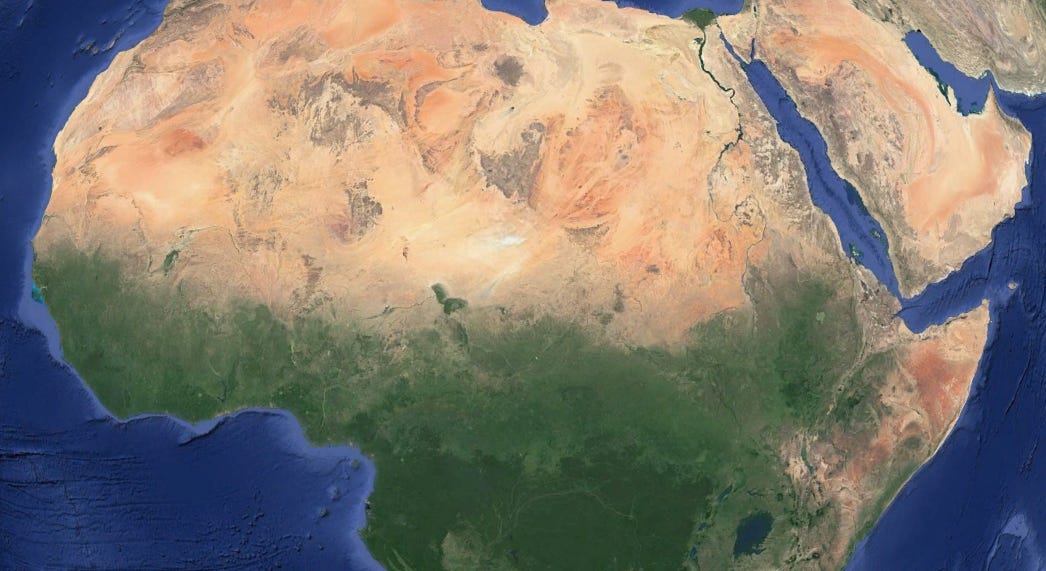
The Sahel is a vast, semi-arid region of Africa that forms a transitional zone between the arid Sahara Desert to the north and the more humid savannas and forests to the south. Stretching over 1,800 miles across the continent, it covers an area of about 1.2 million square miles. That’s a huge area! To give you some context, the large U.S. state of Texas is about 269,000 square miles and the entirety of the United Kingdom (not including overseas territories) is about 94,000 square miles. So the Sahel is quite large.
And within this vast area is a terrain that is mostly flat, with occasional plateaus and low mountains, and soil that is pretty bad overall. The sparse vegetation consists of grasses, shrubs, and a few trees. Overall, rainfall varies widely across the region, from as low as 100 millimeters (4 inches) per year in the west to about 600 millimeters (24 inches) in the east. As you can imagine, this makes any sort of meaningful agriculture pretty difficult, which is why so many Sahel countries rely on imports for food.
The Sahel spans several countries, two of which are going to be the primary subjects of today’s article, but generally include Senegal, Mauritania, Mali, Burkina Faso, Niger, the northern part of Nigeria, Chad, Sudan (including South Sudan), and in some definitions, Eritrea.
But while most of these countries have their own struggles, two in particular, are having a no-good, very bad week: Senegal and Niger. Both of these countries are having issues around who will lead the country into the future, but they’re happening in slightly different ways.
Senegal’s bad week

Senegal, having most recently had a successful democratic election in 2019 for the president, is facing an unprecedented situation today. The country is one of the very few African countries that has never suffered from a coup de’tat or a form of authoritarianism that is fairly common in other countries nearby (post colonialism of course). Unfortunately the country is teetering on the brink of just such a situation today.
Earlier this week, Senegalese authorities issued an arrest warrant for Ousmane Sonko, the leader of the popular opposition party Pastef. According to the AP, he is accused of calling for insurrection, conspiring against the state, threatening national security and other charges. I can’t independently verify any of this, and, frankly, it’s not really my expertise to know the internal workings of Senegal. What I will say though, is that this is a fairly common tactic used by governments not wanting to give way to a popular candidate who can potentially unseat your party.
Sonko’s arrest was followed shortly after by the ruling party disbanding the Pastef party and restricting mobile internet use within the country, another sign that someone isn’t willing to let go of power. All very bad things.
But while Senegal is having a bad week, Niger’s is, surprisingly even worse.
Niger’s very bad week

If Senegal is teetering on the brink of authoritarianism, Niger jumped in head first. If you haven’t been following the news, as of July 26th, soldiers who previously were part of the Presidential Guard held a coup de’tat where they arrested the country’s democratically elected president Mohamed Bazoum and seized control of the government at large. And while all this technically happened last week, this week has been pretty rough for the West African country.
Niger has had a somewhat beneficial relationship with France, it’s former colonial occupier, for quite a long time. So much so that France has been Niger’s second largest import and export partner for quite a long time, just behind China (which is probably not a surprise). Niger would receive things such as food, machinery, and, er, weapons in exchange for uranium which France needs to power all of its nuclear power plants. It was a fairly mutually beneficial agreement. But with the coup, that has all changed. France, and to a lesser degree the United States, have put pressure on the coup to restore the president by withholding aid and trade.
Even ECOWAS, the organization that constitutes most West African countries, have put pressure on the Niger coup holders to restore the former president. Nigeria, Niger’s southern neighbor, has simply cut off power to the country to the extent that they can in order to put pressure. And ECOWAS has not ruled out intervening militarily.
So yeah… things are quite fluid in Niger at the moment.
Sahel’s no good year
While Senegal and Niger are the two stars of today’s article due to their recent issues, the entire region has not been having a good last couple years. You’ll recall earlier this year when two separate military groups within Sudan began fighting each other for control of the country leading to the current civil war. As of today, it’s estimated that about 4 million people have fled the country. Mali and Burkina Faso also had their own coup de’tats in 2021 and 2022 respectively. So this seems to be somewhat of a trend.
And one player in all of this that seems to be, perhaps, what’s stoking all these internal issues is Wagner, the Russian mercenary group. While I can’t find evidence of Wagner’s involvement in either Senegal or Sudan, for Mali, Burkina Faso, and now Niger it’s pretty clear they’ve been involved in all coup de’tat efforts. Which is pretty alarming given that Wagner has also been seen in places such as the Central African Republic, and potentially the Democratic Republic of the Congo. South Africa has also been unusually friendly with Russia as well.
All this is to say, Russia has seemingly been able to bend African countries to its will, much to the chagrin of western countries. And unfortunately, it’s the people within these countries that will ultimately pay the price.