


Good news! For those who live in Portland, OR (me) you may be aware that our fair city’s government is going to look very differently in the not too distant future. For those who aren’t from Portland, let me break down our current system:
Portland, which is a city of over 600,000 people is represented by five people: 4 commissioners and 1 mayor. There are no districts. Those 5 people can come from anywhere and, far more often than not, have hailed from the wealthy west side of the city. I’m sure you can see where some of the problems might begin, but it gets so much worse than that.
You see, while having only 5 people represent 600,000+ is already a bad idea, what really clusterfucks the whole system of government is that those 5 people are then assigned to be the head of different city bureaus (we call them bureaus here not departments, don’t sweat it). So, for example, Commissioner A who has absolutely no education or knowledge of transportation would be put in charge of the Portland Bureau of Transportation. Not just legislatively, but in charge of everything. Bad idea, right? Every other city of Portland’s size (or greater) has a city manager who then hires experts to run their respective bureaus and departments. Like really bad, right? Well I’m sorry to say that it still gets even worse.
As it turns out, when you put petty politicians in charge of whole bureaus what you end up with is petty politics infiltrating what should otherwise be benign city operations. Essentially what it creates are fiefdoms within the city. So if Commissioner A controls that transportation bureau and Commissioner B controls the parks bureau, but those two commissioners don’t like each other or get along, they will and have told those two bureaus to NOT work with each other, thus leading to siloed city bureaus.
After over 100 years of this, Portland residents came together to vote for a new system of governance that does some really cool (if slightly experimental) things. Here’s what that looks like:
The city will be broken into 4 districts each with 3 representatives voted at large within those districts
The 3 representatives will be voted using ranked choice voting
A mayor will be voted in at large for the entire city
The city will hire a city manager to oversee all bureaus which will each have their own properly vetted bureau manager
Ahhhhhh… sanity. But let’s not get ahead of ourselves.
Remember the rat-fuckery?
Unfortunately, while the people of Portland have voted on this new system of government, there’s a lot of work to be done to ensure that it actually comes to pass. For one, in the weeks and months leading up to the election, political action committees (PACs) were formed to start a misinformation and negative campaign against the effort. The PACs were spearheaded by entrenched businesses, wealthy individuals, and current politicians. So basically all of the people who would get less power with this new system of government. Here in lies the issue: many of the same people who tried desperately to stop this current system from being voted in, are now going to be in charge of rolling out the new system.
One commissioner in particular, Mingus Mapps, has been very clearly opposed to this effort and has now signaled that he plans to use his influence to shake it up as much as possible through a thinly-veiled newsletter which you can read right here.
Right now, it’s expected that for the 2024 election cycle, the city of Portland will elect 12 new commissioners based on their respective districts, the mayor, and the city auditor. Whether that actually happens and in what form it actually takes, remains to be seen. There’s a lot of work that needs to be done and a lot of areas where nefarious parties can inject their inputs and desires for their own gain, not least will be how the four districts are drawn up.
I hope for the best for Portland. As someone who lives here, I’m excited for this new system and the change it will bring. But I also have a cynical outlook on the ability of politicians to chart their own future. After all, we could end up with districts that look like this:
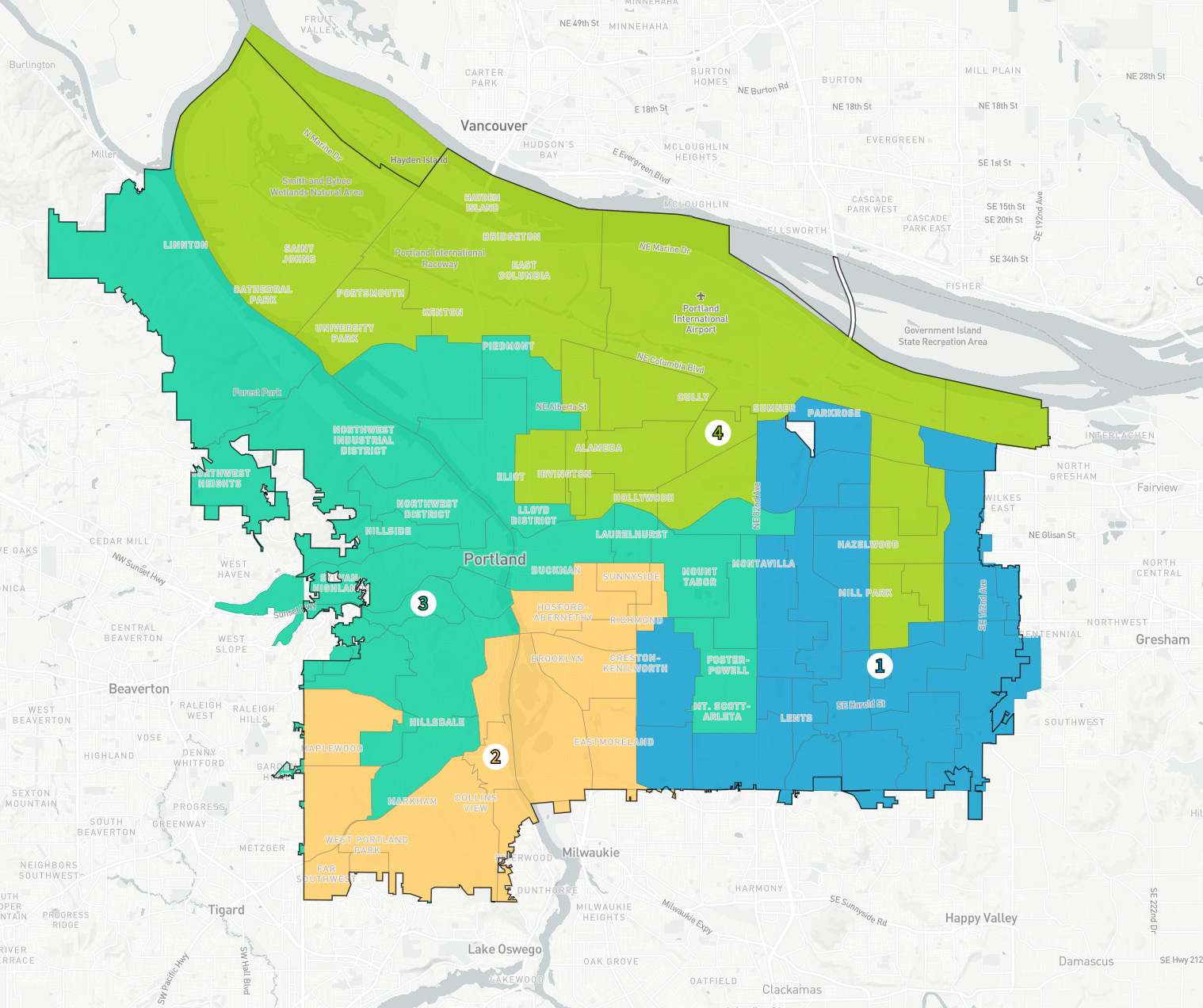
Where Portland gets carved up into areas where the wealthy will still have an outsized influence on who gets elected.
2024 is a long time away but there’s a lot of work to be done, and even more work for people to hold current elected officials accountable.