


Depending on where you’re from, there are anywhere from five to seven continents. Those of us in the United States are taught that there’s North America (1), South America (2) Africa (3), Europe (4), Asia (5), Australia/Oceania (6), and Antarctica (7). Some places combine those continents such as the Americas and Europe/Asia. But there’s never really been more than 7 until pretty recently. That potential continental candidate is none other than Zealandia, the sunken continental ridge that lies under the ocean, but is otherwise connected to a smaller piece of land called New Zealand.
What exactly is Zealandia?
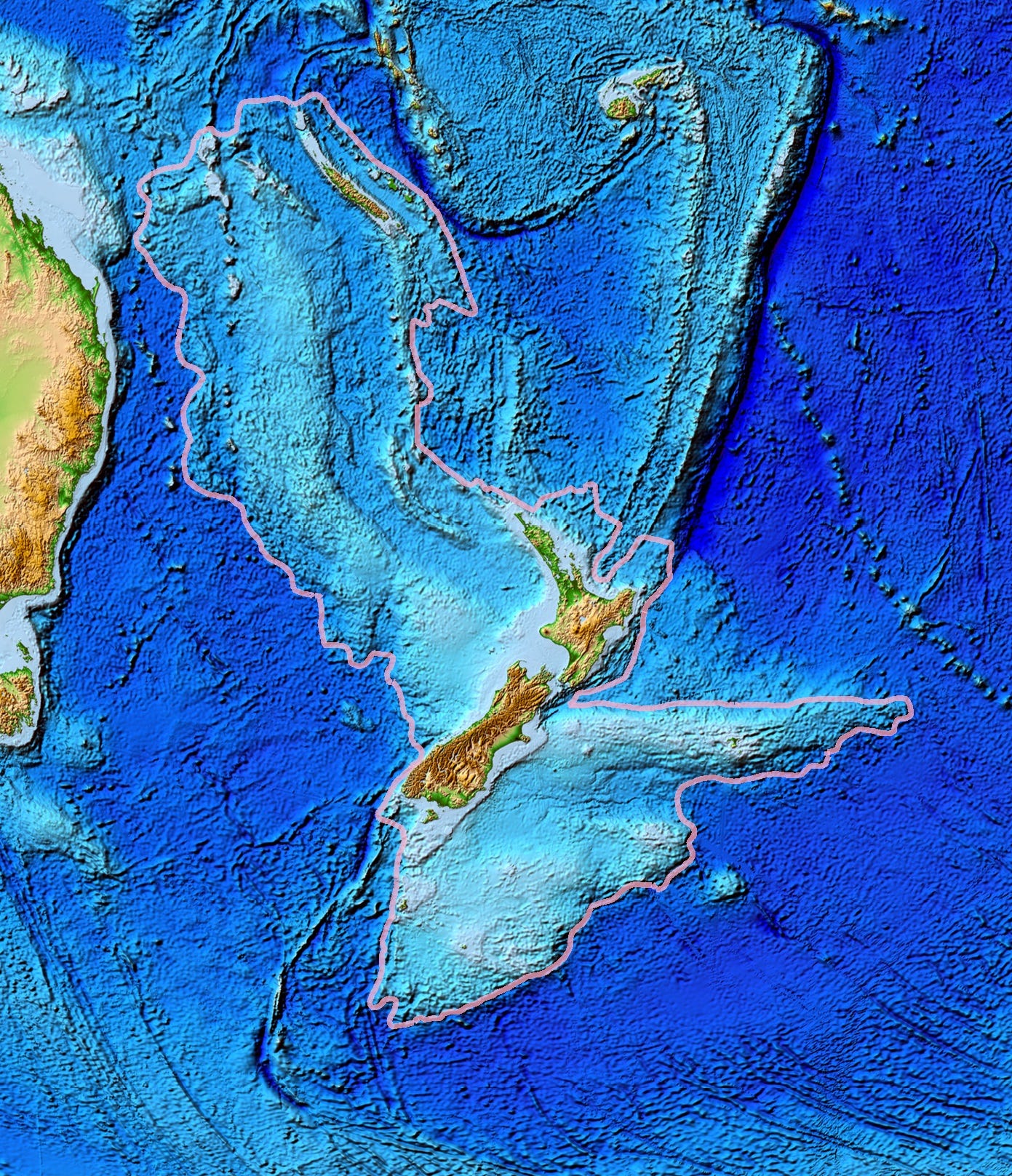
Zealandia is a large swath of continental crust roughly two-thirds the size of Australia, that’s nestled in the southwestern Pacific Ocean. And while typically we associate continents with, you know, dry land, about 94% of Zealandia’s landmass is submerged under the ocean, leaving only a small portion, which includes New Zealand and New Caledonia, visible above the sea surface.
But despite its relative obscurity — and newfound geographic fame — Zealandia holds key information about Earth's history and allows us to think a little differently about continental geography. Which is why it’s so fun!
Continents have historically been relegated to the “kind of matters, but not really” bin of geographic thought. Mostly because a continent has no power unto itself really. Not in the same way as a country that is. And that means there’s no system of government for a continent and therefore no laws, regulations, or any of that stuff. Continents are more typically associated with broader cultural aspects such as when something “feels” European or when someone associates as being American (as in from the continents North and South).
And yes, of course, there are bodies of government like the European Union but that’s not all inclusive of the continent and being within Europe does not mean you’re a part of the E.U.
How long has Zealandia been a thing?

According to the Wikipedia article, the name Zealandia, derived from New Zealand of course, was first proposed in 1995 by American oceanographer Bruce Luyendyk. But it would take quite a bit longer for Zealandia to become more accepted within the larger scientific community. In 2017, the Geological Society of America published an article in their journal “GSA Today” that sort of gave Bruce’s idea a bit more weight.
The notion of a continent might bring to mind a vast, continuous landmass, like Africa or Asia. However, geologists define a continent using several criteria, including elevation relative to surrounding areas, a distinct geology, a well-defined area, and a crust thicker than that found on the ocean floor. Zealandia checks all these boxes.
Although mostly submerged, Zealandia is distinct from the ocean basins surrounding it. Its crust, up to 40 km thick, contrasts with the much thinner oceanic crust. Also, Zealandia's distinct geology showcases a diverse range of silica-rich rocks and distinctive fossil content.
So, why is Zealandia important geographically?
As I already alluded to earlier, the recognition of Zealandia challenges the traditional "club of seven" continents that has been taught in schools. And this this essentially underscores the concept that continents are not necessarily continuous, expansive landmasses thus reshaping our definitions and understanding of continents and continental crusts. Basically it’s just one of those things that truly broadens our horizons, even if only a bit.
That said, if you’re wanting something a bit more tangible, the discovery of Zealandia has helped us better understand plate tectonics. Around 85 million years ago, Zealandia, then part of the super-continent Gondwana, started to break away. This rifting was different from other continental separation processes and led to Zealandia's current mostly-submerged state. Studying Zealandia has given us invaluable insights into the geodynamic models of continental rifting and plate tectonics. Which can then help us to better understand and, possibly even predict, things such as earthquakes.
Zealandia's submerged mountains and varied landscape may also be influencing global climate patterns. The hidden landmass acts as a barrier to ocean currents, which in turn can shift things such as where warm and cold water are flowing. And if we know anything about ocean currents, it’s that they have a dramatic impact on climate! Just ask those who study El Nino and La Nina patterns.
And of course Zealandia has considerable economic implications, with potential mineral and petroleum resources. Because the continental crust is relatively shallow, the exploration of fossil fuels and other resources is something people are no doubt considering. Though is should be said that deep-sea mining and exploration would pose environmental issues. And to be quite honest, the world doesn’t need anymore resource extraction.
And that’s basically it! You can probably shuffle this into the ‘fun geographic facts’ part of your brain for now. But at some point Zealandia could become much more and personally I think it’s pretty cool we’re still learning some pretty fundamental aspects of our planet.
And it's a great new 'continent' for wine, of course!
In some parallel universe, Zealandia actually *is* a continent above water.
And while we're at it, there are other parallel universes yet in which islands or island chains that, in our universe, are mainly submerged but which in any of those universes are mainly above water. I'm talking about the likes of Kerguelen, the area between Mauritius and the Seychelles, Rockall, Doggerland, the Grand Banks, etc. etc.