


Place matters. That’s definitely something I will always reinforce when I’m talking or writing about geography. But while I definitely think that places matter, there’s also some evidence that some places might matter more than others when it comes to living a long life. In particular, I’m referring to the so-called “blue zones” of the world, wherein people have a habit of living well beyond the natural life expectancy of the given country.
It’s something that seems to make the rounds on social media every now and then. In fact, I was just leafing through a few-months old National Geographic magazine about them (hence this week’s article!). So let’s explore life expectancy and geography!
What is a blue zone?
Simply put, there exists specific places within the world where people live longer than what their national or regional life expectancy says they should live. For example, if country A has a life expectancy of 75 years and region B within country A frequently has people living to the age of 90, then it would likely qualify as a so-called blue zone. When one of these regions pops up, people tend to want to study why that might be the case. Obviously there has to be some reason… and there usually is!
The blue zones of the world
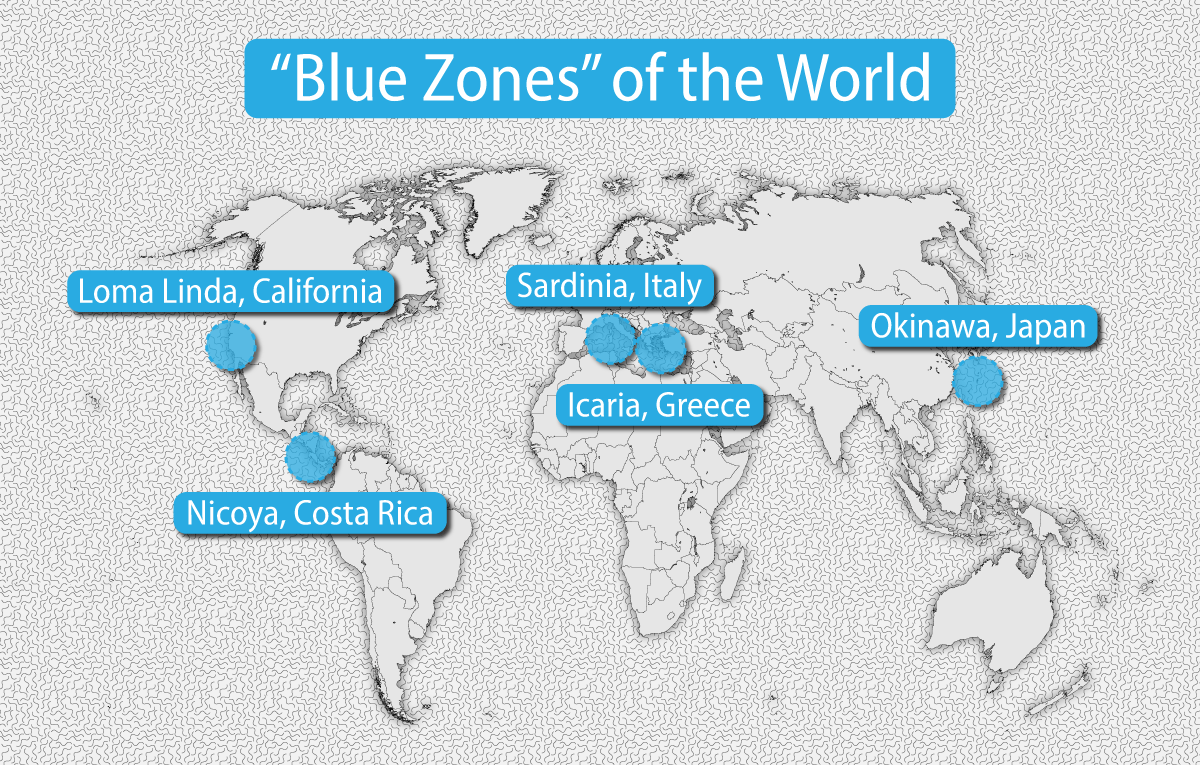
At present five blue zones are thought to exist within the world today, though there’s constant debate on the matter. Those blue zones are:
Okinawa, Japan
Sardinia, Italy
Nicoya, Costa Rica
Icaria, Greece
Loma Linda, California
If one of those doesn’t feel like it belongs, you’re right! Loma Linda, California, existing within the United States and all of the unhealthy ways we manage to shorten our collective lives, would at first appear to have slipped in by accident. But it does appear to have a longevity of life that no other place in the country can match!
Why people live longer in this areas
This is where we’ll start to get to some of the critiques of the blue zone theory. But first, let's talk about why people appear to be living longer in these areas. I’ll break the news up front: it’s not magic and there’s really nothing special about the places specifically. At least nothing that couldn’t be replicated elsewhere given the effort. No secret fountains of youth here! Really when we compare all five areas they all share four common themes:
Consistent physical activity
Social community or family
Plant-based diets
No smoking and no or very little drinking alcohol
This handy venn diagram I found on Wikipedia breaks this down a bit more between three of the communities.
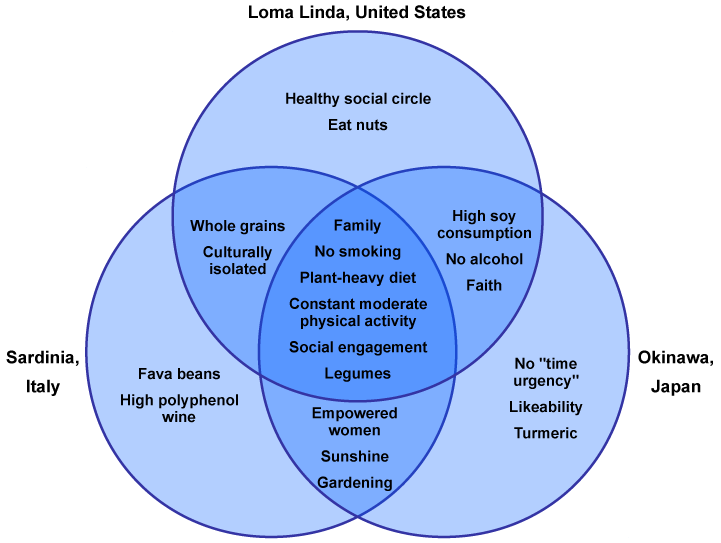
And all of this makes sense! We know that walking rather than driving leads to healthier outcomes. We know that having a community and family that you regularly interact with improves mental health. We know that plant-based diets are far healthier than meat, especially red meat. And, of course, we know that smoking and drinking alcohol have a wide variety of health implications.
In some ways, given that we know all of this, it’s kind of shocking that only five places meet the criteria for the blue zone. But most places aren’t actually like this at all. Here in the United States in particular, we’ve developed our cities in ways that actively fight against a couple of these themes. Most cities in the U.S. make physical activity anywhere outside of an expensive gym impossible and places like many suburbs actively separate and spread people out, isolating them socially. It’s hard to feel community when you rarely see anyone else.
Now all that said, it may be that these blue zones aren’t even all that blue to begin with…
Criticisms of the blue zones

A study out of the Asia-Pacific Journal of Public Health has since shown that life expectancy in Okinawa, Japan has been declining in recent decades at a rate that would otherwise be very shocking if this area didn’t previously show it had higher than average life expectancy. What this means is that, unless there was an incredible change somewhere in the region – a viral pathogen (this was pre-COVID), change in diets for everyone, natural disasters, etc. – then it means something else must explain the change. And there does appear to be something!
What researchers found was that people in Okinawa were actually probably younger than they originally thought due to records having been destroyed in World War II. So this means that when men in Okinawa were dying of “old age” at 95 years old, they may have actually been 85 years old. Which would fall pretty dang close to Japan’s current life expectancy of 84.62 years.
Another critic, Dr. Harriet Hall was also very critical of the so-called blue zones of the world. In fact, she singled out Loma Linda as a good example of how correlation does not equal causation. Loma Linda, California does appear to have longer life expectancy, but it’s also worth pointing out that Loma Linda is a fairly wealthy suburb and no study has sought yet to see if life expectancy in any of these communities factors in wealth.
The real geography to living more healthily

All this being said, there absolutely is an argument for geography affecting your health. Living in walkable areas such as many cities and towns in Europe will always lead to better health outcomes than sprawling suburban or car-dependent cities that are more often found in the United States, Canada, or Australia.
But while we know this is true, the reality is that living healthy and living long don’t always go hand-in-hand. Someone who smokes every day can and has lived longer than what they would be expected to. And someone who walks everywhere, eats a vegetarian diet, and has a community can and has died well before.
Life is weird and complicated, and while geography has its place in health and even life expectancy, so do a million other things! The blue zones certainly might have an impact on living longer, but it’s far too basic of a theory.