

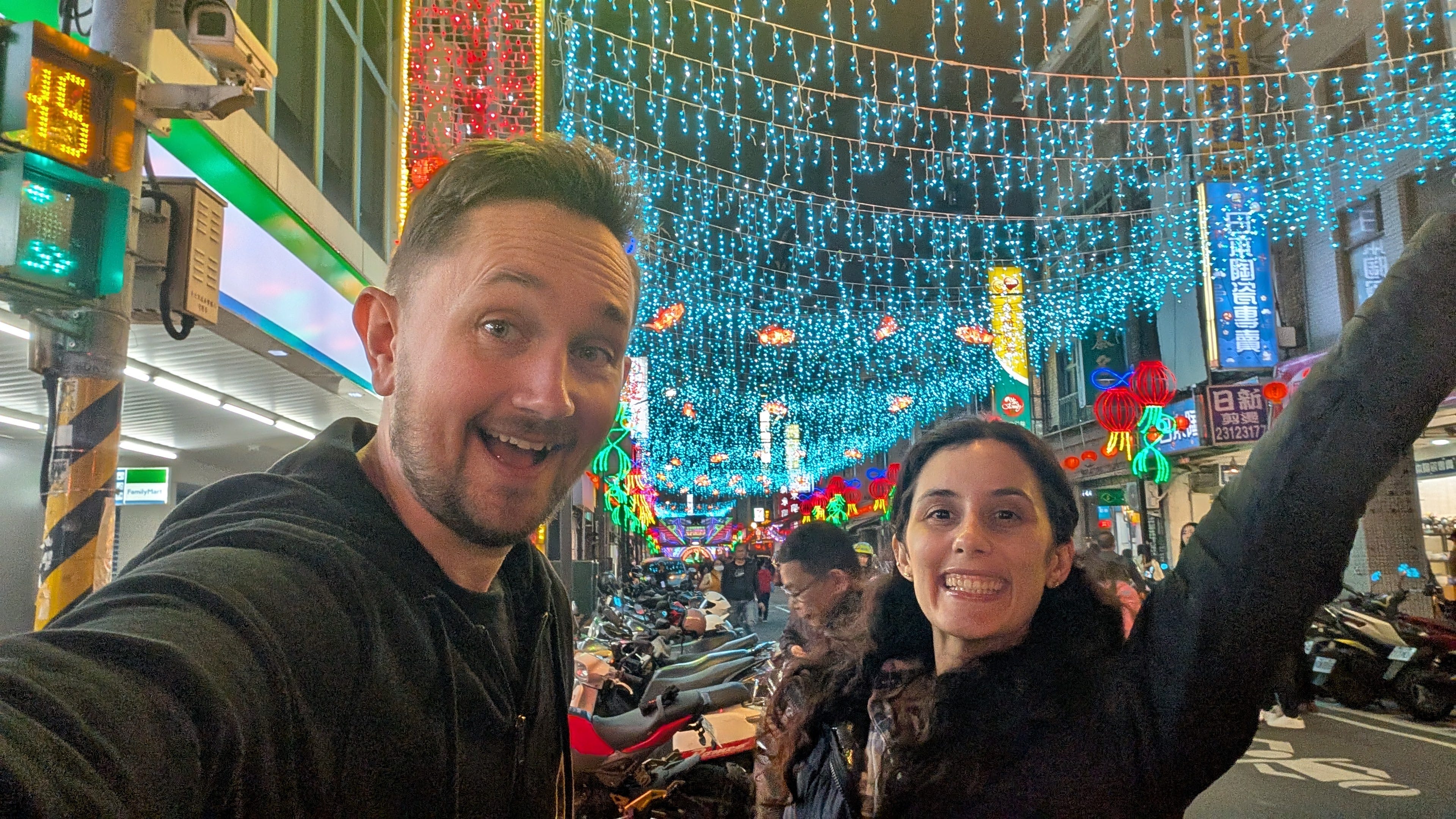
I’m in Taiwan this week! Alexa and I will be circumnavigating the entire island starting in Taipei. From Taipei, we’ll be renting a car (crazy I know!) and driving south along the west coast all the way until we hit the southern tip. Then, we’ll drive back up to Taipei, but this time on the country’s much more rugged and isolated east coast. And you can watch this journey right here:
Well you can start with the west coast road trip. Next week is a whole new episode all about the very different, and, dare I say, much more geographically amazing eastern side of Taiwan. So stay tuned for that.
Now, you may have noticed that I said Taiwan is a country in the title. While I stand by that, the reality is that Taiwan’s situation is complicated. So, for today’s article, I’m gonna write about that. Next week, I’ll talk more about Taiwan’s dramatic east side.
Oh and next week’s Geography By Geoff episode is also about Taiwan. So it’s gonna be a Taiwan heavy week. Hope you’re into that! Now that I’m experiencing the world ‘in place’ (to use a geographic term), there will probably be more of these kinds of themed weeks. I can already tell you there will be a lot written about Vietnam in the coming weeks.
The country of Taiwan

Taiwan has one of the more interesting histories as far as countries go. Though its modern status remains politically complex, the island today has evolved into a self-governing, democratic nation with a distinct identity that I would argue is completely separate from mainland China at this point. That said, the origins of Taiwan's people, its historic ties to mainland China, and its post-war transformation are all irrevocably tied to China. So it’s different, but still connected. I would liken it to the way cousins are in a familial structure today. Hopefully that’s not offensive to anyone.
Of course, long before foreign influence, Taiwan was home to indigenous Austronesian peoples who had lived on the island for thousands of years. And interestingly, these groups are directly related to mainland Chinese. Instead they’re linguistically and culturally linked to Pacific islanders, navigated the region’s seas long before Chinese or European contact. In this way, the indigenous Taiwanese would appear to have more in common with the native Maori of New Zealand or native Hawaiians than the mainland Chinese. This makes Taiwan a colonized country in the same way that the United States or Canada is, as the indigenous populations are smaller and diminished compared to the Taiwanese population that exists today.
Of course, the Europeans were also involved in colonial efforts of Taiwan, to the surprise of absolutely nobody. The first significant European control came with the Dutch, who established a colony in the early 1600s, bringing Christian missionaries. Around the same time, the Spanish briefly controlled part of the island’s north but were soon driven out. The Dutch ruled Taiwan for nearly four decades, but their influence ended when Ming loyalist Koxinga (Zheng Chenggong) fled from the fall of the Ming dynasty in China, capturing Taiwan in 1662. His rule was short-lived, as the Qing dynasty took control in 1683, incorporating Taiwan into its vast empire. But it lays the groundwork for Taiwan’s status in China as a historic place for fleeing dissidents and governments to fight back against the mainland.
We’re gonna jump to that because the history involved gets rather complicated and there’s much more to say about their modern iteration. But suffice it to say, both China and Japan basically administered Taiwan to varying degrees over the next couple hundred years.
Taiwan’s fate as an independent entity took a dramatic turn in 1949 when the Chinese Civil War ended with the Communist Party taking control of mainland China, establishing the People's Republic of China (PRC), which is still in power over mainland China today. But their opposing side, the Nationalists, were never entirely destroyed! Instead, they fled to Taiwan where they could continue to rule. Here’s the interesting part though, the Nationalist government, known as the Republic of China (ROC) fled with with around 1.5 million Chinese citizens, almost the entirety of China’s gold reserves and quite a lot of cultural artifacts. Their leader, Chiang Kai-shek declared Taipei the new capital of the Republic of China, vowing to one day retake the mainland. Meanwhile, the PRC claimed Taiwan as part of its rightful territory, a position it still holds today. For their part, the ROC also still claims mainland China, though that sentiment is less pronounced than it once was.
For decades, Taiwan operated under martial law, with Chiang’s Kuomintang (KMT) party ruling under authoritarian rule. Despite this, the island remained internationally recognized as the legitimate government of all China, even holding China’s seat at the United Nations until 1971, when diplomatic recognition shifted to the PRC. Basically, western governments wanted access to mainland China’s much larger population and economic base. This left Taiwan as a bit of a global outsider because, one of the stipulations mainland China required for doing business with it, was that Taiwan could not be recognized as anything other than a rogue Chinese province.
This all made a certain amount of sense in the 1970s and 1980s. After all, Taiwan was as much of an authoritarian country as mainland China and the two were still bitter enemies. But then, Taiwan made a dramatic shift to democracy. In 1987, martial law in Taiwan was lifted, allowing political opposition and free elections. This event, in my opinion, is often overshadowed by the Soviet Union’s collapse and the German Reunification, but is just as important a geopolitical event as both. By the 1990s, Taiwan had transformed into a fully democratic society, with peaceful transfers of power between competing political parties. And today, Taiwan operates as a sovereign country in all but official recognition. It has its own government, military, economy, trade deals and diplomatic relations with select countries (such as Guatemala), though the PRC continues to pressure nations not to recognize its independence.
Despite its political limbo, Taiwan has a unique identity distinct from mainland China. And I would argue that, for all intents and purposes, Taiwan is its own country today. I’m not sure if there’s still a strong sentiment towards Taiwan wanting to retake mainland China (my feeling is there’s not), but it’s clear that Taiwanese people see themselves as Taiwanese first and Chinese second, even if there’s a shared history language and, perhaps some historic artifacts left over from when the ROC fled the mainland.
I would include specific mention of Japan’s 50 year rule of Taiwan because it sets the stage for the strategic argument in the US Pacific theatre over whether to invade Taiwan or the Philippines. MacArthur wanted the latter but what might have happened differently if the US had landed on Taiwan and stayed there as the war moved onwards towards Japan?
Not really. It’s a safe harbor for KMT fascists who lost the war. It thinks it’s a country, but it’s an island territory of China.