

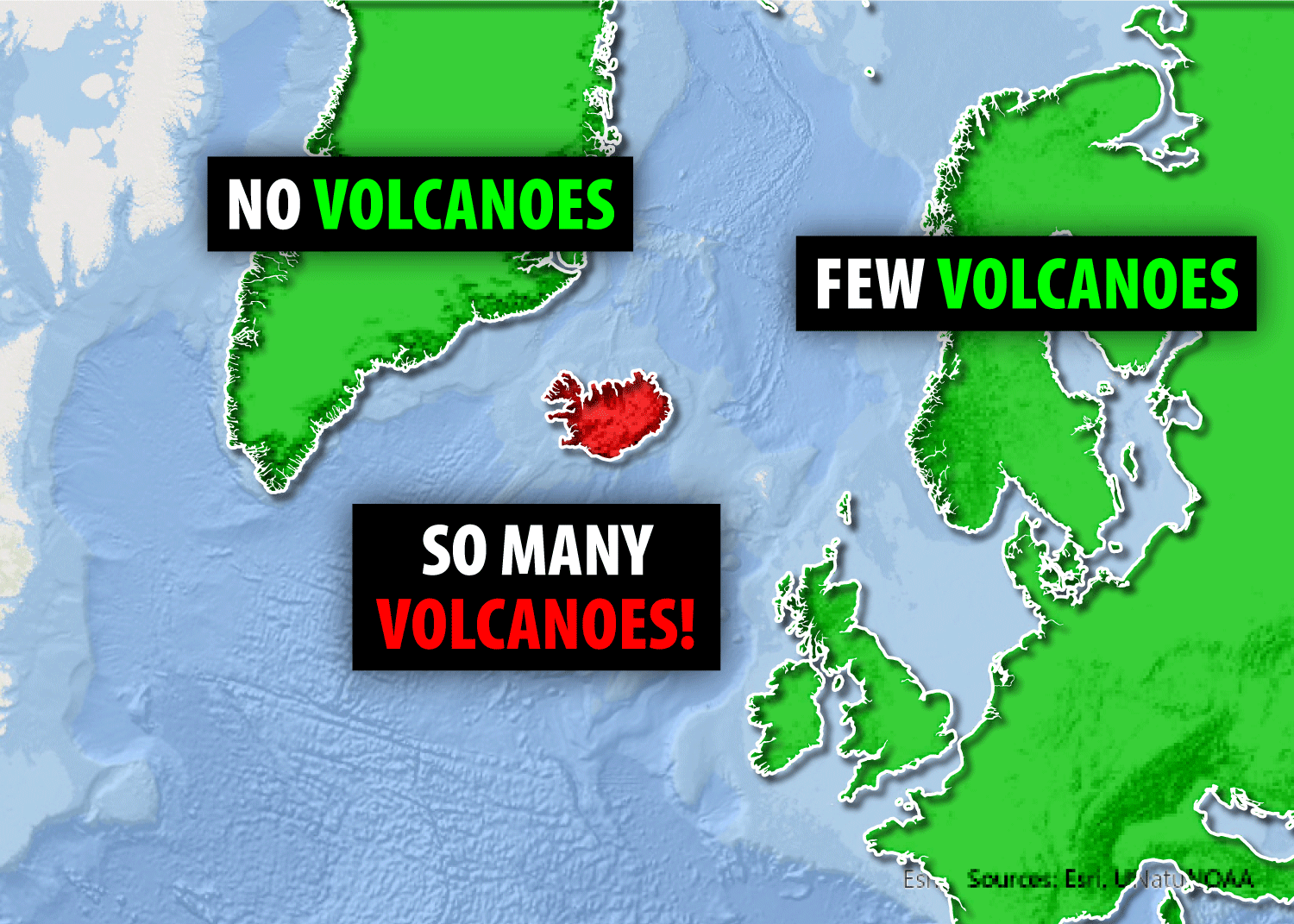
I’ve opted to take a brief break from the usual themed articles. Normally, I had planned to write an article about the Congo Rainforest that would match up with my video on Brazil and our podcast episode on the Amazon Rainforest, but then Iceland started acting up volcanically. And while I think volcanoes are endlessly fascinating unto themselves, Iceland’s volcanic eruptions are particularly of interest to the global community.
But before we get into Iceland’s current potential eruption, it’s worth it to go back in time to 2010 when the volcano Eyjafjallajökull erupted. While this might seem like ancient history at this point, this particular volcano wreaked havoc in a way that not many predicted.
The Eyjafjallajökull eruption

If you paid attention to global news at the time you might remember that Eyjafjallajökull, a relatively small ice-covered stratovolcano located in southern Iceland, began its volcanic activity in late March 2010. The eruption intensified in April, ejecting a massive ash cloud into the atmosphere. This plume of ash, consisting of fine particles of pulverized rock and glass, posed a serious threat to aircraft engines. The fine ash particles could melt in the high temperatures of an aircraft engine, potentially causing engine failure.
The volcanic ash cloud rapidly spread across the North Atlantic, affecting some of the busiest air travel routes in the world. The response was immediate and widespread: European airspace was closed for several days, grounding approximately 100,000 flights and affecting an estimated 10 million passengers. This marked the largest disruption of air travel since World War II, though obviously the COVID-19 pandemic has since had a bigger impact. Still, for a single volcano… absolutely devastating for the industry.
The impact on travel between North America and Europe was profound. Major airports across Europe, including in the UK, France, Germany, and Scandinavia, were shut down, leaving thousands of transatlantic travelers stranded. This had a cascading effect on global air travel, with flights delayed or cancelled across the world. The economic impact was significant, with airlines and industries reliant on air freight suffering heavy losses.
In addition to the immediate disruptions, the Eyjafjallajökull eruption raised broader concerns about the preparedness of the global aviation industry for such natural events. The vulnerability of air travel to volcanic activity, prompted a reevaluation of protocols for handling airspace closures and ash dispersion forecasting. That said, there’s little way of controlling such an event and, unfortunately, Iceland happens to be both incredibly active in terms of volcanoes, and in one of the most traveled through airspaces in the entire world. There’s a reason why Iceland Air is such a prominent airline in North America and Europe.
Which begs the question: why is Iceland so geologically active as compared to Greenland and Europe?
Iceland’s unique volcanic activity

Iceland, a small island nation in the North Atlantic, is renowned for its extraordinary volcanic activity, starkly contrasting with its neighbors Greenland and mainland Europe. This unique geological feature is primarily due to Iceland's location on the Mid-Atlantic Ridge, a divergent tectonic plate boundary that runs through the heart of the island.
This ridge is a part of the global mid-ocean ridge system, which is the longest mountain range in the world, mostly submerged underwater. Iceland's position atop this ridge, where the Eurasian and North American tectonic plates are moving apart, accounts for its high volcanic activity. As these plates diverge, magma rises from the mantle to fill the gap, leading to frequent volcanic eruptions and the creation of new crust.
Furthermore, Iceland is situated above a hotspot, an area of unusually hot rock in the Earth's mantle. The combination of the Mid-Atlantic Ridge and the hotspot results in a significant amount of geothermal and volcanic activity. This is why Iceland has numerous active volcanoes, hot springs, and geysers, which have shaped its rugged landscape.
In contrast, Greenland, though geologically part of the North American plate, is not located near any major tectonic boundaries. Its geological stability accounts for the lack of volcanic activity compared to Iceland. The island is predominantly covered by ice, with its underlying rock shield remaining largely unaffected by volcanic or seismic activities.
Similarly, mainland Europe's volcanic activity is more sporadic and less intense than Iceland's. Europe's volcanism is largely due to its proximity to other tectonic plate boundaries, such as the Eurasian and African plates in the Mediterranean region. However, these areas do not experience the same level of tectonic activity as the Mid-Atlantic Ridge running through Iceland.
Iceland's unique position at the juncture of a tectonic plate boundary and a mantle hotspot makes it one of the most volcanically active regions in the world. This has led to a landscape that is both dramatically beautiful and continuously evolving, offering a unique window into the dynamic processes shaping our planet.
An upcoming 2023 eruption?
By all accounts, it appears that Iceland is about to suffer another large eruption. While nothing has happened quite yet (and that very well could change by the time this is published!) there is clear evidence that something is about to happen, including a series of earthquakes, ground fissures, and bulging earth. All of these are clear signs that something is about to happen. Which begs the question: are we in for another Eyjafjallajökull level disruption of air travel? Probably not.
According to CNN, because Eyjafjallajökull erupted near glacial ice, the eruption proved to be far more explosive than it normally would have. This is precisely what propelled so much ash into the atmosphere, thus causing the issues with air travel. Thankfully, the current volcanic issues, while severe for those on the ground, does not appear to be at risk of causing a similar kind of eruption. In fact, volcanologists are predicting at most this eruption will cause lava flows only and little or no atmospheric ash. All that’s to say, if you’ve got some European travel coming up, you should be fine.
Still, this all paints the picture of Iceland’s unique place in the world as the home of particularly explody volcanoes that can essentially halt European air travel. And unfortunately, there’s always a chance that a future volcano could wreak havoc once again.
A few things to say:
1) The start of the COVID pandemic in early 2020, especially concerning the mass repatriation flights in March of that year, reminded me so much of the 2010 Eyjafjallajökull eruption and its flight disruptions that that was one big way the pandemic sparked my interest in immense and/or profoundly disruptive volcanic eruptions.
2) It's mainland northern Europe that has few volcanoes (one of them being Eifel in Germany, sharing a name with Paris's Eiffel Tower). Mainland southern Europe - especially Italy and Greece - has quite a few volcanoes and much seismic/tectonic activity.
3) Finally, seems to me that geologically and in terms of total area (though most certainly not in terms of population size), Greenland is to Iceland what Australia is to New Zealand.
I would not have said that Greenland has no volcanoes. It has not active volcanoes NOW, but historically it may have had a few. As for European volcanoes - the ones that have been identified are ancient and mostly worn away, much like the Appalachian Mountains on the East Coast.