

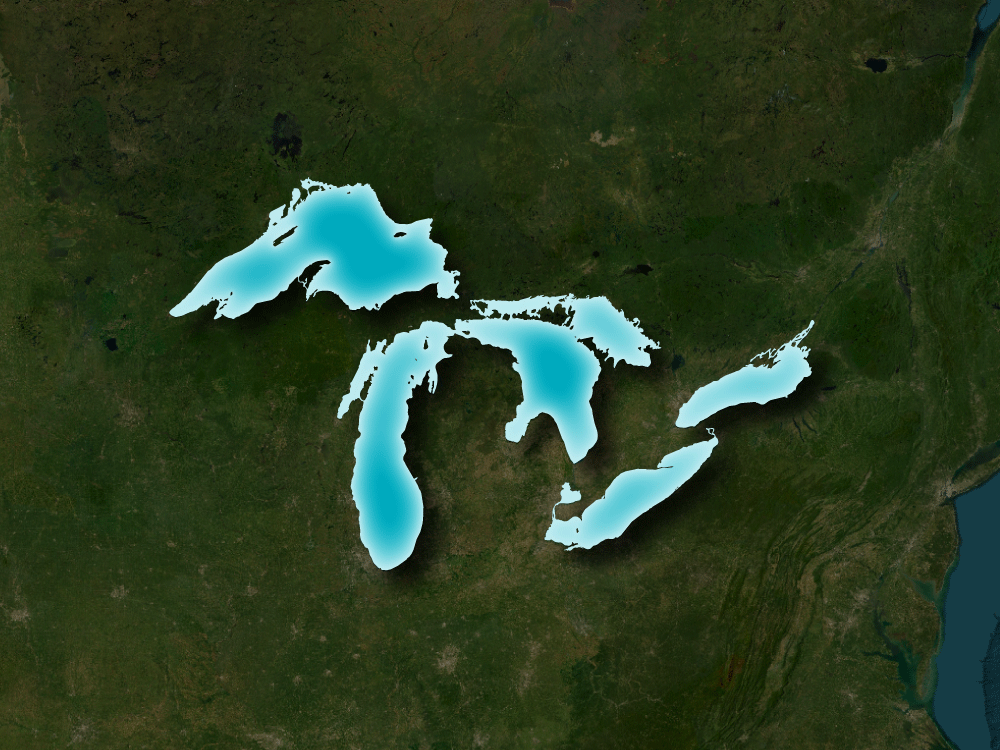
Those of us who live in the United States and Canada often take for granted the enormous resource that is the Great Lakes. I’d wager that you, reading this right now, have not thought too much about the enormity of fresh water that exists within those lakes. And given we live in a world where climate change is rapidly increasing the amount of wildfires and droughts, the importance of the Great Lakes is only going to increase over time.
I’ve talked quite a bit about water on YouTube, including one episode specifically on the Great Lakes, but I’ve never actually thought about where all that water comes from. After all, the Great Lakes hold approximately 21% of all of the world’s surface fresh water. That’s an incredible amount of fresh water. From what I’ve read, if you drained the Great Lakes and spread it out over the entirety of the contiguous United States, the entire country would be 9 feet under water. 🤯
The Great Lakes

Before we ‘dive’ into where all the water comes from, let’s level-set a bit. IN case you didn’t know, the Great Lakes are a series of interconnected lakes that exist primarily on the border of the United States and Canada. Despite other really large lakes existing nearby, the Great Lakes are comprised only of Lake Superior, Michigan, Huron, Erie, and Ontario. The nearby really large lakes (but not quite great) of Winnipeg and Nipigon are not part of the Great Lakes.
In total, there’s nearly 5,500 cubic miles of fresh water contained within all five lakes. That might not sound like too much, but it’s a lot of water. One cubic mile of water is more than 1 trillion gallons of water. But not all the lakes are created equally. Here’s a handy graph that the U.S. Environmental Protection Agency put together:
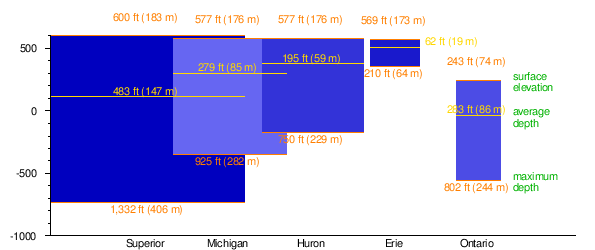
Superior and Michigan are the largest by volume, which is not a big surprise as they’re the largest by surface area as well.
Where all the water came from

The Great Lakes are really just remnants from the last ice age somewhere around 20,000 years ago. As the ice began to recede, the now melted water drained into large depressions that were created by the glaciers themselves. But this was not a quick process! According to the National Oceanic and Atmospheric Administration, it took approximately 17,000 years after this melting began for the Great Lakes to reach their current sizes and proportions.
This does raise the question though: why aren’t there more great lakes across the continent and why are they all situated in a relatively small area? To that question: I have no idea! There are other really large lakes located primarily in Canada that were created under similar circumstances. And of course the last ice age has had an indelible impact on all regions of the continent, regardless of whether it created a great lake or not. The Missoula Floods, for example, created the bountiful area that we know today as the Willamette Valley.
Regardless, the Great Lakes today are an incredibly resource for Canada and the United States in an increasingly dry and warm world. Thought it’s worth noting that, while the Great Lakes water feels infinite, it very much isn’t. After all, it didn’t take all that long for the Soviet Union to drain their own great lake the Aral Sea. But that’s an article for another day. For now, let’s all just revel in the sheer enormity of the Great Lakes. They’re magnificent!
Can you and Hunter do an episode on “What If The Great Lakes Didn’t exist?”