


First! Apologies for no article last week. I’d like to be able to blame the Thanksgiving holiday in the states as the reason, but the real reason is that I’ve been traveling a lot through Morocco, southern and western Europe and just lost track of time. It just happens sometimes.
If you were to look at a map of the world and guess the order in which homo sapiens (the type of human that we are all a part of) spread around to the continents after leaving Africa, common sense would suggest a simple ripple effect. Surely, given its proximity, the earliest homo sapiens would walk next door to Europe before sailing off to Australia, right?
Common sense, in this case, is wrong… possibly! I’ll get to why its only “possible” in a bit, but the point to make here is that the human history of Australia is so much older than we give it credit for. If it’s not necessarily as old as Europe, the fact that there’s even debate about it is pretty dang impressive.
One of the most counter-intuitive facts of human history is that our ancestors were likely painting rock art in the tropical heat of Northern Australia while Europe was still a fortress of ice with neanderthals (the type of human we’re not part of). This made the northern continent largely impenetrable to homo sapiens.
Here’s how the timeline breaks down, and why the “remote” continent of Australia was inhabited at least around the same time as the “Old World” of Europe.
The Australian timeline

To understand the scale of this migration, let’s look at the dates. While exact years are always debated in archaeology, the consensus has shifted in the last decade. Here’s what I could find:
Australia (Sahul): Arrived ~65,000 years ago (based on the Madjedbebe rock shelter findings).
Europe: Definitively arrived ~45,000 years ago. But there’s some evidence that could suggest anywhere from 55,000 to 60,000 years as well.
The Americas: Arrived ~15,000–20,000 years ago.
So humans were likely living in Australia for at least 5,000 years but possibly as much as 20,000 years before they permanently settled in Europe. That’s an incredible concept because the distance between Africa (where homo sapiens migrated from) to Europe and Australia is wildly different. So how did we skip an entire continent that was so close? The answer lies in the path of least resistance.
When homo sapiens left Africa (roughly 60,000–90,000 years ago), they didn’t just wander aimlessly. They likely followed a “Southern Route” along the coasts of Arabia, India, and Southeast Asia. And they did this for a couple reasons:
First there was the climate. Tens of thousands of years ago the planet was much colder than it is now. This meant that places such as Europe was largely encased in ice year around, or otherwise just very hard to survive in. But this souther route was tropical and coastal. It offered a consistent diet of seafood (rich in omega-3s for brain development) and didn’t require complex cold-weather technology like sewing heavy furs or building insulated shelters. It was also much closer to the home of Africa. The comfortability of this route would prove to be the main decision factor in migration.
But also, this route acted as a “superhighway.” Populations could expand rapidly along the beachheads of the Indian Ocean without facing significant geographic barriers, such as the incredibly challenging mountainous terrain of Europe, until they hit the end of the line.
When these migrants reached Southeast Asia, the world looked different. Sea levels were much lower, exposing continental shelves that don’t currently exist. This enabled a migration that required little, if any, vessels that could sail in the ocean. In fact, there were two large land masses back then that no longer exist today:
Sunda: The islands of Indonesia (Java, Sumatra, Borneo) were connected to mainland Asia in a giant landmass called Sunda.
Sahul: Australia, New Guinea, and Tasmania were all connected into one massive continent called Sahul.
Between Sunda and Sahul lay Wallacea—a zone of deep ocean trenches and islands.9 Even with lower sea levels, early humans could never walk to Australia. There was always at least 80 kilometers (50 miles) of open ocean to cross, often with currents so strong they would push a swimmer out to sea.
Which means something even more incredible! The first Australians were mariners. Roughly 65,000 years ago, they built rafts or boats and intentionally crossed the horizon, making them the world’s first open-ocean voyagers. This kind of migration so long ago really can’t understated and its way Australia’s aboriginal populations are so incredibly important to the humans at large. They’re a direct connection to one of the most remarkable feats of human migration on the planet.
But let’s get back to Europe.
Why was Europe So Hard?
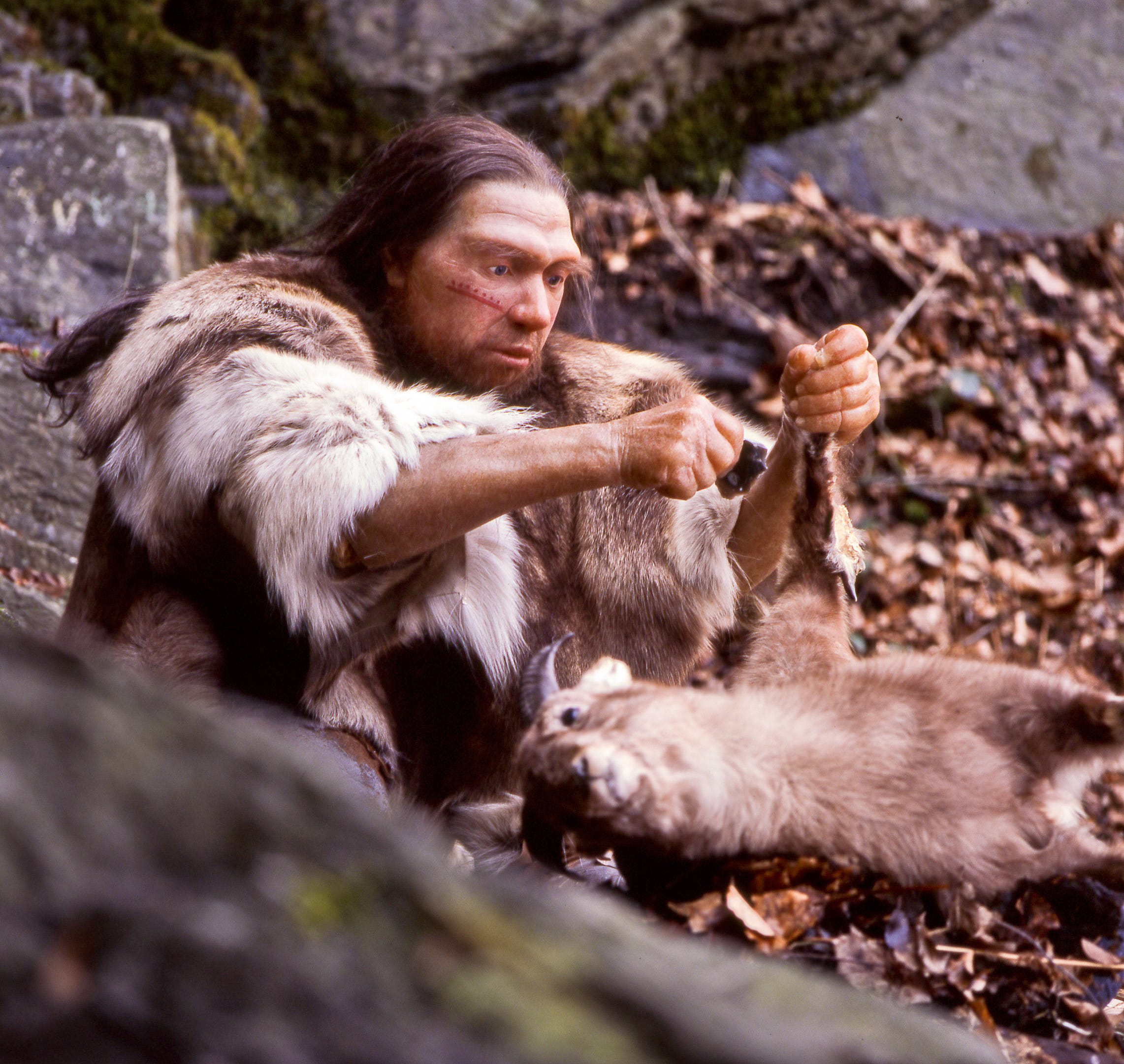
If humans could build boats and cross oceans, why couldn’t they just walk into Europe? Europe is, geographically speaking, right next door to Africa. The delay in settling Europe wasn’t about distance; it was about resistance. And resistance of a few different things:
1. The ice barrier
Europe 50,000 years ago was not the temperate place it is today. It was deep in the grip of the Last Glacial Period. The climate was harsh, dry, and brutally cold. For a species evolving in the African tropics, Europe was an alien, hostile environment requiring technologies (tailored clothing, superior fire control) that took thousands of years to perfect.
2. The neanderthal fortress
Europe wasn’t empty. It just wasn’t home to homo sapiens. Instead, it was the stronghold of homo neanderthalensis.
Neanderthals had lived there for hundreds of thousands of years. They were physically stronger, adapted to the cold, and skilled hunters. Early modern humans trying to enter Europe faced direct competition for resources with a species that knew the terrain perfectly.
For thousands of years, the Levant (modern-day Israel/Syria) effectively acted as a border zone. Modern humans and Neanderthals likely traded territory there, but we couldn’t push fully into their European heartland until their numbers began to dwindle or our technology gave us a decisive edge.
The big picture
The colonization of Australia flips the script on how we view “primitive” humans. We often imagine that history is a straight line of progress: that we conquered the easy, nearby lands first (Europe) before figuring out how to reach the hard, distant ones (Australia).
The reality is that adaptation dictates destination. It was easier for our ancestors to traverse thousands and thousands of miles (or kilometers) of tropical coastline and invent maritime navigation than it was to survive a European winter or outcompete a Neanderthal.
So, while our cousins were shivering at the gates of Europe, the first Australians were already mastering a new continent, isolated by the sea, where they would develop the oldest continuous living culture on Earth.
And this is why Australia continues to fascinate me every single day.
Very interesting and logical
Is it just me or does that look like a couple of roos pulling Santa’s sleigh?