

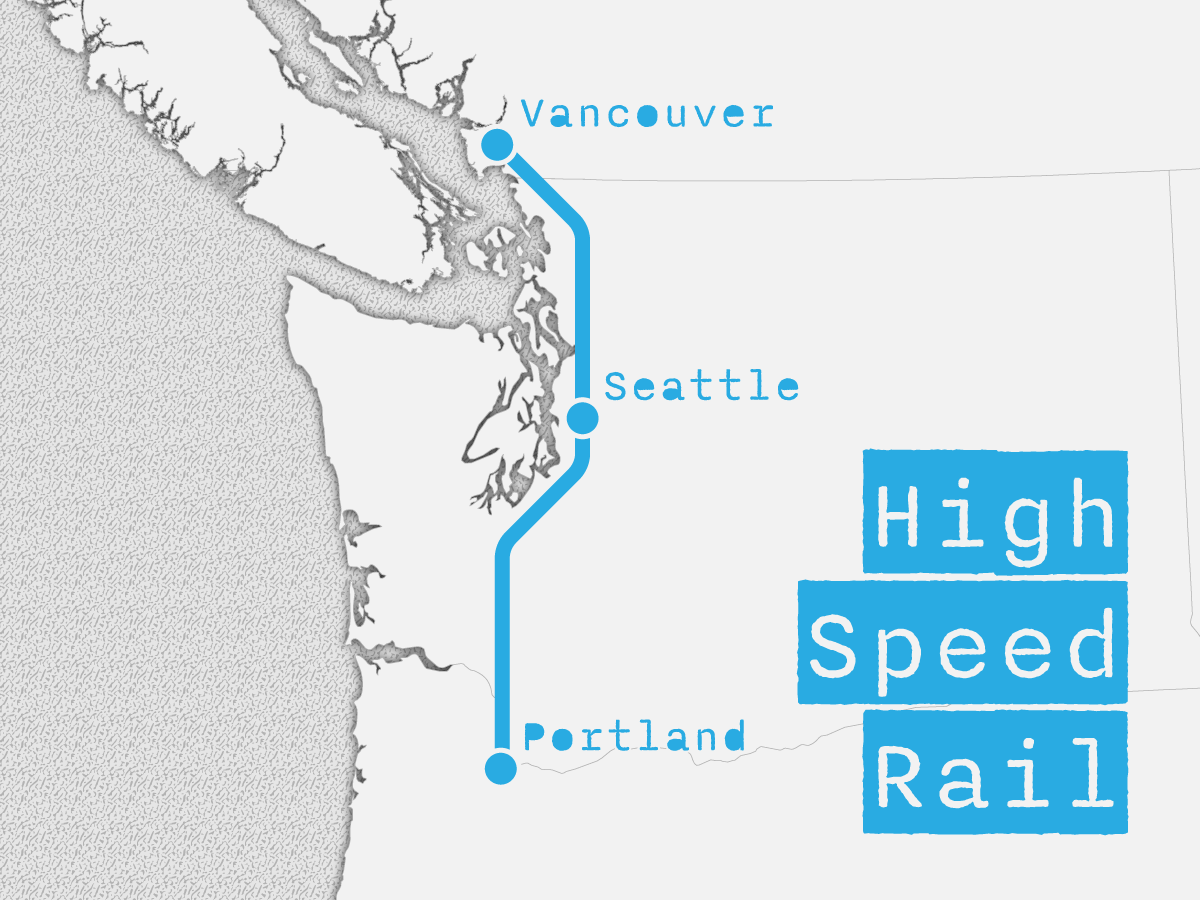
The Pacific Northwest is one of the more unique regions of the United States and Canada. And I’m not only saying that because I’m based here in Portland, though I’ll certainly acknowledge my bias. The fact that the region is bound together over international borders, across multiple major cities and 3 different provinces/states definitely gives it a different feel than say the Northwest Corridor, or the Great Lakes region. I suppose Detroit and Toronto might have a similar feel as well. Regardless, my point here is that Portland, Seattle, and Vancouver have an intrinsic link in spite of our infrastructure, not because of it.
Right now, if you live in Seattle and had to travel to either Vancouver, BC or Portland, OR you it will take you a minimum of about 3 hours regardless of which method of transportation you take:
By car it will take you about 3 hours with no traffic or border checkpoint shenanigans.
By plane it will take you less than one hours flight time, but travel to and from the airport as well as wait time at the airport will add at least a couple hours to that, not including going through customs and immigration for Vancouver.
By bus, again it’ll be a minimum of 3 hours with no traffic and I’m not sure how fast the border check points are by bus.
By train it takes about 3 and a half hours, unless there happens to be a freight train using the same track, in which case you can probably add an hour or two to that.
Obviously if you’re traveling from Portland to Vancouver, you can basically double all those times.
With a combined population of over 8 million people (just within the three metropolitan areas), multiple specialized industries, and a highly educated workforce it seems like there should be a better way to travel between the three, but there isn’t… yet!
Cascadia high speed rail

If you didn’t know, high speed rail has been considered for the region for at least the last ten years. But newer efforts have not been driven by the respective local governments, but rather by industry groups. In particular, Microsoft has taken a special interest in getting high speed rail moving by funding a business case study to see if it was economically feasible (full disclosure: I worked on this project as a transportation planner). The good news is that based on the population and industries present, a high speed rail connecting the three main cities would be economically feasible.
The bad news is that, no matter how you slice it, building out a high speed rail line just between Portland, through Seattle, and up to Vancouver would cost a lot of money. Estimates as of 2017 put the price tag at somewhere between $24 billion and $42 billion. That number is almost certainly higher today based on inflation. But that’s small potatoes compared to the estimated $355 billion in economic growth and 200,000 jobs provided by the project. And for those who doubt those numbers, infrastructure projects have time and again shown that, on a per dollar ratio, you get far more money back that you spend.
But while the upfront price is high, you also get a world class high speed rail line that will take you to the other major cities in less than 1 hour if you’re traveling from Seattle, or less than two hours if you’re traveling from one end to the other. That kind of time savings would be monumental. Day trips, which are currently either rigorously challenging, or just not feasible, would suddenly become very palatable. I won’t bother creating all the scenarios for you, but time is perhaps the most valuable thing any single person has. If you can save time, you unlock a whole lot of possibilities. Possibilities which, today, simply aren’t feasible with our current methods of transportation.
Why we don’t have high speed rail yet

So you may find yourself asking: if this is such a slam dunk of a infrastructure project: why haven’t we built out a high speed rail line yet? And it’s a good question! Personally, I can only theorize, but as someone who works in city and transportation planning, I can definitely weigh in at least a little bit here.
Unfortunately, like most things have become in life, high speed rail has become mired in politics today. Passenger rail infrastructure of any kind has become seen as an “other” sort of transportation, meaning that only “other” countries use passenger rail. Socialized Europe, for example, or cramped and crowded trains in India or China. It’s become common for conservative politicians, for example, to say something along the lines of: we don’t need 1800s technology to solve 2022 problems. Or some such nonsense.
But even outside of politics, high speed rail faces stiff resistance from other industry groups and lobbying efforts. The airline industry, for example, doesn’t want to lose revenue from the 20+ daily routes between Portland and Seattle. Nor does the automobile industry want to compete with another mode of transportation. Hell, Elon Musk has basically admitted that his hyperloop idea was all just a scam in order to try and ‘derail’ the California High Speed Rail project.
The reality is that high speed rail has few proponents and many, many opponents. No matter how you look at it, until there’s a united and combined effort that exists outside of government to bring high speed rail to the Pacific Northwest (or anywhere else outside of California and the Northwest Corridor), it’s simply not going to happen. But damn does it make a lot of sense.