

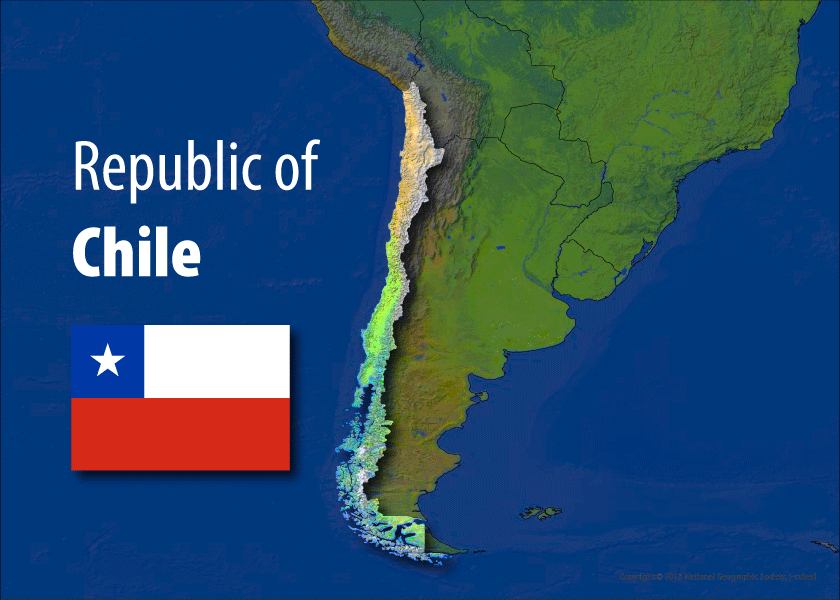
Chile has perhaps one of the most interesting boundaries of any country on the planet. And it’s for that reason that I’m writing about it today! Well, kind of. While its physical geography is definitely a notable feature of Chile, the country is interesting well beyond its unique shape. And we’re going to explore that a bit in this week’s country profile.
Quick facts
Population: 18,430,408
Capital: Santiago
Area size: 291,930 sq mi (756,096 sq km)
Language(s): Spanish
GDP per capita: $28,526
The geography of Chile

Chile has a wild geography! Due to its long and narrow shape, it extends all the way from the 17th parallel (above the Tropic of Capricorn) in the north and all the way to the 56th parallel in the south. And this means that it spans a huge range of different climate types in a relatively small amount of space. At the very far north is the Atacama Desert, a desert so dry that, in some places, there is no recorded rainfall whatsoever. And at the very far south, is an archipelagic region of Patagonia that is very cold and very wet. In the middle is the whole spectrum in between!
Because of this, most Chileans live in its capital city of Santiago. All told, there are about 7 million people living within Santiago, comprising roughly 40% of the entire population. This would make Santiago a “primate city” for the country, which means the city is overwhelmingly dominant in terms of population, economy, and culture. If you’re curious as to why Chile’s population is so condensed within Santiago and its surrounding regions, be sure to check out my video coming out Monday, May 29th on this very topic. You can watch it on YouTube!
Chile has its unique shape largely due to the geographic features that contain it. To the west is the Pacific Ocean, and to the east is the Andes mountain range. Because of this unique topography, it was difficult for early Chile to lay claim to land beyond the mountain range when its capital region and most of its population was on the other side. This meant that most Chilean settlers would move either north or south rather than east or west.
Finally, Chile is very much a part of the Pacific “Ring of Fire” that creates issues for all Pacific-oriented countries. Sitting right off the coast of the country is the Nazca tectonic plate. And this plate is continually and slowly pushing underneath the continent of South America. Every once in a while, this plate “slips” and creates a massive earthquake. In 2010, a magnitude 8.8 earthquake unleashed off the coast of Maule, Chile wreaking havoc on the country. This particular earthquake also caused a tsunami that caused damage as far away as San Diego, California. Needless to say, earthquakes are quite common in Chile and is just something that most Chileans have learned to deal with.
The place and how it interacts with the world

Chile is a relatively wealthy country as far as many of its peers go. Some estimates have it as the wealthiest country per capita within South America. And much of this is on the back of its extensive natural resources. And most of that wealth is almost exclusively held within Chile’s copper deposits. As of 2019, copper exports made up fully 20% of Chile’s entire GDP and 60% of its exports. Additionally, Chile is home to large deposits of lithium, the material that powers most of the gadgets (and now vehicles) we love. As of 2022, Chile was the second largest exporter of lithium. Given the trajectory of technology, that’s probably only going to become a more important and lucrative export for Chile over the next few decades.
Today, Chile is part of the Community of Latin American and Caribbean States (CELAC). The organization was officially founded in 2010 and was originally intended to serve as a way to deepen the ties of Latin American states while also decreasing the influence and dependence of countries in this area on the United States. Chile is also a member of the Organisation for Economic Co-operation and Development (OECD) and the United Nations. Finally, Chile is a founding member of the Pacific Alliance, a trade organization between Chile, Mexico, Colombia and Peru. Given Chile’s unique natural resources, this trade alliance could prove to be very powerful in the near future.
Fun fact

Chile is squished in between the Pacific Ocean and the Andes mountain range, but that doesn’t mean the rest of the country is flat. Nearly 80% of all land in Chile is either mountain or some form of mountainous terrain. This means that a disproportionate amount of Chileans actually live either directly on a mountain or very close to one!