

Maps are very powerful. We might not think that they are, but as soon as something gets added to an official map of some sort (and official is being used very loosely here) it begins a record that can then be traced back decades or even centuries to make modern day claims. This power is laid bare in today’s article about China’s nine-dash line in the South China Sea. And it’s this line that has lead to Vietnam banning what is poised to be one of the most popular summer Hollywood blockbusters.
And while today’s Geography is the News article centers around a rather silly movie, it’s really just the latest in a long string of issues surrounding this particular geopolitical situation created by China. And I’m gonna break it all down right here!
What is the nine-dash line
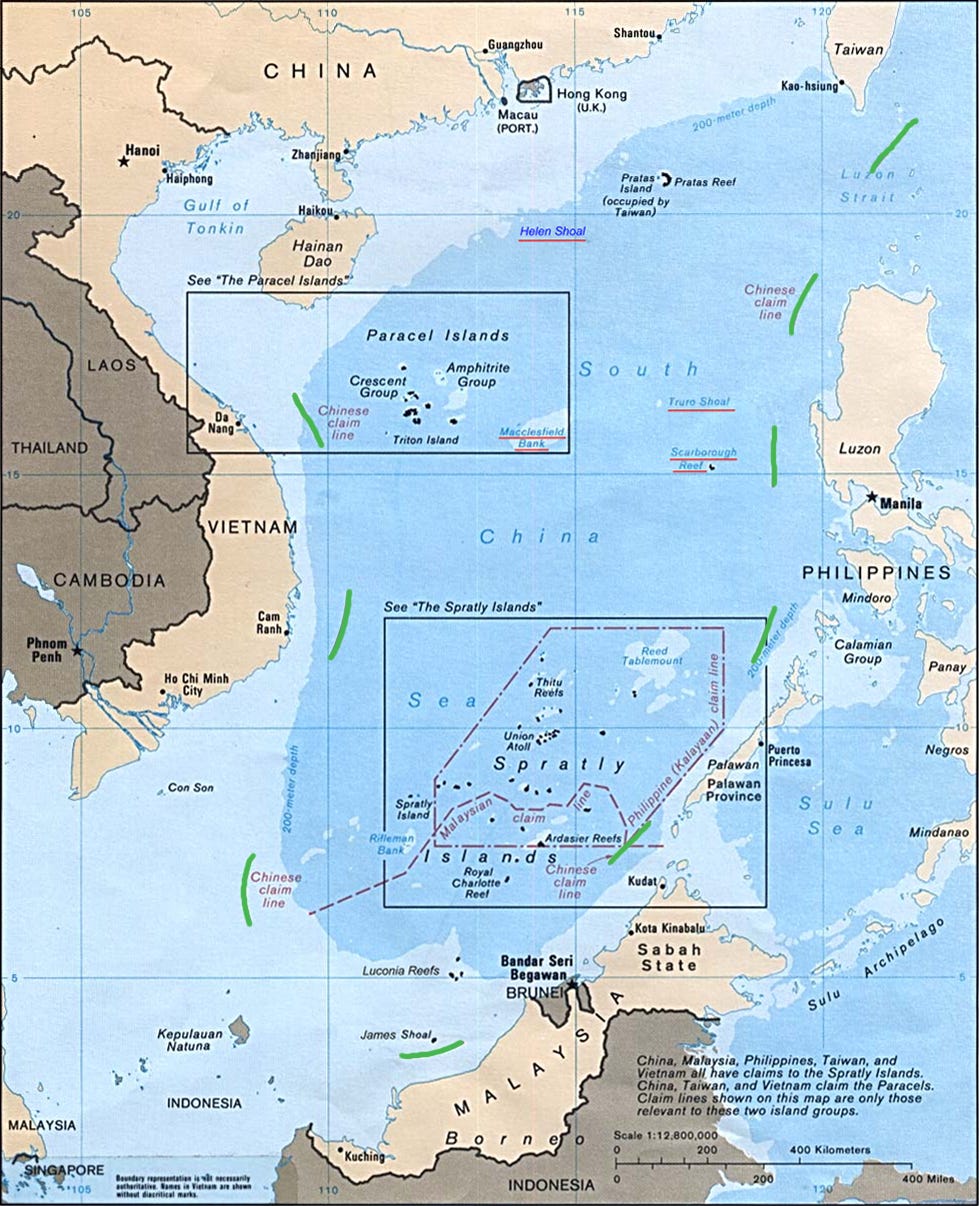
The nine-dash line is a demarcation line used by the People's Republic of China (PRC) for their claims of the major part of the South China Sea. The contested area in the South China Sea includes the Paracel Islands, the Spratly Islands, and various other areas including the Pratas Islands, the Macclesfield Bank, and the Scarborough Shoal.
The claim represented by the line encloses an area of international waters and several disputed island chains. The origin dates back to 1946, where it first appeared on Chinese maps with eleven dashes, but was later reduced to nine dashes when China dropped claims to the Gulf of Tonkin in agreement with Vietnam.
The nine-dash line is significant today due to the geopolitical conflicts in the South China Sea. It is seen by many as a core interest of China in its foreign relations, its ability to project power throughout the region, and its right to extract resources exclusively from the South China Sea, in particular fish. However, it is not recognized by international law and the United Nation’s Convention on the Law of the Sea ruled against China in 2016 in a case brought by the Philippines. Despite this ruling, China has continued to maintain its claim.
It’s worth noting that the Republic of China (Taiwan) also claims the area established by the nine-dash line, though it has not been nearly as aggressive about it. Technically they claim everything in the eleven-dash line but that’s like a whole other thing. So let’s move on.
Why is the nine-dash line in the news?
Before we get to the news, let me ask you a question: why might a Hollywood movie based on Barbie (the toy) even be involved in this geopolitical issue? Because if you think about it, like really think about it, it’s kind of dumb. But it’s also 2023 and everything is kind of dumb these days.
As it turns out, Hollywood really likes for their movies to be released in China. Probably not surprising to anyone reading this. China is a very wealthy country these days with a consumer base that spends lots of money. Hollywood wants that money. But in order to get their movies released into China, foreign films need to be cleared by China’s regulators which means showing (or not showing) certain things. And if you’re going to have a map of the South China Sea in your movie and you want that movie to be released into China, you damn well better have nine-dashes encircling the South China Sea. Otherwise your movie will never make it into China.
Enter Barbie (the movie)

So here we get to the issue at hand. At some point in the movie Barbie there exists a map of the South China Sea. Now I don’t know how or why a movie about Barbie would even factor in the South China Sea, but apparently its there. No doubt in shades of bright cyan and pink (I actually can’t wait to see it). And because Warner Bros. — the movie production company behind the film — wants to release Barbie in China, it has included the nine-dash line on said map.
But while this might appease Chinese regulators, it also pisses off a bunch of other nearby countries who take particular issue with the nine-dash line. It’s precisely because of the nine-dash line’s inclusion in Barbie that Vietnam has now banned the movie from releasing in their country. And it’s not the first movie to do so. Vietnam has banned Dreamworks’ Abominable and Sony’s Uncharted movie for the same reason.
So what happens next?
Probably nothing. The movie will stay banned in Vietnam. The movie will probably get banned in the Philippines as well. It might get released in China, though I’m unsure of how its fairing in regards to China’s regulatory hurdles.
For Hollywood it’s pretty simple math. They’ll make far more money by releasing their movie in China than they would by getting banned in Vietnam. Even if other countries joined in, they would probably still prefer to release in China. The unfortunate reality is that China, because of its wealth, military, and sheer size, is able to make certain declarations about what territory it thinks it owns. And even if those territories are internationally unrecognized, that matters very little to a country that has the ability to project its power. And, if nothing else, China can project.
Source links:
https://www.abc.net.au/news/2023-07-03/vietnam-bans-barbie-movie-over-south-china-sea-map/
https://en.wikipedia.org/wiki/Nine-dash_line