

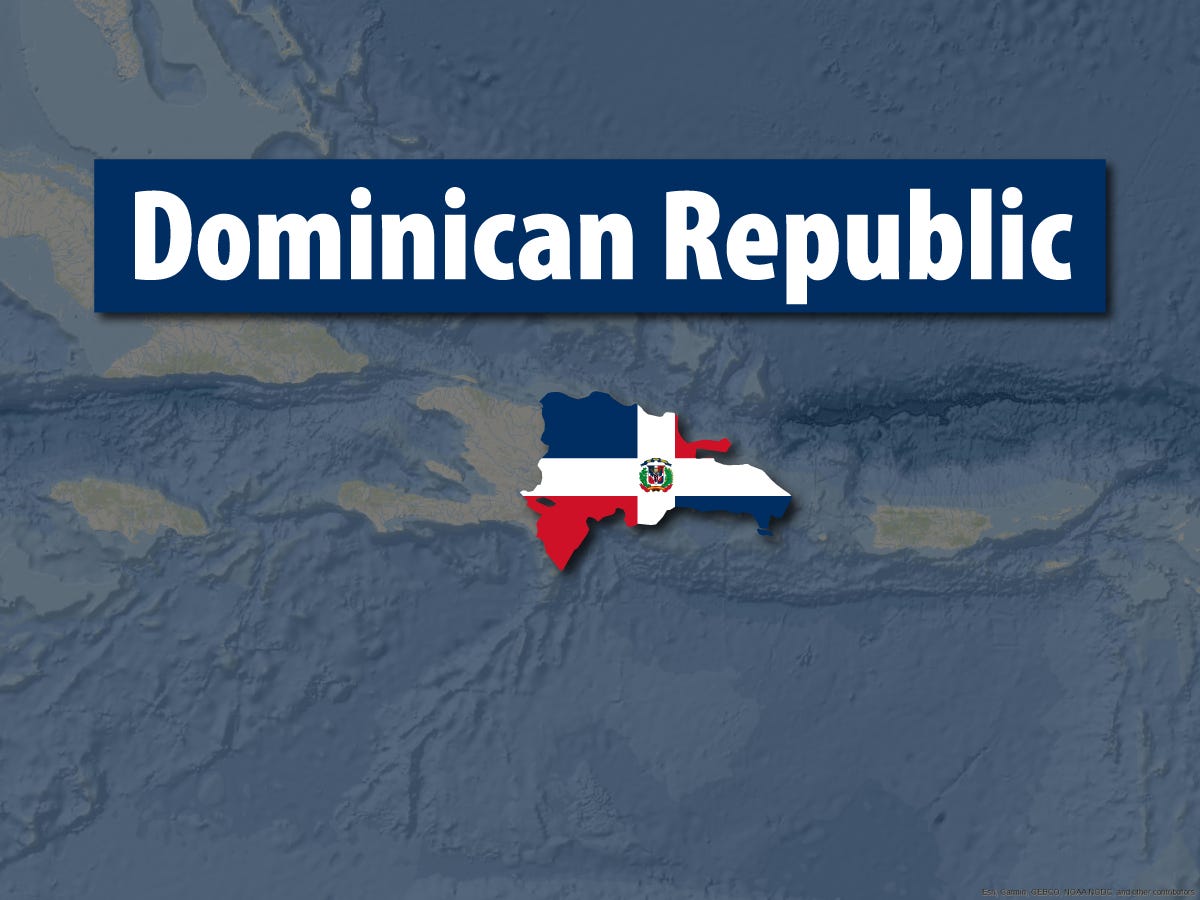
Welcome to the second country profile ever! If you haven’t had a chance yet, be sure to check out the newsletter on the Kingdom of Denmark from last week. Today, we’re off to the Caribbean country of the Dominican Republic. And I chose this country because over on my YouTube channel (@GeographyByGeoff), I’ll have an episode that explains why Haiti is struggling so much while the Dominican Republic is pretty safe. It’s a fascinating and, honestly, sad story. But in that episode I spent most of my time talking about Haiti, so I figured an article about the Dominican Republic was in order.
Quick facts
Population: 10,694,700 (2022 estimate)
Capital: Santo Domingo
Area size: 18,792 sq mi (48,671 sq km)
Language(s): Spanish
GDP per capita: $23,983 (PPP)
The geography of the Dominican Republic

Probably not too surprising, but the Dominican Republic exists on an island within the Caribbean called Hispaniola. But what is pretty interesting about Hispaniola is that it’s home to two completely separate and independent countries. Most smaller islands around the world consist of just a single country, not all but most. The Dominican Republic makes up the eastern five-eighths of the island with Haiti taking up the western three-eighths.
Speaking of the national divide! If you’ve ever taken a look at some images of the border area separating the two countries, you might have noticed that there’s a pretty stark tree coverage difference between the two countries. While this divide is primarily due to the way the two colonizers (France and Spain) treated their colonies, it also has to do with the geographic location of both countries! Splitting the country almost in half is a series of mountain ranges. As the trade winds blow storms in from the east, the mountain range bisecting the island creates a mini-rainshadow on the Haitian side. So deforestation that occurred hundreds of years ago are still struggling to be regrown due to a simple lack of water. The Dominican Republic side, of course, gets much more water and, therefore, has forests that regrow themselves much quicker.
Finally, as is well known at this point, the entire island of Hispaniola is very seismically active. Haiti suffered two very serious earthquakes in 2010 and 2021 respectively. The Dominican Republic, on the other hand, hasn’t suffered a major earthquake that resulted in mass destruction since 1946. This is primarily due to where the Domincan Republic’s primary fault line is with respect to its major population center: Santo Domingo. The Septentrional Fault runs along the northern part of the island while most of the population is on the southern side. This doesn’t mean the Dominican Republic can’t suffer destructive earthquakes, but it’s definitely in a better situation than Haiti’s Port-au-Prince which exists almost right on top of the Enriquillo Fault.
The place and how it interacts with the world

Today, the Dominican Republic is noted for having the largest independent economy in the Caribbean (this would leave out U.S., U.K., Dutch, and French holdings of course). According to the World Bank, the country has had the fastest growing economy in the western hemisphere. This has naturally translated to a certain amount of cache amongst travelers from places such as the United States. In fact, tourism in the Dominican Republic is surpassed only by Puerto Rico, which also happens to be part of the United States. An estimated 2.1 million visitors visited the island country in 2022.
And while this all makes the Dominican Republic a fairly interesting success story in a region that has relatively few of those, it’s the contrast to its neighbor Haiti that perhaps makes this success story shine even brighter. Haiti, if you haven’t been paying attention to the news of late, is basically in a state of anarchy. And much of this can be traced back to each side's historic colonial roots. France, which owned Haiti, not only brutally ran the colony with people who were enslaved from Africa, it also demanded recompense from Haiti after it became independent. This created a situation where Haiti was never truly able to get an economy growing. The Dominican Republic, by contrast, was relatively forgotten by its colonizer Spain, much to its great benefit today.
This isn’t to say it’s been all sunshine and roses for the Dominican Republic throughout history. After earning its freedom from Haiti (yes, Haiti controlled the Dominican Republic for a couple decades), the country was subjected to a series of dictators and even a full-fledged occupation by the U.S. military from 1916 to 1922. But throughout it all, the Dominican people made small strides towards a stronger economy, better infrastructure, and a more educated and healthier people overall.
The Dominican Republic today is a democratic country, though admittedly, it still has problems in this regard. According to Freedom House:
The Dominican Republic holds regular elections that are relatively free, though recent years have been characterized by controversies around implementing a new electoral framework. Pervasive corruption undermines state institutions. Discrimination against Dominicans of Haitian descent and Haitian migrants, as well as against LGBT+ people, remain serious problems.
But that’s certainly better than Haiti and Cuba, which continue to struggle with rampant corruption, dictatorships, and general political instability.
Fun fact
The Dominican Republic is not to be confused with the Commonwealth of Dominica, another island country located in the Caribbean. Despite the similarity in the two names, they actually come from fairly separate origins. The Dominican Republic’s name comes from Saint Dominic, founder of the Dominican Order, whereas Dominica’s name apparently comes from the Latin phrase “dies Dominica” which translates to “the Lord’s Day.” Dominica, as it turns out, was first sighted by Christopher Columbus on a Sunday and thus it was named in honor of the day.