


Alaska is often left out of national conversations. It’s tucked away up near the arctic, after all. But did you know that it may be the most important state? While its population is small and its cities are few and far between, Alaska’s significance lies not in numbers, but in geography! It occupies a position unlike any other U.S. state, touching the Arctic, sitting just across the Bering Strait from Russia, and housing vast reserves of minerals, oil, and untapped potential. In many ways, Alaska is not just a state, it’s a global hub, a resource bank, and a climate bellwether all at once. And before all you Californians, Texans, or New Yorkers pipe up, let me lay out my argument here.
Oh, and of course, if you’re interested in Alaska, be sure to check out my video this week all about America’s largest (and most important 😉) state:
Let’s start with its sheer size. Alaska is HUGE. It’s more than twice the size of Texas and spans a staggering variety of landscapes from tundra and glaciers to temperate rainforests and massive mountain ranges. This means it contains enormous natural wealth: oil from Prudhoe Bay and the North Slope, gold and zinc from the interior, rare earth elements critical for modern electronics, and massive fish stocks in the Bering Sea and Gulf of Alaska. If Alaska were an independent country, it would still be one of the world’s leading resource exporters. The Trans-Alaska Pipeline alone has moved over 18 billion barrels of oil since it opened, helping power the U.S. economy for decades.
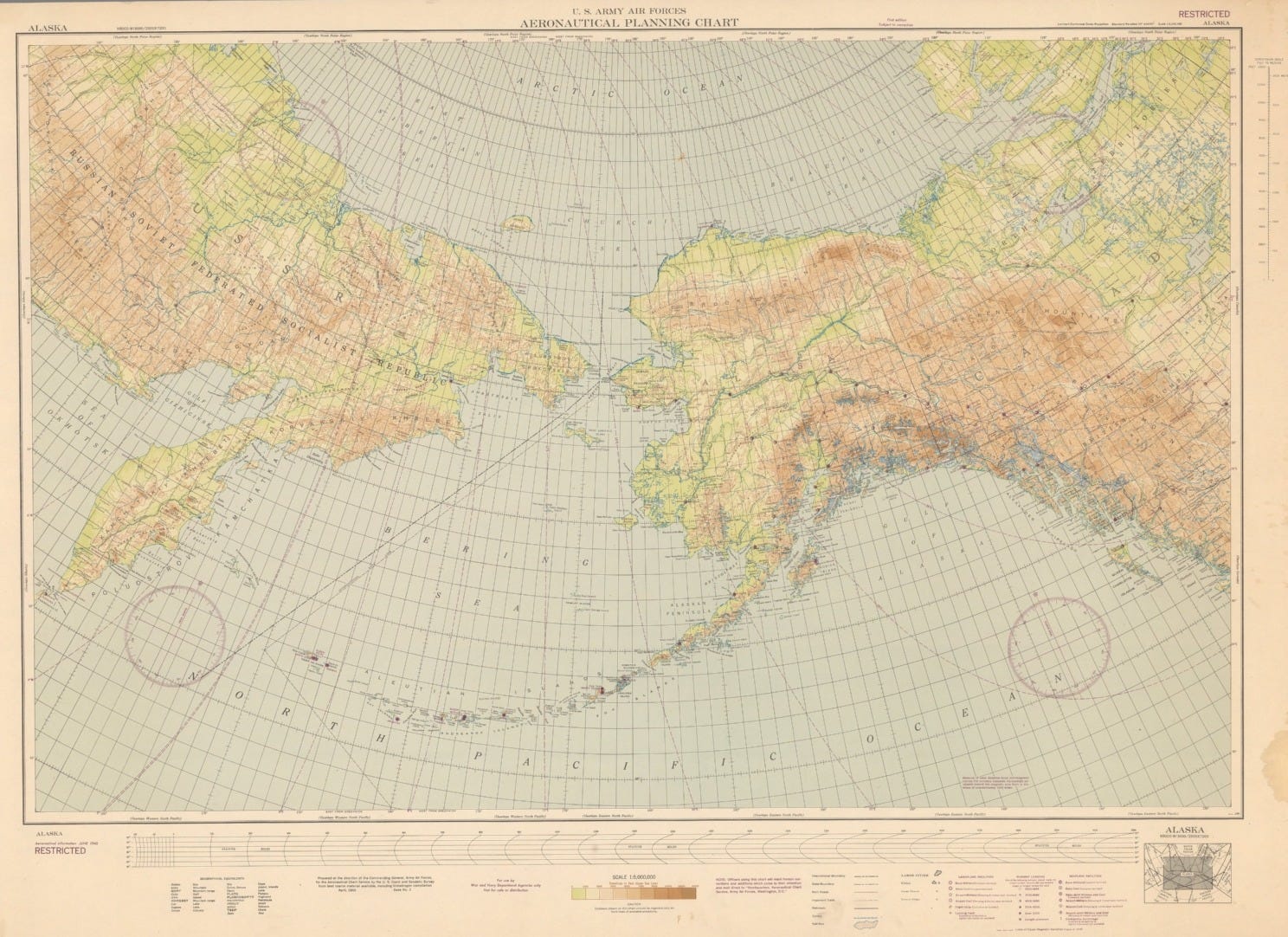
But Alaska’s value isn’t just economic, it’s geopolitical. It sits closer to Russia than any other part of the United States. And while its physically separated by just 55 miles at its narrowest point, due to being close to the north pole, Anchorage is actually closer to many of the world’s major capitals and cities. Beijing, Tokyo, Moscow, Berlin… all closer to Anchorage than their nearest west coast/east coast major cities. Because of this geographic closeness, during the Cold War, Alaska was filled with air bases and radar installations designed to monitor Soviet activity across the Arctic and North Pacific.
Of course, the state still has a large role in national defense today. Alaska is home to key military bases including Joint Base Elmendorf-Richardson and Eielson Air Force Base, along with numerous radar sites spread across its vast terrain. These bases help protect U.S. airspace from any threats coming from Asia or the polar regions. In fact, in a scenario where global tensions escalate, especially with Russia or China, Alaska would likely become one of the most active theaters of American military posture. It’s why the Pentagon continues to invest in Alaskan infrastructure and air defense capabilities.
Today, Alaska’s strategic value has only grown. As melting Arctic ice opens up new shipping lanes and accelerates territorial claims over the polar region, Alaska has become America’s foothold in the emerging Arctic frontier. It offers the U.S. access to the polar seas, a stake in Arctic governance, and a military vantage point in a part of the world increasingly eyed by China and Russia.
Speaking of the Arctic! This may be the stage where Alaska becomes even more important in the decades ahead. Climate change is hitting Alaska faster than almost any other part of the United States. Entire villages are being relocated due to rising seas and melting permafrost. At the same time, that melting is uncovering previously inaccessible resources and trade routes. The Northwest Passage and the Northern Sea Route (both of which are becoming more navigable) could one day rival the Panama Canal in strategic importance. And because of where it sits, Alaska is the only U.S. state that could realistically benefit from or defend against developments in that region.
Even in peacetime, Alaska is a strategic laboratory. It serves as a testing ground for cold-weather military operations, arctic survival skills, and energy independence experiments. It’s also a proving ground for climate science. Alaska's rapidly changing landscapes are constantly monitored by scientists trying to understand how the planet is shifting. From melting glaciers to vanishing sea ice, Alaska is a window into the Earth’s future.
All of this makes Alaska more than just a faraway state with pretty scenery and a rugged vibe. It’s a critical hub of American economic resilience, military readiness, environmental observation, and geopolitical presence. And its importance to the U.S. only grows in a world that’s becoming more resource-competitive, climate-sensitive, and strategically multipolar. So, for that reason, I stand by that Alaska is America’s most important state. Which is very far from where it started as “Seward's Folly,” a nickname given to the state because buying it from Russia appeared to be one of the worst purchases in American history.