

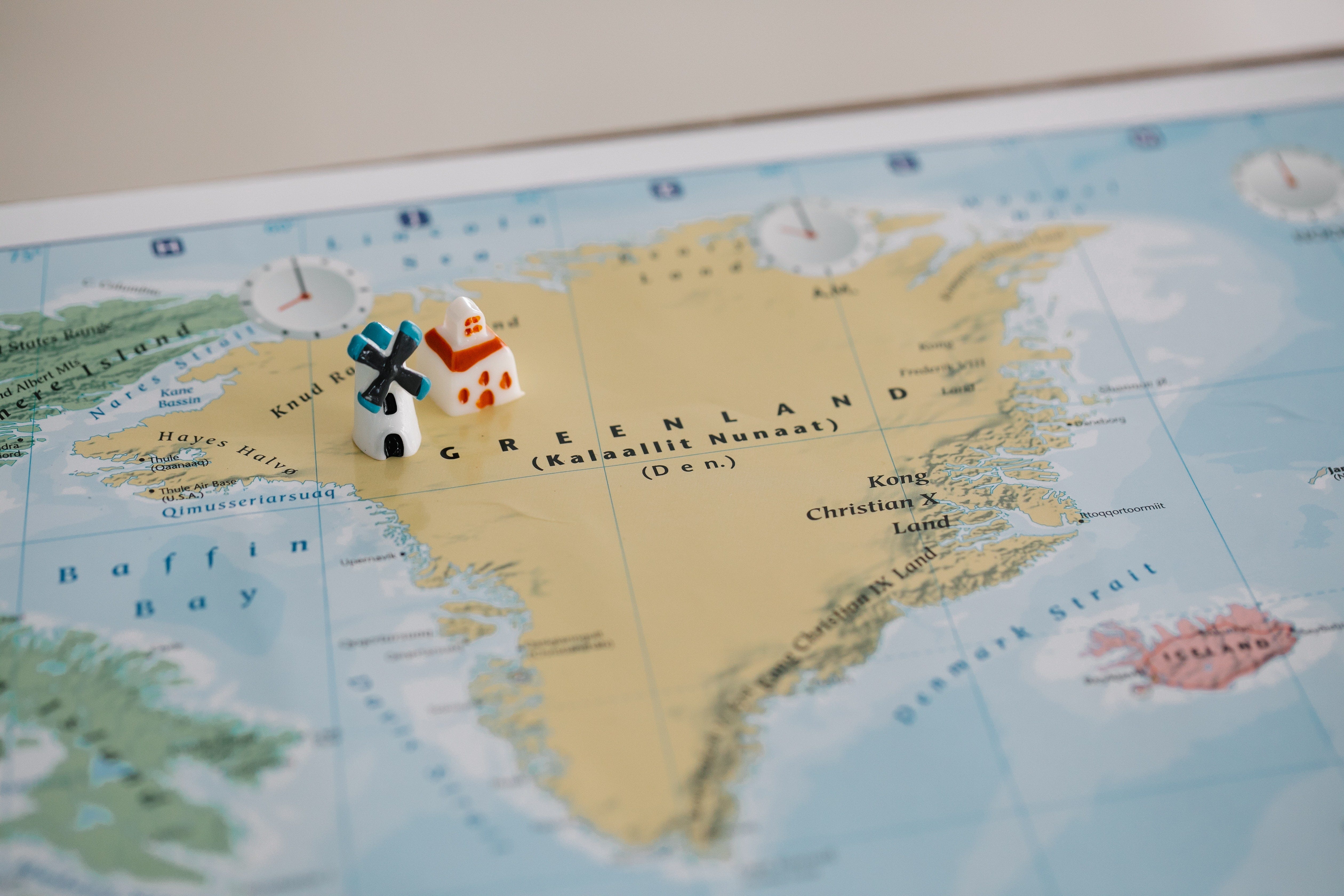
Greenland has recently made news for pushing forward with a renewed effort for full independence from Denmark. The small European country has kind of owned Greenland since the early 1600s when King Christian IV of Denmark and Norway would lay claim to the island based on the explorations of Norwegian-Icelandic explorer Erik the Red. It was more formally assumed into Denmark in the early 1800s with the Treaty of Kiel that divided up various colonial holdings as part of the Napoleonic Wars. And then the island was made into an actual Danish state in 1953. But the current population is increasingly irate with the idea of being part of Denmark.
Honestly, we could spend a whole article just on the history here, so I’m just gonna leave all that behind. Today, Greenland is a part of Denmark, but it’s largely autonomous. Which means it gets to mostly gets to make its own laws, control its own land, and, in the case of international relations, even join various groups such as the Arctic Council, completely independent from Denmark. Further autonomy was granted in 2009. Basically, the Danish government really only controls the right of citizenship, monetary policy, and foreign affairs things such as defense.
But despite having such a high level of autonomy, Greenland still desires full independence. In general, I think what you’ll find in basically all independence movements, is that no amount of autonomy of “self-rule” is ever really enough. So I don’t think this issue is going away for Denmark. Which means there’s a not-small chance that we actually see a completely independent country of Greenland in the near future. And this definitely raises some interesting questions!
A question of geography
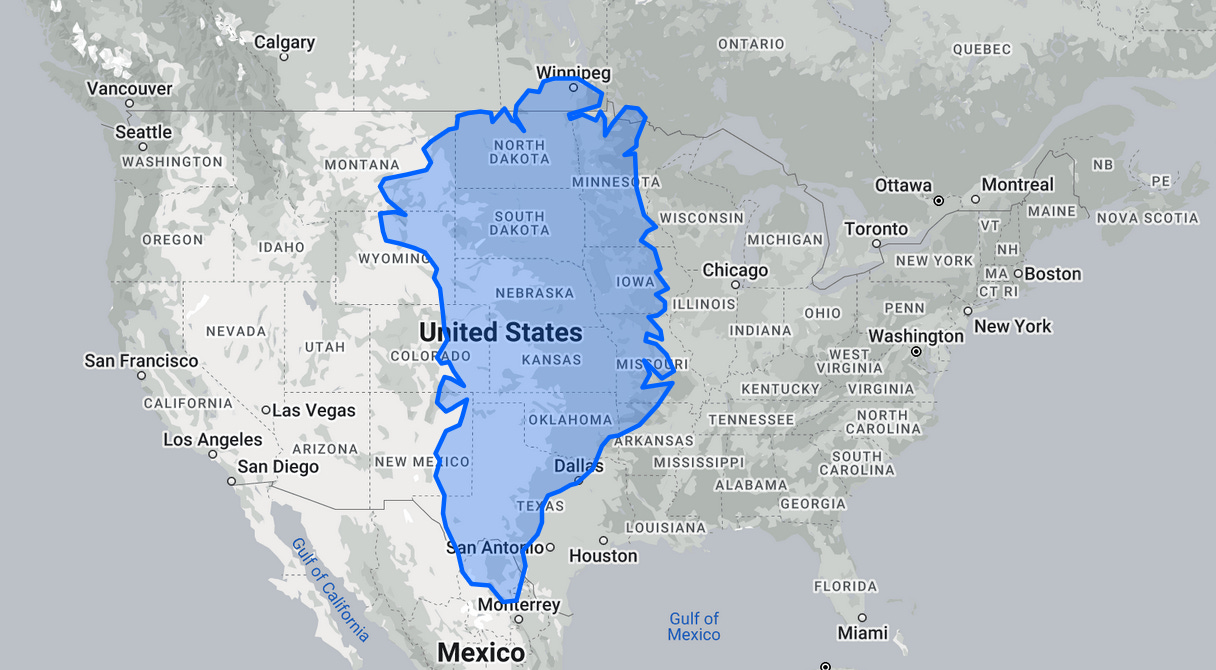
Greenland is a large island. It’s probably not as large as you might think because many of our maps are outrageously wrong in terms of size, but it’s still really big. All told, Greenland is over 836,000 square miles in size (2.1 million square kilometers). That’s about 52 times larger than Denmark. It’s also significantly larger than Alaska, the largest U.S. state. If Greenland were its own country, it would be the 12th largest in the world. That’s a huge country!
Despite its physical size, it’s actually quite small in terms of population. Right now there are only about 56,000 people living in Greenland. That wouldn’t quite make Greenland the smallest country by population, but it would be close. All told, Greenland would rank 186th of 195 countries in terms of population. But all of those other countries are really small. Monaco, Lichtenstein, Tuvalu, Nauru, Palau… these are all really small countries. Greenland, of course is huge, and this means it would have the lowest population density of any other country in the entire world.
Now, granted, most of Greenland is still covered in ice. So there is a physical limiting factor in terms of growing large population centers, but in an age of climate change, Greenland could very well find itself with a lot more land and not a lot of people to manage it, or even ensure that its secure.
A question of defense

Being a big island with a small population in a very geopolitically desirable area would pose unique challenges for Greenland. At the moment, as part of Denmark, Greenland is pretty safe and secure because it’s technically part of NATO. To its west is NATO-members Canada and the United States and to its east is Iceland, the UK and the rest of western Europe, most of whom are also part of NATO. More to that point, as part of a deal with Denmark, the United States has a military base on Greenland and has historically used the island as a strategic location for various military operations for the last 80 years or so.
Suffice it to say, at the moment, Greenland is pretty safe from external threats and incursions into its territory. But an independent Greenland would have a lot of land to manage and not a lot of resources or people to do it with. And because Greenland is not an independent member of NATO, there’s no guarantee that Greenland would be able to maintain its membership even if it wanted to.
While this might not seem like a huge deal — who would want to invade Greenland? — there are definitely a few specific countries (who shall remain nameless because this is about Greenland and not them) that would absolutely prefer a non-NATO Greenland. Mostly because it would likely open the door to different security arrangements, trade deals, and natural resource extraction that probably aren’t as feasible right now. According to a brief paragraph in Wikipedia, there already has been some mineral extraction from external countries, much to the European Union’s chagrin. The original source article, however, is no longer available so I can’t confirm this.
A question of economics

At the moment, Greenland is dependent on Denmark for its financial security. According to the International Trade Administration, Greenland receives an annual grant of about $511 million (USD) accounting for about half of Greenland’s public budget. An independent Greenland, of course, would not get any such grant from Denmark which means they would have to fill that budget hole somehow. And one such idea that’s been floated around is to allow for an increase in mineral and oil exploration and extraction.
It’s no surprise that Greenland’s ice sheet is melting due to climate change. The polar regions are actually heating at a rate twice as fast as other parts of the planet. And with less ice, means more accessible land and more accessible natural resources that might lie underneath said land. This is theorized by some as to where Greenland will be able to fulfill its budgetary gap. But it should be pointed out that extracting minerals and oil would only increase the rate of climate change. Which would obviously be bad for the planet and Greenland itself. All of which would be unnecessary if Greenland remained part of Denmark.
So should Greenland be independent?

Here’s the part of the article where all I can say is I don’t know, nor do I want to know. I’m not someone who should have a say in the matter on Greenland’s independence as I am neither Danish nor Inuit nor Greenlandic. It’s ultimately up to Greenland and, as far as I can tell, they have the right to pursue independence if they want.
What I will say though is that independence is sought for a wide variety of legitimate (and sometimes illegitimate) reasons but there are consequences regardless. I also think that independence is much harder than most people realize with many such endeavors spurred on by populist ideologues who won’t be the same people who have to deal with the aftermath (see: Brexit).
Regardless of whether Greenland becomes or doesn’t become independent, there are a lot of questions they’ll need to face. And for such a large country with an incredibly small population in a particularly valuable and changing region, that can be very challenging.